Expose Corrupt Courts

MLK said: "Injustice Anywhere is a Threat to Justice Everywhere"

End Corruption in the Courts!

Court employee, judge or citizen - Report Corruption in any Court Today !! As of July 5, 2009, we've received over 66,200 tips...KEEP THEM COMING !! CorruptCourts@gmail.com
               Video of 1st Hearing on Court 'Ethics' Corruption
               The June 8, 2009 hearing is on two videos:
         
               CLICK HERE TO SEE Part 1
               CLICK HERE TO SEE Part 2

Saturday, July 11, 2009

Attorney Conflict in Madoff Scam Brings Big Bucks


Madoff Trustee Seeks Interim Counsel Fees of $15 Million

The New York Law Journal by Noeleen G. Walder - July 13, 2009

The trustee charged with liquidating the investment advisory firm of Bernard L. Madoff asked a bankruptcy judge on Friday to approve more than $15 million in interim counsel fees. In the nearly seven months since Irving H. Picard was appointed trustee by the Securities Investor Protection Corp., he and his counsel have made significant progress in investigating Mr. Madoff's massive Ponzi scheme, according to Baker & Hostetler's initial application for attorney's fees and expenses incurred from Dec. 15, 2008, through April 30, 2009. The $14.7 million that the team of lawyers, paralegals and non-legal staff is requesting amounts to a 10 percent discount off their customary rates.

A second fee application filed Friday requested $759,000 for Mr. Picard, "of which 20 percent is to be deferred through the conclusion of the liquidation period," and a mere $45 for his expenses. Mr. Picard and his team have recovered close to $1.1 billion in assets in connection with the liquidation of Bernard L. Madoff Investment Securities LLC (BLMIS). The team has also filed eight avoidance actions seeking to recoup more than $13.7 billion from feeder funds and related parties, according to a separate interim report filed on July 9 to Southern District Bankruptcy Judge Burton R. Lifland. All told, between Dec. 11 and June 30, Securities Investor Protection Corp. (SIPC) has spent roughly $214 million in connection with the liquidation of Mr. Madoff's firm. The 45-page report in In re Bernard L. Madoff, 08-1789, comes less than two weeks after Southern District Judge Denny Chin sentenced Mr. Madoff, 71, to 150 years in prison for his "extraordinarily evil" crimes (NYLJ, June 30). Mr. Picard's report stresses that as of June 30, SIPC has advanced $214.4 million "to pay all administrative costs associated with the liquidation of the estate," including $45.9 million for administrative expenses. The $169.4 million balance has been used to pay customer claims. 

In recent months, Mr. Picard has come under fire by some victims of Mr. Madoff's fraud, who claim they have been shortchanged because the trustee is looking at their entire account history, rather than relying on their most recent account statements to calculate "net equity" (NYLJ, June 11). But in the interim report, Mr. Picard detailed his progress in marshalling estate assets and attending to thousands of claims filed by Madoff victims. "Given the task of liquidating BLMIS and coordinating efforts with federal and state authorities investigating the criminal matter, the Trustee has also dealt with issues spanning a broad spectrum of legal and administrative specialities and disciplines," and received "material assistance" from his counsel in areas ranging from real estate to banking. And in spite of "the monumental and unprecedented task faced by the Trustee," he has "made substantial progress in reviewing and determining customer claims," the report states. As of the July 2 deadline for filing claims, Mr. Picard has received 15,400 in customer claims, 395 claims from general creditors and 16 claims from broker-dealers. Mr. Picard has set aside $231 million in SIPC funds to satisfy 543 claims from victims of the Ponzi scheme who contend they lost more than $2.97 billion. The $231 million is the "largest commitment" of SIPC funds in the history of the Securities Investor Protection Act of 1970. The trustee has also set up a Web site and a toll-free hotline. The trustee has "extensively investigated the Debtor's financial affairs" in the United States and abroad, and has "unearthed a labyrinth of interrelated international funds, institutions, and entities of almost unparalleled complexity and breadth," the report states.

It also chronicles the steps Mr. Picard has taken to generate $1.08 billion for the estate, including:

• settling four class action suits against Mr. Madoff's firm for $55,000;
• selling New York Mets season tickets as well as single game Minnesota Wild and NASCAR tickets for $92,000;
• and collecting $145,000 from political donations made by Mr. Madoff or his firm.

Meanwhile, Mr. Picard has had to defend himself against two motions to intervene in the liquidation proceeding, one launched by a federal prison inmate who has "taken to assuming the name of the Trustee when filing various baseless pleadings" and an unsuccessful bid in May by Ade O. Ogunjobi, who has made numerous outrageous bids to purchase major companies, to buy Mr. Madoff's securities firm for $100 trillion in stock. Noeleen.Walder@incisivemedia.com
*************************************

$14.6M 'BERNIE' BONUS
The New York Post - AP - July 11, 2009 

A Big Apple law firm working with a court-appointed trustee in the $65 billion Bernard Madoff Ponzi case has racked up more than $14.6 million in legal fees. Bankruptcy Court papers filed yesterday also show that trustee Irving Picard is separately seeking about $760,000 for his work locating and liquidating Madoff's assets. A securities-industry group that compensates victims of fraud is covering the legal fees. Victims of Madoff's massive Ponzi scheme have filed more 15,400 claims against the disgraced financier, who was sentenced to 150 years in prison. This week, Madoff through his lawyer said he would not appeal the effective life sentence.

**************************************

Friday, July 10, 2009

Senate Show Time Resumes: Sampson in the Summer

The second hearing by New York State Senate Senator John L. Sampson is planned for August in New York City .... the details and exact date will be announced soon.....

"We are definitely going to reform the state Senate like it's never been reformed before," said Democratic Conference Leader Sen. John Sampson, of Brooklyn

After a Month That Was All About "Empowerment" and "Reform," NY State Senate Is Back to Work

The Associated Press by Michael Gormley - July 10, 2009

ALBANY, NY - New York's Senate stalemate ended Thursday as it started 31 days ago, with a freshman Democrat convulsing the 62-seat house by switching sides and getting a powerful leadership post in the majority. But it took less than 30 minutes on the Senate floor for partisan fights to emerge, with Republicans initially threatening two-hour debates on each of more than 100 noncontroversial bills. Bronx Sen. Pedro Espada's return to the Democratic conference gives Democrats a 32-30 majority for the first time since the June 8 coup. As part of the deal, Espada took the title of Senate majority leader. Espada's move came after Democratic Gov. David Paterson's decision to appoint a lieutenant governor to preside over the Senate, giving his party the upper hand in a chamber that's been divided 31-31."It was never about power, but about empowerment," Espada said at a news conference.

While the stalemate was over, at first the standstill wasn't. Republicans decided to slow the voting process because they were furious Democrats didn't include Senate rules reforms on the agenda. Senate Republican Leader Dean Skelos, of Long Island, said the GOP objected to the Democrats' plan to pass pork barrel spending - also known as member items, money that lawmakers can take back to their districts for pet projects. After an hour of closed-door discussion, member items were removed from the agenda and both sides developed the framework for a rules reform agreement. Both will likely be taken up next week. Both sides said the rules changes will give individual senators more power to move bills out of committees and to the floor for a vote, among other reforms. Most of the bills passed late Thursday and early Friday were for local taxes that would keep local governments funded and running. For more than a month, the Senate's paralysis stalled action on mayoral control of New York City's schools, taxing authority in some municipalities and economic development programs. Paterson estimated that the state's municipalities lost as much as $150 million during the conflict - most of it missed sales tax revenue - including $60 million in New York City. "Today really is 31 days of chaos ending," said Hiram Monserrate, a one-time dissident whose pending felony assault charge divided Republicans and Democrats early in the session. "Judge us not on what has occurred over the last 31 days...but judge us on what we do with this extraordinary opportunity." Republicans accepted their return to the minority, where they were for the past six months for the first time since 1965, but still tried to claim some victory. They say the reforms will serve them well and increase the power of individual Senators.  "Upstate is going to be a player," said Republican Sen. George Maziarz of Niagara County. "We have a conference of 30 strong and with these reforms....We won't be rolled over."

"We are definitely going to reform the state Senate like it's never been reformed before," said Democratic Conference Leader Sen. John Sampson, of Brooklyn. Rank-and-file Democrats welcomed Espada back. That was a contrast to the name-calling of the past five weeks, when many Democrats said they would never serve under Espada in a leadership position. Others called him a thug and turncoat. "I don't think any of us have to accept everybody with open arms," said Sen. Neil Breslin, an Albany Democrat. "He has a right to be in the Democratic conference as an elected Democrat." When asked if it was hypocritical for Democrats to accept Espada as one of their own after calling him a criminal, Breslin said, "There is a level of that." The self-described three amigos - Sens. Espada, Ruben Diaz and Hiram Monserrate - said the end of the standoff is a victory for Latinos, providing them a greater voice. "This is a great achievement for our community. The greatest achievement our community has ever gotten," said Diaz, a Bronx Democrat and leader in the Latino community.  The regular session ended June 22. Despite landing back in the minority, Republicans argue they've helped their constituents by insisting on reforms to give every New Yorker a voice in the chamber. They said any change couldn't have happened without their actions. "I'm very disappointed, but in my mind this was never about a power grab, but about reform," said Republican Sen. Thomas Libous of Broome County.

Thursday, July 9, 2009

Tembeckjian's Crimes, Part 2

Tembeckjian Ignored Niagara County's Surrogate's Court "Criminal Enterprise"


Numerous complaints have been made to the Commission on Judicial Conduct concerning the judicial oddities and financial dealings in and about the Niagara County's Surrogate's Court. But the highly troubling affairs around the upstate Surrogate's Court appear to continue as usual, ignored by the 'ethics' group headed by Robert Tembeckjian.  It appears that judicial ethics oversight has more to do with misplaced $20-dollar-bills by part-time village justices than the organized theft of millions by favored statewide insiders. 

Question for Mr. Tembeckjian: Who told you to ignore the many complaints over the last five years against the Niagara County Surrogates?

*****************************

NIAGARA COUNTY: Broderick won't back down from estate case
The Niagara Gazette by Mark Scheer - May 1, 2009

— The attorney for Niagara County Treasurer David Broderick told a judge Friday that his client wants to continue to oversee an estate that has brought his office under intense scrutiny in recent months.  Broderick’s attorney George Muscato told Niagara County Judge Matthew Murphy that he intends to file a formal objection by May 15 to a motion that would allow the son of the late Marian Snyder to assume control of the remainder of his mother’s estate. While during a previous court hearing on the matter, Muscato suggested Broderick might agree with such an arrangement, on Friday he told the judge he did not believe it would be appropriate for the court to remove Broderick at this time because the majority of the affairs in the Snyder matter had been settled.  Murphy agreed to give Muscato until the court-imposed deadline for filing the necessary paperwork but indicated that he is inclined to allow Snyder’s son, John “Jack” Snyder, to oversee his mother’s estate in the future.  “By making the determination I’m not pre-judging any claims about Mr. Broderick’s handling of the estate,” Murphy said.

Under the law, the Niagara County treasurer as the county’s top fiscal officer is designated as the public administrator of estates.  Snyder’s daughter, Amherst attorney Teresa Snyder, has filed several objections against Broderick in the handling of her mother’s affairs. Snyder maintains Broderick violated state law governing the duties of public administrators by allowing his wife, Jane, to serve as the real estate agent on several properties under his care, including the Snyder family home in Lewiston. Teresa Snyder has strongly objected to what she says was an attempt on the Brodericks’ park to sell her mother’s home to one of their relatives.  State court rules designed to insulate the offices of public administrators from the appearance of any impropriety bar anyone serving in that capacity from self-dealing and from hiring their relatives as outside vendors.  In addition to her objections in court, Teresa Snyder also has sent letters to the attorney for the state Office of Court Administration and the Office of Inspector General, encouraging officials to investigate Broderick’s public administrator work.  Earlier this month, Murphy and fellow county Judge Sara Sheldon Sperrazza sent a letter to the state Comptroller’s Office requesting an audit. The Niagara County Legislature has endorsed their decision.  Muscato has denied all charges of wrongdoing against his client, insisting that he has done nothing unethical or illegal in his capacity as public administrator.  On Friday, Teresa Snyder also submitted objections to the court for the amount of legal fees charged to her mother’s estate by Muscato and three other attorneys involved in the case. Murphy has scheduled an August hearing for the remaining unresolved matters in the case. On Friday, he offered to work with both sides in an effort to reach some sort of settlement. The Snyders and Muscato indicated they would be willing to participate in a future settlement hearing. Muscato warned that the longer the case drags on, the higher the cost of legal work will be to the Snyder estate.  “I want to get this resolved, too,” Muscato said. “We all know that when we go through hearings, there’s going to be a lot of attorney fees here.” Contact reporter Mark Scheer at mark.scheer@niagara-gazette.com

**********************************

BRODERICK CASE: Snyder claims to be dropped
The Niagara-Gazette by Mark Scheer - March 27, 2009
mark.scheer@niagara-gazette.com

An Amherst attorney who raised questions about the conduct of Niagara County Treasurer David Broderick agreed on Friday to drop all claims she made in her family’s case after a judge said he was inclined to allow her brother to handle the remainder of her late mother’s affairs.  Teresa Snyder, who has accused Broderick of overstepping his bounds as public administrator, told Judge Matthew Murphy she would withdraw her petition to have Broderick removed as the administrator of her mother’s estate if the court appointed her brother — John “Jack” Snyder — to oversee the distribution of all remaining assets.  During a hearing in surrogate’s court in Lockport, Murphy announced his intention to turn the responsibilities of the estate over to Snyder’s brother, one of five siblings involved in the case. Broderick’s attorney, George Muscato, said his client would be open to such an arrangement.  “I think Mr. Broderick will consent,” Muscato said

In light of the new agreement, Teresa Snyder told Murphy she planned to discontinue other actions not directly related to her mother’s estate, including requests made to outside agencies for investigations into Broderick’s conduct. Snyder has suggested that Broderick violated state law governing the duties of public administrators by allowing his wife, Jane, to serve as the real estate agent on several properties under his care, including the Snyder family home in Lewiston.  Last week, Snyder sent letters to the attorney for the state Office of Court Administration and the Office of Inspector General, encouraging officials from both agencies to take a closer look at least three cases in which David Broderick was appointed as public administrator by his brother, retired Judge Peter Broderick, and a third brother, Niagara Falls attorney William Broderick, served as the administrator’s lawyer.  Public administrators oversee estates in which the owners have died without leaving wills or the heirs are unable or unwilling to tend the affairs themselves. State court rules designed to insulate the offices of public administrators from the appearance of any impropriety bar anyone serving in that capacity from self-dealing and from hiring their relatives as outside vendors. Under the law, the Niagara County treasurer as the county’s top fiscal officer is designated as the public administrator of estates.  Following Friday’s court proceeding, Snyder said it will now be up to the various oversight agencies to determine if any wrongdoing occurred. She added that as a practicing attorney she felt obligated to adhere to the rules of professional responsibility and report what she found during the course of her research.  “Conflicts of interest should not occur and they did,” she said.  Her brother agreed. “I believe that the use of (Broderick’s) wife is self dealing,” he said. David Broderick and Peter Broderick could not be reached for comment.
Muscato has dismissed Snyder’s claims and insists his client has done nothing illegal or unethical in his capacity as public administrator. When asked about allegations concerning the Broderick brothers, Muscato said his knowledge of surrogate’s court cases involving his client was limited only to the Snyder matter.  “This is not about any other estates,” Muscato said. “It’s about only this estate.”  Reached by telephone Friday afternoon, William Broderick said he did not recall any instances in which he appeared before his brother Peter on estate cases or any other matters. He indicated that any dealings he had in surrogate’s court were assigned to other judges.  “It was my recollection that I never appeared before my brother Peter on anything,” he said.  Earlier this month, Murphy and fellow county Judge Sara Sheldon Sperrazza sent a letter to the state Comptroller’s Office requesting an audit of Broderick’s work as public administrator. The Niagara County Legislature has endorsed their decision.  On Friday, Murphy indicated he did not believe county surrogate’s court was the proper venue to address any outside claims and said he intended to rule only on matters related to the Snyder case.  “Surrogate’s court is a court of limited jurisdiction,” Murphy said.

Before hearing arguments in the case, Murphy addressed what he called a “complaint” about his handling of the Snyder matter that he said Teresa Snyder filed against him with the New York State Commission on Judicial Conduct. Murphy said he did consider recusing himself from the Snyder case, but, after conferring with colleagues, determined that it was best for him to continue as the presiding judge. Murphy said he held no ill will against Snyder or anyone else in the case.  “I believe I can be fair to all the parties in this matter,” Murphy said.  After the hearing, Snyder denied ever making a formal complaint about Murphy to the commission, although she indicated that she did have some interaction with the agency which oversees the conduct of judges across the state. Snyder added that the commission’s dealings were confidential before declining further comment.  Next up in the Snyder case will be a formal review of the accounting of the estate filed by Broderick. The treasurer has requested more than $15,000 in commission for his work on the estate.  Muscato indicated that his client has no intention of withdrawing his claim and said he believes Broderick is entitled to the money. Murphy set aside three days in August to hear arguments from both sides before he renders a decision on the appropriateness of the fee.  John Snyder he has not yet decided whether to contest Broderick’s fee and would discuss the matter with his siblings before making a determination.

CLICK HERE TO SEE TEMBECKJIAN'S CRIMES, PART 1 - "Robert Tembeckjian, $40 Million and Misprision of Felony"

Dreier Used Law License, Rather Than Ski Mask and Gun, To Steal

Dreier Describes Downfall; Seeks 'Rational' Term for Fraud, Theft
The New York Law Journal by Mark Hamblett - July 9, 2009

Marc S. Dreier yesterday sent a confessional letter to the federal judge who will sentence him on Monday, describing in remarkable detail how he funded the once-admired expansion of Dreier LLP by committing frauds totaling more than $400 million. Facing a recommendation from the government that he serve the rest of his life in prison but pleading for a measured sentence, Mr. Dreier, 59, said his seven-year downward spiral began with a simple theft from a client settlement fund and ended at the point where, "I found myself running a massive Ponzi scheme with no apparent way out." Mr. Dreier's letter was submitted as defense attorney Gerald L. Shargel and Assistant U.S. Attorney Jonathan R. Streeter sent competing memos to Southern District Judge Jed S. Rakoff taking a dramatically different view of the U.S. Sentencing Guidelines. Mr. Dreier claimed that selling bogus promissory notes to investors was part of an attempt to salvage the 250-plus lawyer firm he founded, but he also acknowledged a taste for the good life that led him to dig a deeper hole with each fraudulent scheme. "At the beginning, I spent most of the money growing the law firm," he said, "But as time went on, I was more and more self-indulgent. I bought extravagant things—a beach house, an apartment, a boat, expensive art."

Mr. Dreier said that he always believed he would get the money needed to compensate his victims, but he could not. "It all seems so obviously deplorable now," he said. "I recall only that I was desperate for some measure of success that I felt had eluded me. I felt that my law firm was my last chance to make a mark for myself and I was fearful of seeing it fail." Later, Mr. Dreier said, "I will always be remembered as a thief." Mr. Shargel wrote to the judge that his client expected to serve a "significant" sentence. But he appealed to Judge Rakoff for a prison term that is "both rational and proportionate"—a non-guidelines sentence somewhere between 10 years and one month and 12 years and seven months behind bars. Mr. Streeter, describing the depth of Mr. Dreier's selfishness and the damage he has done, asked for 145 years in prison, the maximum under the sentencing guidelines, or in the alternative, "a term of years that would both assure that Dreier will remain in prison for life and emphatically promote general deterrence." Mr. Dreier pleaded guilty on May 11 to one count of conspiracy to commit securities fraud and wire fraud, one count of money laundering, one count of securities fraud and five counts of wire fraud (NYLJ May 12). He has remained under house arrest in his 3,000-square-foot Manhattan penthouse since Judge Rakoff accepted his plea and said Mr. Dreier "has disgraced the honorable profession of law."

'A Life of Fraud'

Mr. Streeter, in his memo, put the total amount of Mr. Dreier's frauds at $740 million—the amount of money that was stolen from hedge funds and other investors, the money that cycled through Mr. Dreier's own accounts and the money he stripped from attorney escrow funds at now-defunct Dreier LLP. "With all of the advantages conferred by a comfortable upbringing, Harvard and Yale educations, and a solid start in the legal profession, Dreier could have pursued a rewarding and productive life as a lawyer, serving clients and the law, with compensation in the top few percent of the general population," Mr. Streeter wrote. "Instead, Dreier decided to seek vast personal riches and prestige through a life of fraud and through dishonor to his profession."  Mr. Shargel, in his memo, said that he was seeking leniency based not on "sympathy" but "reason." The defense lawyer said Mr. Dreier's punishment "has already begun" with his public disgrace and vilification, the loss of his law firm and all of his possessions and "the shame and suffering that his actions have brought upon his family." Mr. Shargel argued that his client had admitted his guilt, expressed remorse and cooperated fully with authorities in trying to recover assets he had stolen. Now, he said, his client is only asking "for the opportunity to still have some meaningful life beyond incarceration." Mr. Dreier's sentencing will come two weeks after Judge Denny Chin imposed a 150-year sentence on Bernard L. Madoff, who admitted running a Ponzi scheme in which investors lost more than $13 billion. "As colossal frauds capture national headlines, sentences for white collar offenders must not be disproportionately long," Mr. Shargel wrote. "In many ways, the goals of sentencing embodied in 18 U.S.C. §3553(a) have suffered collateral damage in the war on white collar crime." That section lays out some of the factors judges are to consider in sentencing.  Mr. Dreier, the sole equity partner in Dreier LLP, was arrested in December for crimes that date back to at least January 2002, when he began selling phony promissory notes to investors that included firm clients.

By 2004, he had begun marketing to hedge funds promissory notes purportedly issued by one of his biggest clients, Solow Realty & Development Co. He backed up the notes with forged documents and, on more than one occasion, he reassured jittery investors by having accomplice Kosta Kovachev impersonate company executives either in person (using a hijacked conference room at Solow) or on the phone. Mr. Dreier also performed phone impersonations of his own and forged documents to appear as if they came from an accounting firm. It all fell apart on Dec. 2, 2008, when, under increasing scrutiny by U.S. investigators, he was arrested in Toronto while trying to commit another fraud. The formal charge was criminal impersonation—pretending to be a lawyer with the Ontario Teachers' Pension Fund. Even while under arrest, Mr. Dreier instructed that $10 million be transferred to a separate non-law firm account. Mr. Streeter made a point in his memorandum of noting that Mr. Dreier used the proceeds from his various schemes to support a life of luxury, a $16 million yacht, two beachfront homes in the Hamptons and "countless art works." Mr. Streeter also told the judge that Mr. Dreier's victims included people who put their life savings into escrow at Dreier LLP as well as the people who lost their jobs when his law firm collapsed. In a letter to the judge, one victim stated that Mr. Dreier used his "law license, rather than a ski mask and a gun," to commit his crimes.

Mr. Dreier's letter spoke of his shame and disgrace, as well as his cooperation with a receiver and trustee appointed by the court to identify and recover assets. "I have lost everything a man can lose, and now I will lose my freedom as well, and rightly so," Mr. Dreier writes. He described how he formed his law firm but had "planned poorly" for the expenses and could not get bank loans, "so I was funding the firm partially with advances from some clients but primarily through 'factors' who charged exorbitant fees and interest and were highly intrusive in monitoring the firm's accounts." By 2001, Mr. Dreier said he was deeply in debt. In January 2002, his wife of 15 years filed for divorce and Mr. Dreier said he took on obligations for child support and maintenance "far more than I could afford," and that his law firm was in jeopardy. "All of this left me feeling overwhelmed—by my debt, by my disappointing career, by a failed marriage," he said. "And so, incomprehensibly, in 2002, I started stealing." First he stole proceeds of a client's settlement, he said, and then he arranged "a few bogus investments with some individuals." "And soon I stumbled on the brazen idea of arranging fictitious loans from hedge funds, ostensibly to my principal client…and diverting the loan proceeds to myself," he said. Most of the money, he said, went to growing the law firm and servicing debt, but Mr. Dreier also acknowledged that he eventually "stepped into a quicksand of spending." "I don't know what gives some men the strength of character to lead virtuous lives for all of their lives, and what causes others, such as myself, to lose their way," he writes. "There is no excuse whatever for what I've done. I have explained it the best I can. I will try to learn from this, and hopefully others will as well."

'Fundamental Flaw'

Mr. Shargel pointed to what he said was "a fundamental flaw' in the sentencing guidelines.  Normally, he said, Mr. Dreier's offense level would be 14 and his advisory guidelines range would be 15 to 21 months. But the amount of losses here, he said, creates a single 30-level enhancement, which he called "both unreasonable and counterproductive," and allows Mr. Streeter to ask for sentence that would be completed only after Mr. Dreier reached the age of 204. Mr. Shargel was happy to quote Judge Rakoff in the sentencing of former Impath President Richard Adelson. Prosecutors had suggested that Mr. Adelson be given 85 years for a $260 million fraud, but Judge Rakoff gave him 3 1/2 years. In United States v. Adelson, 441 F.Supp. 2d 506 (S.D.N.Y. 2006), Judge Rakoff described "the utter travesty of justice that sometimes results from the guidelines' fetish with abstract arithmetic, as well as the harm that guideline calculations can visit on human beings if not cabined by common sense." Mr. Shargel argued that a 30-level enhancement for fraud loss would be "enormously disproportionate when considering the guidelines as a whole," and he compared it to lesser enhancement for, example, trafficking "a portable rocket or missile," or for committing a "felony involving or intending to promote terrorism." There is no indication, Mr. Shargel said, "that this enhancement is based on real-world policy, rather than reactionary politics."The sentencing of Mr. Dreier is scheduled to start Monday at 5 p.m.   Mark.Hamblett@incisivemedia.com

Wednesday, July 8, 2009

Maybe Attorney Dreier Wasn't Talking, Facing Life

Government Seeks Life Sentence for Marc Dreier
The New York Law Journal by Mark Hamblett - July 8, 2009

The lines have been drawn for Monday’s sentencing of attorney Marc Dreier for defrauding hedge funds and other victims of more than $400 million through a series of schemes over a seven-year period. Defense attorney Gerald L. Shargel, in papers filed yesterday, makes a direct appeal to Southern District Judge Jed S. Rakoff for a sentence that is "both rational and proportionate"—a non-guidelines sentence somewhere between 10 years and 1 month and 12 years and 7 months in prison. Assistant U.S. Attorney Jonathan R. Streeter has another number in mind in his own sentencing memorandum—145 years in prison, or, in the alternative, "a term of years that would both assure that Dreier will remain in prison for life and emphatically promote general deterrence." Mr. Streeter puts the total amount of Mr. Dreier’s frauds at $740 million, the amount of money that cycled through Mr. Dreier’s own accounts or was stripped from attorney escrow funds over which he had total control at his now-defunct firm, Dreier LLP. "With all of the advantages conferred by a comfortable upbringing, Harvard and Yale educations, and a solid start in the legal profession, Dreier could have pursued a rewarding and productive life as a lawyer, serving clients and the law, with compensation in the top few percent of the general population," Mr. Streeter writes. "Instead, Dreier decided to seek vast personal riches and prestige through a life of fraud and through dishonor to his profession."

Mr. Shargel said Mr. Dreier’s punishment "has already begun" because he has been public disgrace and vilification, the loss of his law firm and all of his possessions and "the shame and suffering that his actions have brought upon his family." "As colossal frauds capture national headlines, sentences for white-collar offenders must not be disproportionately long," Mr. Shargel writes. "In many ways, the goals of sentencing embodied in 18 U.S.C.§3553(a) have suffered collateral damage in the war on white collar crime." Mr. Dreier will be sentenced just two weeks after Bernard L. Madoff received 150 years in prison for orchestrating the largest Ponzi scheme in history, which defrauded investors of more than $13 billion.  Mr. Dreier, 59, pleaded guilty May 11 to one count of conspiracy to commit securities fraud and wire fraud, one count of money laundering, one count of securities fraud and five counts of wire fraud. (NYLJ, May 12). He has remained under house arrest his Manhattan apartment since Judge Rakoff accepted his plea and said Mr. Dreier "has disgraced the honorable profession of law." His sentencing hearing is scheduled for 5 p.m. Monday.

CLICK BELOW TO SEE RELATED ARTICLES:


Investigation Over Judge's Online Porn Put to Bed

Investigation Over Judge's Online Porn Finally Put to Bed
The Legal Intelligencer by Shannon P. Duffy and The American Lawyer by Susan Beck - July 8, 2009

Judge Alex Kozinski of the U.S. Court of Appeals for the Ninth Circuit has been admonished for keeping sexually explicit material on a family Web site accessible to the public, but no discipline has been imposed on him. Judge Kozinski was "careless" and "judicially imprudent" in not safeguarding his files, creating "a public controversy that can reasonably be seen as having resulted in embarrassment to the institution of the federal judiciary," the 11-judge Judicial Council of the U.S. Court of Appeals for the Third Circuit, held in a 41-page unanimous opinion released Thursday. But the council concluded that Judge Kozinski had corrected the problem by removing the explicit material and destroying it. "The judge's acknowledgment of responsibility combined with the corrective actions he has already completed or has committed to pursue and his apology, along with our admonishment, made public in this opinion, properly remedy the problems raised by the complaint," Third Circuit Chief Judge Anthony J. Scirica wrote in In Re: Complaint of Judicial Misconduct, J.C. 03-08-90050. Judge Scirica said Judge Kozinski had "explained and admitted his error; apologized for it, recognizing its impact on the judiciary; and committed to changing his conduct to avoid any recurrence of the error."

The investigation was sparked by reports in The Los Angeles Times that said Judge Kozinski kept pornographic images on a Web site that was accessible to the public, including "a picture of naked women on all fours painted to look like cows and a video of a half-dressed man cavorting with a sexually aroused farm animal," at a time he was presiding over an obscenity case. Judge Kozinski later said he never intended the images to be public, and the judge's son told The New York Times that it was his fault the site was not password-protected.
The Third Circuit panel agreed that "the material in the stuff subdirectory was plainly intended to be private and not to be presented as a public website." Judge Kozinski cooperated fully with the investigation and was examined under oath for three hours during a hearing in Philadelphia. He was found to be "credible and thoroughly responsive," according to the opinion. As part of the defense, Marc Holscher of Kirkland & Ellis, who represented the judge, submitted the ethics opinions of five law professors, who concluded that the judge had not engaged in any misconduct. (The opinion does not identify the professors.) Judge Kozinski testified that the files were likely e-mails attachments that people had sent him. He admitted that he did remember seeing some of the sexually explicit files. "Frankly, I don't know why I kept them," he testified. "Some I thought were odd or funny or bizarre, but mostly I don't have a very good reason for holding onto them. I certainly did not send them to anyone else or ask anyone to send me similar files." He characterized these materials as "highly offensive," "gross," "demeaning" and with "no redeeming value." The opinion noted: "[Kozinski] testified that he does not visit and has no interest in pornographic websites."

Judge Kozinski himself had called for the investigation, but the judicial council of the San Francisco-based Ninth Circuit asked that the matter be transferred to the judicial council of a different circuit due to "exceptional circumstances." That same day, U.S. Supreme Court Chief Justice John G. Roberts Jr. assigned the investigation to the Philadelphia-based Third Circuit's Judicial Council, led by Judge Scirica. Soon after, Judge Scirica announced he had appointed a special committee that included himself, Third Circuit Judges Marjorie O. Rendell and Walter K. Stapleton; Chief U.S. District Judge Harvey Bartle III of the Eastern District of Pennsylvania; and Chief U.S. District Judge Garrett E. Brown of the District of New Jersey. The special committee was assisted by Robert C. Heim of Dechert and J. Gordon Cooney Jr. of Morgan, Lewis & Bockius. Thursday's ruling was issued by the circuit's Judicial Council, which consists of six appellate judges and the five chief judges of the district courts in Delaware, New Jersey and the eastern, middle and western districts of Pennsylvania. Writing for the council, Judge Scirica said it had dismissed claims against Judge Kozinski relating to his assignment to handle the obscenity prosecution and his decision to recuse himself from the trial when news broke about the material on his Web site. The investigation, Judge Scirica said, showed that Judge Kozinski had not requested the case, but was assigned to handle it by the Central District of California, and that Judge Kozinski had apologized for the disruption his recusal caused. No judicial discipline was called for, Judge Scirica said, because "a judge's recusal decision is merits-related and, as such, is not a subject for determination under judicial misconduct rules." Judge Kozinski said in a statement published on The Wall Street Journal Law Blog, "I asked the Third Circuit Court of Appeals to thoroughly review this matter, and I am pleased that today's unanimous decision reaffirms what I have said all along about my private files: They were kept on a private server and were not intended to be shared publicly. Our Ninth Circuit Court of Appeals has much important work to do, and I look forward to continuing to work with my colleagues to accomplish our goals."

Update on New York Judge Charged at DWI Checkpoint

A rinse before a no to test
Judge declined DWI test, then was allegedly over limit after mouthwash
The AlbanyTimes Union by ROBERT GAVIN - July 8, 2009

GREEN ISLAND, NY -- Albany County Family Court Judge Gerard Maney initially refused a breath test at a sobriety checkpoint on the Green Island Bridge last month -- then tested at nearly twice the legal limit after drinking mouthwash, court papers show. Maney, 59, was charged with driving while ability impaired after he allegedly avoided a police checkpoint on the bridge, prompting a short pursuit by police on June 18. The DWAI charge, a violation similar to a speeding ticket, was brought after the judge allegedly had a blood alcohol level of 0.07. It is just below the 0.08 legal limit needed for misdemeanor driving while intoxicated. Court papers obtained by the Times Union allege Maney, after first refusing to take the initial breath test, registered a 0.15 on it. However, at least one expert said the pre-screening device that was used should be considered highly unreliable, particularly when factoring in the presence of mouthwash. Maney, who lives in Menands, told police when they stopped him just after 8:30 p.m. that he was on his way to Verdile's restaurant in Troy to pick up food. He displayed glassy eyes and had the smell of alcohol on his breath, court papers said. The documents stated that police gave Maney a horizontal eye-movement test and another known as a "walk and turn." The documents indicate he could not perform another test -- standing on one leg -- because of medical problems with his legs. It was that he was asked to perform the initial breath test, blowing into the hand-held pre-screening device. He refused to do so, court papers said. He later "admitted that he rinsed his mouth with mouthwash," and a bottle of mouthwash was found behind the driver's seat of his 2007 Chrysler, the court papers said.

Maney then consented to the test and the result was 0.15. He was taken into custody and read his rights. Court papers show after he was given a DWI "warning" and read his Miranda rights, Maney was "undecided and wanted to talk to a lawyer." At that time, he submitted to a chemical breath test, which registered his blood alcohol level at 0.07. Maney, a Family Court judge since June 1991, pleaded not guilty Tuesday at his arraignment before town Justice Joseph Liotta. "How you can go from 0.15 to 0.07 in an hour is one or both of the machines weren't operating correctly," Joseph McCoy, the attorney representing Maney, told reporters outside court. Albany lawyer Peter Gerstenzang, who specializes in DWI cases, said generally speaking, blood-alcohol results from pre-screening devices are highly deceiving and unreliable. And the results can be "off the charts" when mouthwash is involved, he said. Maney was arrested during DWI patrols prompted by Albany County District Attorney David Soares that involved 16 law enforcement agencies. The court papers say the judge was eastbound toward Troy when he made an illegal U-turn "to avoid the safety checkpoint." He allegedly turned left on Albany Avenue, and Green Island police followed him with sirens and lights activated. "Suspect Maney did not comply with the stop and proceeded down Route 32 in Maplewood and finally came to a stop in front of the Purple Pub restaurant," the court papers state. He was issued tickets for making an illegal U-turn and failure to yield to an emergency vehicle. Maney, who remains on the bench, declined comment after the hearing.


Tuesday, July 7, 2009

Latest on Raise for New York State Judges

NY Assembly & Senate Appeal Ruling Ordering Raise for Judges
The New York Law Journal by Daniel Wise - July 7, 2009

All three remaining defendants in a lawsuit ordering that the state's 1,300 judges receive a cost-of-living raise have filed notices of appeal as of yesterday. The state Assembly and Senate filed appeals yesterday from the Appellate Division, First Department, affirmance in Larabee v. Governor, 4761, of an order requiring the government's other two branches to set judicial salaries at a level reflecting the rise in the cost of living since judges' pay was last increased in 1999. The state filed a notice of appeal last Thursday. The three notices stay the order of Manhattan Justice Edward H. Lehner, who had directed the other two branches to remedy the salary deficit within 90 days. Last Tuesday, the Court of Appeals issued an order that it would hear as a matter of right the appeal of three Brooklyn and Long Island judges whose pay raise suit, Maron v. Silver, 58 AD 3d 102, was dismissed by the Third Department in November. Bernard Nussbaum, a partner at Wachtell, Lipton, Rosen & Katz and the lead lawyer for a suit brought by the court system,Chief Judge v. Governor, 400763/08, said the court system will shortly file a notice to take an appeal directly to the Court of Appeals, and ask that all three appeals be consolidated. In the court system's lawsuit, Justice Lehner issued a ruling mirroring his ruling in Larabee, a case brought by four judges with the support of their judicial associations.

Monday, July 6, 2009

NY's Surrogate's Courts are "Criminal Enterprises"

Before ‘Coup’, State Senate Hears Of Hundred of Millions Stolen Through Westchester Courts

Shocking Testimony At New York State Senate Judiciary Committee Hearing On Corruption

The Westchester Guardian by Catherine Wilson – June 25, 2009

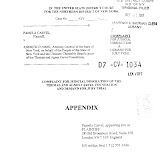
Pamela Carvel, the niece of Tom Carvel Ice Cream, flew in from London earlier this month to testify at a State Senate hearing in Albany concerning the corrupt practices in our Westchester State Supreme Court; practices she referred to as “A criminal enterprise that is a pattern in Surrogate’s Court.” Ms. Carvel, a victim of the Court’s practices, is also an expert fraud investigator who use her professional knowledge to outline the sad saga of her family’s fortune at the hands of local attorneys, judges, and bankers, all of whom profited from the millions amassed by Tom Carvel, leaving his wife with nothing. Carvel testified that there was approximately $250 million in the family estate when her uncle died. She told senators that shortly before his death, she was contacted by her uncle when he notice $100 million missing from his accounts. On the Saturday before his death, according to her testimony, “He told people he was going to fire the secretary and lawyers he thought were responsible.” But the next day, Tom Carvel was dead. Upon investigations, she noticed that her uncle’s death certificate was forged to avoid an autopsy. She is currently requesting an autopsy to determine if her uncle was murdered, possibly poisoned. Ms. Carvel’s testimony about the horrors her family suffered at the hands of our local “judicial” system rivals the saga in Charles Dickens’ Bleak House. Her investigation has uncovered a financial connection between the Surrogate Judge handling her family’s estate, Judge Anthony A. Scarpino, and the bank in charge of the assets, Hudson Valley National Bank.

According to Ms. Carvel, Judge Scarpino received $100,000 for the Hudson Valley Bank during his election campaign; another $200,000 in the form of a “loan” just prior to the trial on Tom Carvel’s estate; and, another $100,000 from the same bank just prior to the trial on her aunt’s estate, Tom Carvel’s wife. She documented and reported her findings to the New York State Commission on Judicial Conduct. Testifying to the Senate hearing that she was told by them that “They [the Judicial Commission] didn’t see a problem with Scarpino not only receiving money from Hudson Valley Bank but allowing Hudson Valley Bank’s controlling shareholder to receive all of the assets from her uncle’s estate, and “to allow him to appear before Scarpino as a witness without ever disclosing that there were financial arrangements between Hudson Valley Bank and Judge Scarpino!”

The financial arrangements surrounding the Carvel estate were not just limited to the money given to the Judge. Hudson Valley Bank and the attorneys involved in the case also profited handsomely. According to Ms. Carvel, “In the course of investigating, I found out that the controlling shareholder of Hudson Valley Bank, William Griffin, was given control of all of my aunt’s real estate which consisted of 19 acres in Ardsley, New York. Griffin was allowed to flip that property to himself through Hudson Valley Bank through one of his former law partner’s brothers. In other words, Griffin signed that property over and then the property came back to Griffin as Hudson Valley Bank. The whole proceeding took place for $2,000,000 on paper that never changed hands. The property is worth $10 million or more”. Pamela Carvel brought this to the attention of Surrogate Scarpino who again found “There was no problem because of the dealing being done by William Griffin who was responsible for paying Surrogate Scarpino at least $400,000”. Her aunt’s attorney, Eve Markowitz, knew of all of these violations, yet, according to Ms Carvel, “[she] betrayed any representation for us on the promise that William Griffin allowed her to be paid $4,000,000 in legal fees. When I filed a complaint with the Commission on Judicial Conduct on her lack of representation and also her complete knowledge of the ethical violations by other attorneys as well as her refusal to take any action herself which was her duty as a lawyer, the decision came back that ‘Her problems would be handled in a lawsuit’ but there was no venue for this lawsuit!”

Ms. Carvel said, “I put in a similar complaint with one of Eve Markowitz’s fellow attorneys, Frank Streng, who didn’t tell me that he was employed by the Judge. He was hired as an attorney of mine and was supposed to represent me. He converted approximately $1,000,000 that I paid him and then took another $1,000,000 from the estate. I was informed that one of his law partners is on the Attorney Ethics Commission in Westchester and that ‘nothing would be done’. The same answer cam back that it would be handled ‘in litigation’ but again there was no litigation in which Frank Streng’s ethics were part of the litigation”. Ms. Carvel said she calls our judicial system a “criminal enterprise” because, as she noted, “the exact tactics being used are in the New York State Penal Code: ‘Coercion, Larceny, Conspiracy’. These are all being operated out of the Surrogate’s Court, in particular Westchester, but I know it is happening in Manhattan, it’s happening in Dutchess. They’re using a one-sided system of favoritism”.
Ms. Carvel revealed how the system is stacked against family members: “My aunt and I, as fiduciaries, should have had equal access to indemnification as all the other fiduciaries. We were the only two fiduciaries denied indemnification because we were the only two working with law enforcement. All the others were paid completely. As long as my aunt lived, she never received a penny from my uncle’s estate!” In contrast, Hudson Valley Bank has continually been allowed to control $100,000,000 of Tom Carvel’s money by Judge Scarpino since his demise over ten years ago “My aunt was the sole beneficiary of this,” Carvel testified. “Yet it’s all been given to them over the last ten years by Judge Scarpino. All of the money in my uncle’s estate and my aunt’s estate has been passed over to Hudson Valley Bank without notice to the named beneficiaries, without notice to the creditors. Without Court approval, assets have been disposed of that were supposed to be in constructive trusts. None of these facts have fazed the Judicial Commission!”

Senator Sampson of Brooklyn hosted this hearing in Albany. When Ms. Carvel completed her testimony, Sampson commented, “Since this is an election year” he wanted to look further into this issued and invited Ms. Carvel to speak with him further. Before stepping down from her testimony, Carvel noted, “Most times when you complain about a decision or a judge’s actions, you have the avenue of appeal. In Surrogate’s Court, the judges either don’t render decisions, even though there’s a 60-day rule, or they may not render a decision for two years or more. They do not hold trials; Surrogate Emmanuelli did not hold a trial for ten years! My aunt’s issues, on my uncle’s estate, were not litigated at trial until five years after she was dead! You’re denied trial by jury or decisions are rendered by transcripts which cannot be appealed. Or, they’re rendered in such a way that it’s too late; the issue, the money, everything has already been gone by the time the [Court] decision has been rendered. This is a pattern and it’s in more than one estate”. Carvel called for complete transparency in our State Courts and noted that no one judge should have control over a case for 20 years. She suggested disposing of the Surrogate Courts entirely and called for a blind rotation of cases instead to judges in the main Supreme Courts as a way to assure that money is not passed to judges handling cases. Lastly she called for an enforcement of the Constitution so that the people appearing in Court will be guaranteed their equal rights under the law.

One witness before the Senate hearing testified that his attorney refused to honor an arbitration decision favoring him and continued to hound him for five years for payment despite both State and Federal laws governing attorney ethics and allowable debt collection methods. One litigant revealed a tape recording he has of the Chief Clerk of the State Supreme Court Appellate Division, Second Department, in Brooklyn, James Pelzer, who state to him, “The Courts may dispense with the rules”. As this litigant noted to the Senators, “that is not true. The Senators cannot dispense with the rules; the citizens cannot dispense with the rules; the President cannot dispense with the rules.” An attorney who spoke at the hearing, Mr. John Aritakis, of New York City, specializes in cases for children who have been abused. He testified that many of his cases involve priests. Aritakis revealed that the Ethics Committee in Albany has stretched their rules to file 50 investigations against him claiming they have “jurisdiction” because he attended Albany Law School over 2- years ago but hasn’t practiced law there in over two decades! The attorney spoke of how he has removed sexual offenders for their jobs and they retaliate by filing complaints. The ethics rules clearly sate that an attorney may only be investigated by the Commission for their county but Mr. Aritakis believes that he is being singled out for investigation by the Albany Commission for his sexual abuse cases against the Catholic Church. He asked, “Why is the Committee going down the Thruway over 150 miles to investigate me? This system is rife with abuse and it needs to be controlled.”

Another attorney, Ms. Eleanor Capogrosso, called for transparency in the disciplinary proceedings against judges. She noted that the current system violated the Federal Constitution but the Senate had an opportunity to correct the process: “By not making it [the system] public, what you are doing is allowing the rigging of the election system in this State. By the State Commission on Judicial Conduct not turning over these complaints to the screening committees who screen the judges, what you’ve done is rig these elections. Nothing more complicated than that! And this is what they’re trying to preserve. They want these elections rigged so they can put the people into power that they want to put in power. It’s Unconstitutional.” Ms. Capogrosso also noted, “The ‘Uniform Judicial Questionnaire’ is hidden under a veil of confidentiality by the Office of Court Administration. The Board of Elections controls the election process with any other politicians in this State but not with the judges. They keep it secret; they keep it under a veil of secrecy. And by doing so, you’re not giving the capability to the public to look carefully at these responses, to look at the resumes of these judges, to see whether or not they’re making false statements.” Ms. Capogrosso referred the State Senators to the Federal website for the Supreme Court appointment hearings for Judge Sotomayer where her answers to her judicial questionnaires and the transcripts to her appointments in the past are posted so the public can view it. “Why should this state deserve anything less? Capogrosso asked. She also quoted the section of New York Sate Election Law (128.17) that states that any public officer who willfully omits, refuses, or neglects to perform any of his duties, is guilty of a felony. As Ms. Capogrosso noted, “When you have administrative judges who are not being truthful to the screening committee when asked ‘if there are any complaints filed against these judges now seeking an elected post,’ they run afoul of this because that questioning is done by an informal process where the screener calls the judge up over the phone where they can say anything or conceal anything. It’s not done under oath with the penalty of perjury with a court reporter in the room.” Ms. Capogrosso revealed that she personally has boxes of letters she sent to administrative judges of ethical violations. But as Ms. Capogrosso concluded “There is no administration of this system!”

One woman, Ms. Esposito, spoke of sexual harassment and assault by her attorney. But despite her videotaped evidence of his sexual abuse, demanding sexual favors from her in lieu of payment for his services, her charges against him were dripped by the state’s legal Ethics Committee. Esposito testified, “I was treated as the criminal. All of my complaints were either dismissed or denied.” She was denied an opportunity to have her attorney present at the hearings and her transcribed video-recordings were tampered with and a redacted version was submitted by the attorney “investigating” for the Ethics Committee. Esposito tearfully quoted a portion of her videotape of her attorney, Alan H. Issac, boasting of his unethical practices and his influence in the Courts. “Yesterday, I was in the Appellate Court, First department. There were 16 cases and my case was the last. I wasn’t arguing it but the client wanted me there because some of the judges on the panel are very close to me. So I wanted them, the Appellate Judges, to know that I am really interested in that case. This is all bullshit politics and they saw me. That case you know is worth $200,000,000. Not like your case.” As this young asked “to whom and where to you report this kind of outrage on the citizens of New York?” She asked the Senators at the hearings to “have the courage to bring these people to justice before they do irreparable harm to our society’s perception of the courts.”

Too late. The readers of the Guardian are sadly all too familiar with the corruption in our courts from previous articles. A full video transcript of the recent State Senate hearings has been posted online on the “You Tube” website by “NYSenateUnCut.” Unfortunately, Senator Sampson’s hearing that day was cut short by the “coup” staged by the out-of-control Republican members of the Senate; ironically a perfect display for the members of that hearing of what happens when power is abused. Senator Sampson promised the attendees that he would be holding additional hearings to investigate this serious issue further. The Guardian intends to be present at those hearings, along with some of the individuals whose cases we have reported, to bring the dire situation in our State Courts to the attention of our representatives in Albany.

Tembeckjian’s Crimes, Part 1

Robert Tembeckjian, $40,000,000.00 and Misprision of Felony

An involved attorney brought to our attention the apparent inaction by the Commission on Judicial Conduct (“CJC”) involving the actions of a Supreme Court Judge and $40 Million Dollars. The involved attorney still questions the inaction of current CJC Chief Counsel, Robert Tembeckjian. The attorney often wonders about Mr. Tembeckjian and the CJC's, at a minimum, failure to act, "A gross failure to act... misprision of a felony, in my mind."

Misprision is a crime of omission and the U.S. Code describes Misprision of Felony as follows: "Whoever, having knowledge of the actual commission of a felony cognizable by a court of the United States, conceals and does not as soon as possible make known the same to some judge or other person in civil or military authority under the United States, shall be fined under this title or imprisoned not more than three years, or both."

In July of 2007, a complaint was made concerning New York State Supreme Court Justice Charles E. Ramos who had received a "waiver" of the Rules Governing Judicial Conduct from the then-Chief Administrative Judge based upon information he (Ramos) provided in writing. The “waiver” pre-approved Judge Ramos to be co-executor of two estates of a couple who were alive and, importantly, over their various trusts.

The Ramos Waiver Request Was Not Truthful


The highly unusual "waiver" of the State Judicial Rules was given by the then-Chief Administrative Judge on May 7, 2003, about a year prior to the jurist's involvement in the 2004 "corporate greed" lawsuit filed by the New York State Attorney General involving the New York Stock Exchange, former Exchange Chairman Richard Grasso and then-NYSE director Kenneth G. Langone, a co-founder of Home Depot.

The May 7, 2003 dated letter from the Administrative Judge allowed Judge Ramos "to be named and to serve as a co-executor and trustee under the Wills of Ruth and Herb Weissberg.”
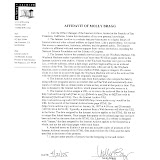
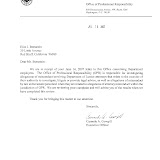
(Click here to see "Ramos-Weissberg Documents")

On May 7, 2003, however, Ruth and Herb were very much alive. And though Herbert Weissberg would die about 2 months later, on July 3, 2003, it was confirmed that Herb had had a stroke and couldn’t speak due to dementia and aphasia, for well over one year prior to his death.  While the then-Chief Administrator’s letter reiterates Justice Ramos' contention- possibly as a backside-covering document, or simply as a courtesy to a fellow jurist- that he "had a longstanding relationship of trust and confidence with the Weissbergs going back 36 years," there is no mention as to why the original March 24, 2002 dated Will did not name Charles E. Ramos as an executor or trustee but, instead, the Last Will named trusted accountant Andrew Rubin and long-time friend attorney Paul Herman as co-executors.  It was only by virtue of a subsequent Codicil by the long-incapacitated and dying Herbert Weissberg that Andrew Rubin and Paul Herman were removed as named co-fiduciaries, and replaced with Judge Ramos and the frail, soon-to-be-widow, Ruth Weissberg as the new named co-fiduciaries.

Troubling Beginnings

After graduating Fordham law school, Judge Ramos joined the law office of Benedict Ginsberg in the late 1960’s. After reportedly running that law firm in the early 1980’s, Judge Ramos was appointed to the New York Civil Court by a mayoral committee.  As a Civil Court judge and, from 1988 through 1993, an acting Supreme Court justice, Ramos joined several other judges in publicly criticizing the screening panels that chose Democratic candidates for Manhattan judgeships, claiming they trumped law with politics. In 1992, and after having just lost a run for the Supreme Court, he criticized the selection process in a letter to the New York Law Journal, accusing "those who have accumulated and hold on to political power" of ignoring Hispanic candidates for the bench. It is reported that the interview with the committee to approve his being a judge was an act of “going through the motions,” as the decision had already been made by the party bosses. During that interview, candidate Ramos was asked if it was true that he had once represented a client, and proceeded through a full trial with that client, without informing his adversaries or the sitting judge that his client was, in fact, his (Ramos’) wife. Candidate Ramos reportedly replied, laughingly, “Yes, guilty as charged.”

New Information, No Laughing Matter

Various interviews with sources in New York and New Jersey, and who asked not to be identified, have now confirmed that Herb could barely say “yes” or “no” and was in a fetal position during the last year of his life. All of the nearly two dozen people interviewed for this article, and who knew the Weissberg family for decades, were surprised, if not shocked, to hear that Judge Ramos had presented himself as a long time "dear friend" of Herbert Weissberg. “It’s a lie,” said one 80-year-old friend of Herb’s who says he has known the Weissberg family for 50 years. It also appears that other plans to wrestle control of Herb's millions were in the works. It is also alleged that in October of 2001, Herbert Weissberg’s attorney, Paul Herman, went to the hospital to visit Herb, who was at that time extremely ill and unable to speak due to dementia and aphasia. While it cannot be determined exactly how many documents, purportedly signed by Herbert Weissberg, emerged from that hospital visit, or exactly from whom, what is certain is that Herb’s signature varies significantly from one writing to another on papers with the exact same date. Also, and falling under the caption of "sloppy frauds," is one document supposedly prepared by Herb and which misspells the word “Gramercy” – as in the Gramercy Park Hotel- the place Herbert Weissberg had run for decades.

Do People with Dementia & Aphasia Initiate Complex Estate Changes?

It appears that out of thin air, but with a judicial waiver in hand, Judge Ramos then appeared and became a paid trustee. The question remains that if Judge Ramos was such “a close, personal friend of the family” and as presented to the then-Administrative Judge who had to “sign-off” on the waiver, then Judge Ramos surely would have known that Herb Weissberg had been very ill, could barely scribble a signature, and could not communicate or understand anything complex- all long before the codicil giving him (Ramos) so much was even drafted.

Lack of Oversight Breeds Other Brazen Judicial Acts

In 2008, a New York Daily News EDITORIAL, "Charles Ramos in no state to rule on Citigroup, Wells Fargo and Wachovia (October 7, 2008) provided more insight into the unchecked state of the judicial process in New York:

It is an understatement to say that the stakes are astronomical in the battle between Citigroup and Wells Fargo for control of Wachovia bank. The fight involves billions of dollars and is the latest front in the U.S. effort to keep banks from going under. Predictably, the tug of war ended up in court - where depositors, shareholders, employees and taxpayers deserved the highest level of judicial attention. But that's not what they got - not even close. While the whole world was watching, the New York State courts, in the person of Manhattan Supreme Court Justice Charles Ramos, conducted half-baked proceedings and issued a back-of-the-envelope ruling that was summarily tossed within 24 hours. Ramos should be embarrassed - as should the judges who are responsible for making sure that the city's courts, particularly those in Manhattan, are prepared to handle major commercial disputes.  The background is that Citigroup, working with the federal government, thought it had reached a deal to acquire Wachovia. But on Friday, Wells Fargo and Wachovia announced that they had struck a different takeover arrangement. Claiming breach of contract under New York law, Citigroup rushed on Saturday to seek a court order barring Wells Fargo and Wachovia from consummating their deal until a judge sorted out the issues. But New York's courts are closed on Saturdays - and they don't keep a commercial judge on call. That left the lawyers to find one on their own. They came up with Ramos, tracking him down at at his home in Cornwall, Conn. (By the description in The New York Times, the house is a stately white Georgian place, unlike the address from which Ramos votes in upper Manhattan.) Now, things got sloppy. Ramos had only the lawyers from one side before him. He got other attorneys on the telephone. But Ramos' house wasn't equipped to run a conference call. He had to talk with one lawyer, relay what was said and relay a response, and so on. There was no court reporter to record what was said. After a couple of hours, Ramos issued a handwritten order freezing the Wells/Wachovia deal. But on Sunday, Manhattan Appellate Division Justice James McGuire chucked the whole megillah. He ruled that 1) Ramos didn't have the power to issue an order when he was out of state; 2) Ramos didn't have lawyers for both sides present, and 3) Ramos was just too fuzzy in the way he wrote his decision. McGuire's rebuke of a fellow judge who overlooked the basics that his authority stopped at the border and that all sides must be fully represented was fittingly stern. New York, the center of world commerce, deserved far better from its courts.

Being Fair to Robert Tembeckjian and the CJC

In fairness to Mr. Tembeckjian and the Commission on Judicial Conduct, it is possible that the Ramos/Weissberg complaint simply disappeared and never made its way to the proper individuals who would be involved in any Ramos investigation process. The magical disappearance of certain complaints have been known to occur at most “ethics” committees around the state- acts orchestrated by well-placed cogs who have access, and the motivation, to make complaints against favored-people simply vanish. It is widely believed that this practice (of white-washing or causing the disappearance of complaints) has been largely perfected over the last twenty years.

So, Mr. Tembeckjian and the CJC, now you have the issues and, importantly, the filed documents that raise and support very troubling issues.

Sunday, July 5, 2009

Presiding Justice Gonzalez Asked to Shut Down Manhattan's Corrupt "ethics" Committee

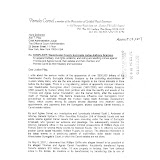
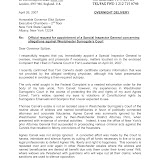
The Presiding Justice of the New York State Supreme Court, Appellate Division, First Department, the Honorable Luis A. Gonzalez, has been asked to shut down the corrupt "ethics" committee in Manhattan...... Here's the letter which will be delivered to the court before noon on Monday, July 6, 2009 (U.S. Express Mail #EW253855700US):

Integrity in the Courts
“Injustice anywhere is a threat to justice everywhere.” (Dr. Martin Luther King, Jr.)

July 4, 2009

The Honorable Luis A. Gonzalez
Presiding Justice, Appellate Division, 1st Dept. 
27 Madison Avenue 
New York, New York 10010


RE: Call for Immediate Action to Address Systemic Corruption at the Manhattan
Attorney ‘Ethics’ Committee, the Departmental Disciplinary Committee (the “DDC”)


Dear Judge Gonzalez:

Your appointment as Presiding Justice of the Appellate Division, 1st Department, has renewed the promise of hope to the great people of New York and, indeed, the many beyond our borders. Scores of people- attorneys, judges, litigants and just regular people- seek the restoration of a broken faith in their judicial branch of government. You, it is respectfully submitted, Judge Gonzalez, have the sole authority to immediately address the long-practiced and improper actions of the DDC.

We request that you immediately suspend all DDC activity until such time that you have appointed a special panel to fully investigate, and report to you, recommendations for the correction of the gross failings at the DDC, and for new leadership with integrity so the DDC may return to its stated mission.

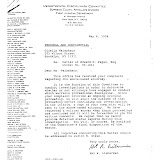
To be specific, it is requested that you direct the immediate closure of the DDC offices on the 2nd floor at 61 Broadway in Manhattan, and that you direct that the locks be changed-- just like the Presiding Justice of the Appellate Division, 1st Department, did in January of 1989 amid a list of corrupt practices in and about the DDC. (Please see the attached, The Murphy Report, dated January 31, 1989)

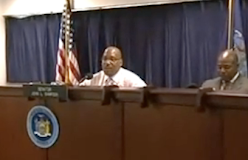
Barely one month ago in Albany, on June 8, 2009, New York State Senator John L. Sampson held the first of numerous planned public hearings on the corruption that exists in and about the four statewide Appellate Division attorney ethics oversight committees. The videotaped testimony reveals a startling series of allegations specifically involving the DDC: (a) the existence of dozens of complaints that have been “white-washed”; (b) horrifying acts of retaliation by DDC superiors to chill certain individuals, including respected attorneys; (c) an 80-year-old Holocaust Survivor who had to wait over ten years to see any action on her DDC complaint; (d) a woman who has been ignored and procedurally defrauded by the DDC after her lawyer, who was recorded on tape wanting sex in return for a favorable outcome in court, was found to be one of the “protected” Manhattan attorneys, and who even boasted of his juice with sitting Associate Justices of the 1st Department; (e) the violation of Judiciary Law where non-court personnel- policy committee members- are provided with confidential case material; (f) the mathematical impossibility that attorneys from large law firms are never held accountable by the DDC; and (g) the outrageous presumption by the current DDC leadership that if a complaintant, or complaining family member, is incarcerated or a member of a minority, then any complaint to the DDC is automatically void of sufficient grounds for any legitimate disciplinary inquiry.

We invite you to review Senator Sampson’s June 8th hearing. In a Google search, enter “Corrupt Courts” – click: www.ExposeCorruptCourts.blogspot.com; and view Part 1 and Part 2 in the upper right corner.

The evidence is clear: the DDC is corrupt. The growing outcry, volume of lawsuits and complaints from every corner of this state represents the serious condition of wholesale corruption and lawlessness by those charged with “ethics oversight.” The time for action is now, and the most capable person is you. We respectfully request that you take immediate, and public, action.

Our two-year-long research has revealed a troubling state court “ethics” oversight structure that is itself corrupt. We have documented dozens of examples where the law, attorneys, litigants, state employees and, in fact, judges have been targeted for annihilation simply because of a political whim or the vengeful, misguided desires of a few. Conversely, we have evidence of many outrageous and criminal acts by certain individuals within and about the state court system that have been substantively ignored for no other reason than their favored position or political affiliation.

We also ask that you publicly support the New York State Senate hearings as started on June 8th.

True “ethics oversight” must be restored, and the current system of destruction and cover-up must end.  We are confident that future generations will echo our gratitude of your restoration of our faith in our government and in our system of law.

Very truly yours,

Frank N. Brady
Integrity in the Courts
347-632-9775 (tel)
corruptcourts@gmail.com

Saturday, July 4, 2009

More Fireworks on Surrogate's Court 'Criminal Enterprise'

Below is a letter to New York State Senator John L. Sampson:

CHRISTOPHER DONOHUE, ELIZABETH PAGENDARM, MICHAEL PAGENDARM
ON BEHALF OF ALL OF THE BENEFICIARIES OF 
THE FRED F. GOETZ TRUST
P.O. BOX 51793, ALBUQUERQUE, NM 87181 
(505) 323-4327 - goetztrust@aol.com

A VERY DIRTY COP*
THREE VERY CROOKED LAWYERS*
A VERY CORRUPT WESTCHESTER COUNTY SURROGATE'S COURT*
AND
MORE THAN EIGHT HUNDRED THOUSAND DOLLARS
- $800,000.00 -
IN MISSING FRED F. GOETZ TRUST MONIES*

TO: New York State Senator John L. Sampson
9114 Flatlands Avenue, Brooklyn, NY 11236   (via facsimile) 

DO WE HAVE YOUR UNDIVIDED ATTENTION???

Reiterating and expanding the scope of the above information.

* THE VERY DIRTY COP IS THE CHIEF OF POLICE FOR THE TOWN OF EASTCHESTER, NEW YORK - ONE TIMOTHY BONCI

* THE THREE VERY CROOKED LAWYERS ARE ONE LUKE CHARDE AND ONE MARY NITSCH

OPENLY ADMITTED BY THE WESTCHESTER COUNTY SURROGATE'S COURT AS ANTHONY SCARPINO CRONYISM APPOINTEES AS "GUARDIAN AD LITEMS"

AND ONE DOMENICK PORCO

THE LAWYER FOR BOTH THE  DEFENDANTS BARBARA MORRIS AND ELIZABETH KNUDSEN AND TIMOTHY BONCI, ILLEGALLY INSTALLED FOR THE PLAINTIFF(!)
AS THE NEW "PUPPET TRUSTEE"

BOTH THE PLAINTIFF AND DEFENDANTS IN THIS ACTION HAVE BEEN "SIMULTANEOUSLY" REPRESENTED BY THE SAME LAWYER, DOMENICK PORCO

VERIFIED FACTS

FACT 1 - Defendant Elizabeth Knudsen is the Mother-In-Law of Timothy Bonci.

FACT 2 - Defendant Barbara Morris is the Aunt-By-Marriage of Timothy Bonci.

FACT 3 - Domenick Porco is the local Traffic Court Judge in The Town of Eastchester, New York, where his friend and crony, Timothy Bonci, is the Police Chief.

FACT 4 - Domenick Porco is a known Gambino Crime Family Associate having represented, among others, the Gambino, Alfred Lafata, Jr., who was convicted on Federal Charges, and the Gambino soldier, Primo Cassarino, who had been indicted along with Peter Gotti and Anthony 'Sonny" Ciccone..

* And, more than $800,000.00 of our Fred F. Goetz Trust monies was put
into Timothy Bonci's care and it has all disappeared.

FACTUAL BACKGROUND

In August of 1999, the Fred F. Goetz Trust, M L. Donohue, Trustee filed a "Turn-Over" Proceeding in the Westchester County Surrogate's Court against the Defendants Barbara Morris and Elizabeth Knudsen for the recovery of substantial Fred F. Goetz Trust assets that Barbara Morris and Elizabeth Knudsen had diverted and converted during their tenure as Attorneys in Fact using Power of Attorneys - that were notarized by Timothy Bonci - and for a complete Accounting of all of the Defendants actions as Attorneys in Fact. When the Defendants both failed and overtly refused to provide the Accounting as required - by Black Letter Law - and as agreed to via a Settlement Agreement dated June 21, 2000, an independent Forensic Accounting was done.  Via the AFFIDAVIT OF FORENSIC ACCOUNTING dated September 11, 2003, this Independent Forensic Accounting identified more than $627,122.00 of Fred F. Goetz Trust assets were "Missing and Unaccounted For" by the Defendants Barbara Morris and Elizabeth Knudsen. The $627,122.00 remains "Missing and Unaccounted For" to date!

During Discovery, Depositions and via EBT Exhibits, it was evidenced that in addition to the "Missing and Unaccounted For $627,122.00" that an additional $76,425,96 that was "Accounted For" had been misspent or improperly "Gifted" by the Defendants including the $7,040.00 improperly "Gifted" to Timothy Bonci's wife and two older sons. During the course of this Litigation, the Defendants did file a Cross Motion against the Fred F. Goetz Trust for the Fred F. Goetz Trust to file an Accounting with the Court. The Fred F. Goetz Trust did file a complete, detailed and transparent Accounting which reconciled to the penny. As a result, the Defendants, in their pre-trial papers, as filed, identified that they had no grounds to contest or object to any items or parts of the Fred F. Goetz Trust's Accounting and let the Fred F. Goetz Trust's Accounting stand as presented.

OUR RIGHTFUL DEMANDS

We, THE BENEFICIARIES OF THE FRED F. GOETZ TRUST, ARE DEMANDING - NOT ASKING - BUT DEMANDING - that you stop the wholesale and rampant CORRUPTION AND THE OUTRIGHT THEFT of our Fred F. Goetz Trust monies that has been on going at the Westchester County Surrogate's Court. That you completely OVERHAUL THIS VERY CORRUPT COURT and the very corrupt and dysfunctional "Guardian" system of "lucrative" appointments to personal and political cronies for various paybacks currently in place.  This Court has violated New York State Law after New York State Law and Procedure after Procedure in an ONGOING COURT CONSPIRED AND COURT SPONSORED EXTORTION RACKET whose goal is the wholesale raping of our Fred F. Goetz Trust funds to provide the funding for payments of fraudulent "Legal/Guardian Fees" to the previously identified lawyers.

This Court has IGNORED IN THE ENTIRETY all of the FACTS as to this ACTION and all of the LAWS OF NEW YORK STATE relevant to our Fred F. Goetz Trust Rights. These include, but are not limited to "DENIAL OF DUE PROCESS, DENIAL OF REPRESENTATION, "PHANTOM TRIALS" AND UNAVAILABLE OR NONEXISTENT COURT "RECORDS" AND ACTS THAT ARE CRIMINAL IN NATURE COMMITTED UNDER THE 'COLOR OF THE LAW'. This Court has intentionally selected two absolutely crooked lawyers - one Luke Charde and one Mary Nitsch - whose roles are as "Shakedown Thugs" and "Bagmen" to force the Sole Legitimate Trustee of the Fred F. Goetz Trust to capitulate to their extortion demands. Luke Charde and Mary Nitsch have been demanding in excess of $108,000.00 in fraudulent "Legal Invoices".

The Sole Legitimate Trustee was constantly threatened with that if she did not "go along" and agree to pay all of the lawyers whatever they wanted EXCLUSIVELY OUT OF THE FRED F. GOETZ TRUST COFFERS that she would be PHYSICALLY HURT, PERSONALLY AND FINANCIALLY RUINED AND THAT ALL OF HER PERSONAL ASSETS WOULD BE ATTACHED.

When the Sole Legitimate Trustee refused, the Court told her that she would be removed and that the Court would appoint someone who would just rubber stamp the lawyers fees. At the instigation of Domenick Porco and Luke Charde, the Court then "Appointed" as the "Puppet Trustee" one Timothy Bonci, a party who is an Unnamed Co-Defendant along with the Named Defendants, Barbara Morris and Elizabeth Knudsen. Timothy Bonci is an Unnamed Co-Defendant in that he is the party who notarized multiple Powers of Attorney that were used by the Defendants Barbara Morris (Timothy Bonci's "Aunt-By-Marriage") and Elizabeth Knudsen (Timothy Bonci's "Mother-in-Law") to steal - A PROVABLE - IN TOTALITY - $703,547.96 of Fred F. Goetz Trust assets from 1994 through 1999. This "Puppet Trustee" Timothy Bonci, has been continuously represented throughout this Action by the Defendants Attorney of Record, one Domenick Porco. Thus, the Court has created a situation where the Plaintiff, one Timothy Bonci, and the Defendants Barbara Morris and Elizabeth Knudsen are being represented simultaneously by the same crooked lawyer - Domenick Porco - in the same Action. The two crooked "Guardians" have colluded with Domenick Porco to absolve the Defendants from having to return to the Fred F. Goetz Trust the more than $800,000.00 that is proven by the evidence as rightfully owed to the Fred F. Goetz Trust. In FACT, both Luke Charde and Mary Nitsch each filed - not one - BUT TWO(!) - "Affirmation in Oppositions" - ACTIVELY opposing the recovery to the Fred F. Goetz Trust of the more than $800,000.00 rightfully owed to the Fred F. Goetz Trust and their Assigned Wards. Concurrently, the two crooked "Guardians" claim that all legal fees are to be paid exclusively out of OUR Fred F. Goetz Trust monies!

The Westchester County Surrogate's Court - via numerous letters signed by Anthony Scarpino (aka Tony Soprano) and Charles Scott - Anthony Scarpino's henchman – also claims that WE, THE BENEFICIARIES OF THE FRED F. GOETZ TRUST, HAVE NO RIGHTS in this matter.  The listing of LEGAL RIGHTS that the Fred F. Goetz Trust has been denied at the Westchester County Surrogate's Court is mind boggling. ALL of the basic tenets that compose our LEGAL SYSTEM have been violated by this Court in service of the ONGOING COURT CONSPIRED AND COURT SPONSORED EXTORTION RACKET. The only parties with "RIGHTS" are the crooked lawyers who are openly stealing our Fred F. Goetz Trust funds. Attached, is a listing of several documents that will give you a preliminary foundation as to the depth and scale of the travesties, the corruption and the violations of the Laws of New York State that have gone on to date at the Westchester County Surrogate's Court. What is identified herein is only a small representation of the egregiousness of the VIOLATIONS OF NEW YORK STATE LAW, PROCEDURE, AND THE TOTAL IGNORING OF THE FACTS THAT HAVE CONSISTENTLY OCCURRED AT THIS COURT, which we will gladly remit upon your request.

What has been going on at the Westchester County Surrogate's Court makes the scandals of Judge Gerald Garson's Court in Brooklyn, New York, pale in comparison.  The convicted Judge Gerald Garson was taking relatively small sums - dollar wise - of bribes to "fix" cases. Where at the Westchester County Surrogate's Court, the "criminal fixers" are the "Court (Cronyism) Appointed Guardians" Luke Charde and Mary Nitsch who have demanded a "whopping minimum of $108,000.00 and upwards of $128,000.00 in fraudulent "Guardian Invoices" and Timothy Bonci as the Dummy/Puppet "Trustee" has already 'paid' them $77,320.00 in extortion money exclusively from our Fred F. Goetz Trust funds.

Christopher Donohue
Elizabeth Pagendarm
Michael Pagendarm

cc: M.L. Donohue, Sole Legitimate Trustee of the Fred F. Goetz Trust


ATTACHMENTS AVAILABLE:

1.   AFFIRMATION IN OPPOSITION TO PETITIONS…FOR UNEARNED (FRAUDULENT GUARDIAN FEES) dated February 21, 2007 brought by ALL OF THE NAMED BENEFICIARIES OF THE FRED F. GOETZ TRUST.

2.   AFFIRMATION IN OPPOSITION TO PETITIONS ...WHEREBY LUKE CHARDE AND MARY NITSCH ARE PETITIONING FOR "FRAUDULENT GUARDIAN FEES" dated January 11, 2007 brought BY M.L. DONOHUE, SOLE LEGITIMATE TRUSTEE OF THE FRED F. GOETZ  TRUST. 

3.   MOTION FOR A SUMMARY JUDGMENT dated April 15, 2007 brought by ALL OF THE NAMED BENEFICIARIES OF THE FRED F. GOETZ TRUST.

4.   MOTION TO REMOVE THE ILLEGALLY APPOINTED TRUSTEE TIMOTHY BONCI WHO, IN ACTUALITY, IS AN UNNAMED CO-DEFENDANT IN THIS LITIGATION dated May 24, 2007 brought by ALL OF THE NAMED BENEFICIARIES OF THE FRED F. GOETZ TRUST.


NOTE: The above submissions are just a small selection as to verify only a small portion as to what is stated in our cover letter. There is a substantial amount of documentation and evidence as to all of the statements, claims, allegations and verified facts as identified in the above and via numerous other documents that we are most willing to make available. We have limited what is being initially sent to you so that we do not overwhelm you with a mountain of documents.

Friday, July 3, 2009

New York's Corrupt "Character and Fitness" Committee at it Again

Empire State's Ethics Hypocrisy:  "New York’s courts have overlooked misconduct like lawyers’ solicitation of minors for sex, efforts to deceive judges and possession of cocaine..."

Finding Debt a Bigger Hurdle Than Bar Exam
The New York Times by JONATHAN D. GLATER - July 2, 2009

All his life, Robert Bowman wanted to be a lawyer. He overcame a troubled childhood, a tragic accident that nearly cost him a leg and a debilitating Jet Ski collision. He put himself through community college, worked and borrowed heavily to help pay for college, graduate school and even law school. He took the New York bar examination not once, not twice, not three times, but four, passing it last year. Finally, he seemed to be on his way. In January, the committee of New York lawyers that reviews applications for admission to the bar interviewed Mr. Bowman, studied his history and the debt he had amassed, and called his persistence remarkable. It recommended his approval. But a group of five state appellate judges decided this spring that his student loans were too big and his efforts to repay them too meager for him to be a lawyer. “Applicant has not made any substantial payments on the loans,” the judges wrote in a terse decision and an unusual rejection of the committee’s recommendation. “Applicant has not presently established the character and general fitness requisite for an attorney and counselor-at-law.” Mr. Bowman, 47, appears to have crossed some unspoken line with his $400,000 in student debt and penalties, accumulated over many years.

New York’s courts have overlooked misconduct like lawyers’ solicitation of minors for sex, efforts to deceive judges and possession of cocaine. Those instances have led merely to temporary suspensions from practice. “It usually takes a pretty significant record of some underlying misconduct to keep you out permanently,” said Deborah L. Rhode, a law professor at Stanford who has studied bar admissions across the states. Excluding someone for having too much debt was odd, she said; the hard questions about loans usually involve applicants who have used bankruptcy to try to escape loans, she said, and Mr. Bowman has not. Mr. Bowman concedes that he has never made a payment on his loans, partly because of medical and other deferrals and problems with his lender. But he says he intends to make good, adding that his only hope is to begin practicing law — which means overturning the judges’ decision. While thousands of indebted students have complained about their treatment by lenders, Mr. Bowman has documented his personal debt crisis with remarkable, obsessive intensity. He claims Sallie Mae overcharged him, imposing hefty and unjustified fees; did not allow him to defer payments when he was entitled to do so and improperly accounted for periods when he did defer. According to his detailed records, a Sallie Mae representative even threatened him. “If you default, your license will be taken from you,” the representative said. “Do you understand that?”  When Mr. Bowman said that he did not yet have a law license, the representative responded that the company would prevent him from getting one. Martha Holler, a Sallie Mae spokeswoman, said that such threats would violate the company’s rules. “The size of this account is extremely unusual, but not surprising given that the customer took out 32 loans to pursue undergraduate, law and masters of law studies and has not made a single monthly payment over his 26-year student loan history,” Ms. Holler said. “We are performing an extensive review of his extraordinary case, and if we identify any errors we will quickly rectify them.”

Mr. Bowman has not had an easy time of it. He was shuffled through foster care and various legal proceedings as a child. He was impressed by the lawyers who represented his interests and saw a possible life’s work. Getting a college degree took 10 years because he had spent nearly six in rehabilitation, relearning how to walk after an all-terrain vehicle hit him while he was stopped on his motorcycle. The accident nearly cost him his left leg; he graduated from the State University of New York in Albany in 1995. He enrolled at the University of California Hastings College of Law in San Francisco in 2000. After his third year, he began a masters of law program in London, where he lived with a girlfriend. He graduated in December 2004 with about $230,000 in student loan debt, and she helped support him while he studied, and studied again and again, for the bar exam. In 2007, Mr. Bowman asked for an accounting of his loans, the payment deferrals he had used and his repayment options. He said he did not receive that information for nearly two years — a point disputed by Sallie Mae, which said it tried to reach Mr. Bowman several times in 2007. Mr. Bowman passed the New York bar in February 2008. Soon after, while living with his once-estranged mother in Miramar, Fla., he was swimming at a beach when a Jet Ski lost control and slammed into him, breaking his good leg in four places. “My luck on these things,” Mr. Bowman said. “So I contacted Sallie Mae and I’m like, I need a medical deferment and advice. Their response is, none available.”

Sallie Mae transferred Mr. Bowman’s private student loans, the ones not guaranteed by the federal government, to a collection agency, which tacked on a 25 percent fee. That agency transferred the loan again, and he said the next collection agency tacked on another 25 percent fee. Sallie Mae denied this, saying he was charged the fee only once. But suddenly, Mr. Bowman found that he owed more than $400,000. Knowing it would be difficult to explain his debt to New York’s Committee on Character and Fitness, which reviews applications for admission to the bar, Mr. Bowman gathered correspondence with Sallie Mae, loan statements, even the emergency room report on the Jet Ski incident. The three lawyers who interviewed him in Albany in January found Mr. Bowman’s “determination to pursue a postsecondary education remarkable,” according to the written evaluation. As for the loans, they continued, “it appears unconscionable that a student loan indebtedness could go from $270,000 to $435,000 in four years.” Two of the committee members did not return calls seeking comment; the third could not be reached. In April the judges rejected the committee’s recommendation and ruled Mr. Bowman could not be a lawyer. Michael J. Novack, the clerk of the court that handled Mr. Bowman’s application, declined to comment specifically on his case. “Generally speaking, if the committee on character and fitness recommends admission of an applicant, the court approves of it,” Mr. Novack said. “But not always.” Along with asking the court to reverse its decision, Mr. Bowman has consulted lawyers and is preparing a lawsuit against Sallie Mae. One way or another, he vows, he will make the switch from client to lawyer.

Thursday, July 2, 2009

The Judge and the Mob Bagman

Tale of the Judge and the Mob Bagman Adds Ugly New Chapter to Scandal
The Legal Intelligencer by Leo Strupczewski - July 2, 2009

PHILADELPHIA, PA - A pair of witnesses testified during a court hearing Wednesday that reputed northeastern Pennsylvania mob boss William "Billy" D'Elia had envelopes delivered to disgraced former Luzerne County President Judge Michael T. Conahan at the courthouse and that Conahan met with D'Elia and another admitted felon multiple times to discuss fixing cases. The hearing was ordered by the Pennsylvania Supreme Court after a Wilkes-Barre newspaper argued that a defamation case handed down against the paper by Conahan's colleague, indicted former Judge Mark A. Ciavarella Jr., should be vacated. Lawyers for the newspaper are arguing that Conahan helped fix the case on behalf of a friend of D'Elia's. In petitioning to reopen the case, the newspaper's lawyers cited the judges' guilty pleas in federal court to honest services fraud charges, as well as newspaper articles in The Legal and its sister publication, Pennsylvania Law Weekly , detailing suspicions of case fixing in Luzerne County and ties to criminal figures.The key witness for the newspaper Wednesday was admitted felon Robert Kulick. During several of their routine cocktail sessions, D'Elia would discuss with him a defamation case that was pending in the Luzerne County Common Pleas Court, Kulick testified. Coverage of the case, Joseph v. Scranton Times , was in the Wilkes-Barre papers at the time, Kulick said Wednesday, and D'Elia would get upset when Thomas Joseph, a businessman, would deny any relationship with D'Elia.

A source had told the Citizens' Voice newspaper that federal officials were investigating Joseph to see if he used his direct mail and advertising business to launder money for D'Elia and if his taxi and limousine service was used to traffic guns, drugs and prostitutes between the Wilkes-Barre/Scranton and Lehigh Valley international airports and Atlantic City, N.J., New York City and Philadelphia. Joseph was never charged with any wrongdoing and sought to distance himself from the reputed mob boss. In his lawsuit against the paper's parent company, he argued that articles written about him damaged his reputation and business. "It was hilarious," Kulick said of Joseph's denial during the court hearing in Allentown. "I'm sure there's records that money changed hands. I'm sure there's records that Billy D'Elia was Joseph's son's godfather." And just like everyone knew the real relationship between Joseph and D'Elia, Kulick said, D'Elia purported to know what the outcome of Joseph's defamation case would be. "According to him, he knew Tommy Joseph was going to win the case," Kulick said. "And we laughed about it." For more than two hours Kulick's testimony — which touched on socializing with Luzerne County judges and D'Elia, along with judicial case fixing — was the central focus of the first day of a multi-day hearing ordered by the state Supreme Court. The justices ordered the hearing in April and assigned Lehigh County Common Pleas Court President Judge William H. Platt to determine whether corruption in the Luzerne County Courthouse played a role in the assignment of Joseph's defamation suit to Ciavarella, who along with Conahan has conditionally pleaded guilty to federal fraud charges. Attorneys for the Scranton Times , the parent company of the Citizens' Voice newspaper, petitioned the court to use its King's Bench power to reopen the case after the two judges entered their conditional guilty pleas. Ciavarella, who heard the Joseph case, awarded Joseph and his businesses $3.5 million in damages after ruling that articles published by the Citizens' Voice damaged Joseph's reputation and businesses. During Wednesday's hearing, attorneys for the Scranton Times said they were attempting to show a conspiracy existed in Luzerne County to fix the outcome of certain cases, including the Joseph case. Joseph's attorney, George Croner, worked to poke holes in that theory from the beginning. Even before Kulick took the stand, Croner seemed set on discrediting the man's credibility. During his cross-examination of the Scranton Times 'first witness, a courthouse security guard named Patty Benzi, Croner concluded his questioning by asking her what Kulick's reputation for "truth and veracity" was in the community. "It's not good, is it?" Croner asked. Benzi, who grew apprehensive with Kulick sitting in court, dropped her voice and said, "It's OK." "Do you remember telling me," Croner followed up with Benzi, "that his reputation on a scale of 1 to 10 was a minus 1?" "Yes," Benzi said. Later, after Kulick had testified, Croner asked another of the newspaper's witnesses, Robert Jabers, a businessman who knows both D'Elia and Kulick, the same question. "It's deceitful," Jabers said. "He lies, he's a con man ... I wouldn't want to be in a fox hole with him." While cross-examining Kulick, Croner got Kulick to admit that he didn't know if Conahan ever took steps to fix cases.

The morning session, which featured opening arguments and a lengthy process in which attorneys for the newspaper introduced roughly 100 exhibits, was followed by a string of witnesses put on the stand by attorneys for the newspaper to show Conahan's link to D'Elia and Kulick helped determine the outcome of the Joseph case. That string began with Benzi, a security guard in Luzerne County's main court building who testified that D'Elia's access to the courthouse was so good that the reputed mob boss could leave his car in the employee parking lot and walk in through a secured prisoner's entrance. Benzi further testified that she ran between 10 and 20 plain white or 8 1/2 x 11 inch manilla envelopes from D'Elia directly to Conahan's hands over nearly a three-year period. On three occasions, Benzi alleged she left the envelopes with Conahan's tipstaff, Nick Callen. But, the security guard said, she would never leave the unmarked envelopes with anyone else. And she never left them unattended. Instead, she would abandon her security post when D'Elia arrived in the employee parking lot, retrieve the letter and take it straight to Conahan's chambers. Sometimes, Benzi said, she would walk straight past Conahan's secretary. Upon receipt, Conahan never asked whom the envelopes were from. "He'd say, 'Thank you,'" Benzi said. Benzi said she did not know what was in the envelopes. She said she never looked, never asked and was never told. Conahan, along with D'Elia and Conahan's cousin, former Luzerne County Court Administrator William T. Sharkey Sr., invoked their Fifth Amendment rights, according to attorneys in the case, and did not show for the hearing Wednesday. D'Elia has been described in publications as the reputed head of a northeastern Pennsylvania crime family. The Associated Press reported D'Elia pleaded guilty in March 2008 to money-laundering conspiracy and witness tampering charges. Sources told The Legal back in January that D'Elia was cooperating with federal investigators in their probe into corruption at the Luzerne County Courthouse. On Wednesday, Kulick shed some light on how the man he once considered a friend operated.The two would meet Conahan on a regular basis at Perkins Family Restaurant in Wilkes-Barre to socialize and, on occasion, discuss their interests in certain cases. One man or the other would walk away from the table so his counterpart could meet with Conahan in private and, at least in Kulick's experiences, the outcomes would sometimes be favorable to his interests, he said. The men also met inside the Luzerne County Courthouse, Kulick said, and at parties.During a Christmas party at Kulick's home, a local businessman asked Kulick and D'Elia to talk with Conahan about a case the businessman had before the judge. "Days later," Kulick said, "Billy D'Elia told me he did." •

Wednesday, July 1, 2009

Is It Too Much To Ask That Employees Stop Altering Court Records?

Judge Accused of Altering Her Grandson's Court File, Calling Cop an "A$$#@!="
The Legal Intelligencer by Zack Needles July 1, 2009

See Related Story: "Confessions of a New York Court Reporter, Part 1"

PHILADELPHIA, PA - The Judicial Conduct Board announced Monday that it has filed a complaint with the Court of Judicial Discipline against a Bucks County magisterial district judge for allegedly altering official records and for "indecorous language and behavior toward a police officer." The board alleged that Judge Susan E. McEwen, of Magisterial District 07-1-06, inappropriately altered her grandson's court records by reducing his fine for an underage drinking citation. The board also alleged McEwen was verbally abusive to a police officer who was attempting to obtain an arrest warrant at 4 a.m.

ALTERED RECORDS

On the evening of Nov. 20, 2007, according to the board's complaint, Lower Southampton police officers responded to an anonymous phone complaint of an underage drinking party at McEwen's home in Feasterville, Pa. When the police arrived at the home, McEwen's grandson, Matthew Keller, answered and the police told him to get his grandmother, the complaint said.
When McEwen came to the door she appeared to have just awakened and said that she did not know about the underage drinking party in her home because she had been asleep, according to the complaint. McEwen then allowed the officers to enter her home and they cited 10 people, including Keller, for underage drinking, the complaint said. David W. Heckler, the county's president judge at the time, assigned all 10 cases to Magisterial District Judge Donald Nasshorn, of Magisterial District 07-2-07, the complaint said. On Jan. 9, 2008, according to the complaint, all of the defendants appeared before Nasshorn with their parents, except Keller, who was absent from the proceedings. Nasshorn found all 10 defendants guilty, the cases were adjudicated and the original files and paperwork were returned to McEwen's court, the complaint said. Keller was found guilty in absentia and was assessed a $300 fine plus $121.41 for court costs, according to the complaint. The complaint said that a payment determination hearing for Keller was scheduled for Feb. 26, 2008. On that date, the complaint said, McEwen brought Keller to her court offices and asked her acting court clerk administrator for her grandson's file so that she could reduce his fine. The administrator told McEwen that Keller's case belonged to Nasshorn, to which McEwen responded, "This is a case in my court," according to the complaint. The complaint alleged McEwen altered the file, changing the original $300 fine to $150. Keller paid $100 cash that day but failed to make the first $25 payment on March 26, 2008, the complaint said. On April 16, 2008, McEwen gave the administrator a check for the balance owed on the altered $150 fine and the administrator noted in computerized court records that the fine was paid in full, the complaint said. The board charged McEwen with violating the state constitution by "engaging in conduct that prejudices the proper administration of justice" and by "engaging in activity that brings the judicial office into disrepute." The board also charged McEwen with violating Rule 2A of the Rules Governing Standards of Conduct of Magisterial District Judges, which states that district judges "shall respect and comply with the law and shall conduct themselves at all times in a manner that promotes public confidence in the integrity and impartiality of the judiciary" and "shall not allow their family, social or other relationships to influence their judicial conduct or judgment." The board argued McEwen was also in violation of Rule 8A of the district judge rules, which requires district judges to recuse themselves from cases "in which their impartiality might reasonably be questioned."

VERBAL ABUSE

In its complaint, the board also alleged that in the early morning of Sept. 23, 2008, several Warminster Township police officers responded to a domestic violence incident involving a man named Wuirman Hott and determined that an arrest warrant should be immediately obtained for Hott given his "lengthy prior criminal history, violent past, and unknown residence." Officer Brian Outland was assigned to obtain the arrest warrant from McEwen, who was the "on-call" district judge that day. Outland made arrangements to meet with McEwen, arriving at her court offices at about 4 a.m., the complaint said. When he got there, Outland gave one of McEwen's court clerks the information for the arrest warrant documents, which the clerk completed before McEwen arrived about 10 minutes later. According to the complaint, McEwen walked in and immediately approached Outland, pointing her finger in his face and screaming about how angry she was to have been called out at 4 a.m. for a warrant she did not think the police would immediately serve. According to the complaint, McEwen repeatedly called Outland a "bastard" and a "stupid asshole" McEwen was quoted in the complaint as saying, upon looking at the arrest warrant paperwork, "You asshole, I can't believe you called me out for this. I am going to require you to swear to this." The complaint alleged that even as Outland left the court offices, McEwen continued her rant, referring to the police as "stupid assholes" and saying, "I know how you police work," and "The warrant will still be sitting until the following afternoon without being served." In addition to the same two constitutional violations charged in connection with the alleged alteration of records, the board charged McEwen with violating Rule 3A of the district judge rules, which requires judges to "devote the time necessary for the prompt and proper disposition of the business of their office." McEwen was also charged with violating Rule 4C, which says district judges must be "patient, dignified and courteous to litigants, witnesses, lawyers and others with whom they deal in their official capacity."

CONSEQUENCES

James C. Schwartzman, an ethics and professional responsibility attorney from Stevens & Lee who practices in front of the Court of Judicial Discipline, said all of the charges against McEwen carry "potentially serious" consequences, especially those pertaining to the alleged alteration of records. "Removal from office, suspension, I'm sure are possibilities," he said. "If a lawyer in the disciplinary system that governs lawyers changed a record such as a pleading or something like that he would almost certainly face loss of license for a period of time, if not disbarment depending on the facts and circumstances." Robert L. Byer, a former judge of the Commonwealth Court and Court of Judicial Discipline who is now with Duane Morris, agreed, saying alteration of official records is a "very serious offense."

"As a matter of fact, I think that's criminal if it's true," he said. "That's the type of offense that could justify removing someone from the bench." Byer and Schwartzman both said that the alleged verbal abuse of a police officer is not to be taken lightly either. "It's not trivial because the last thing you want to do is tell a police officer 'You've got to wait until the morning,' or make the police officer reluctant to contact a judge at all to sign a warrant only to have the evidence disappear before the judge wakes up," Byer said, adding that this is particularly true when it comes to arrest warrants, for which time is of the essence. Schwartzman said misconduct in magisterial district court should be taken just as seriously as misconduct at any other judicial level. "That's the court most people come in contact with most often," Schwartzman said, adding that "most people form their impression of how the judicial system works" from their experiences with magisterial district court. McEwen's attorney, William I. Arbuckle III of the Mazza Law Group in State College, Pa., declined to comment beyond what was contained in a press release he issued Tuesday.  According to the press release, Bucks County President Judge Susan Devlin Scott entered an order Tuesday placing McEwen on temporary paid administrative leave. "Judge McEwen appreciates the courtesy shown to her by Judge Scott given her health and family situation," the press release said. The press release also said McEwen will file a formal response to the complaint "within the time allotted by the rules." Joseph A. Massa Jr., chief counsel of the board, declined to comment on the complaint, citing board policy, and Nasshorn declined to comment on the record.

Update on Judges Judging Judicial Pay Increase

Top Court to Review Judicial Pay Decision

The New York Law Journal by Joel Stashenko - NEWSBRIEFS - July 1, 2009

The Court of Appeals informed parties in Maron v. Silver yesterday that it will hear an appeal as of right in the case in which state judges are seeking a pay raise from the Legislature and governor. Court spokesman Gary Spencer said letters sent yesterday to the attorneys indicated that the Court will hear the case in its normal course, meaning after a full briefing schedule. It typically takes the Court about seven months to hear oral arguments in a case after accepting an appeal, and another month to hand down a written ruling. A 4-1 Appellate Division, Third Department panel dismissed Maron v. Silver, 58 AD 3d 102 (NYLJ, Nov. 14, 2008). Also yesterday, the Court denied as unnecessary a motion for leave to appeal filed by the Maron plaintiffs, who had sought to appeal either as of right, because a substantial constitutional question is directly involved in the case, or through a leave grant. Chief Judge Jonathan Lippman took no part in considering the leave-to-appeal request. He has indicated that because he is a plaintiff in one of the suits, he would recuse himself from any judicial pay litigation that reaches the Court. Lawyers in the two other judicial pay suits pending in the courts, Chief Judge v. Governor and Larabee v. Governor, have indicated that they would like their cases to be consolidated with Maron and for the Court of Appeals to decide the pay raise question at the same time.

Tuesday, June 30, 2009

Governor Names Krane to Commisson on Public Integrity

Former State Bar President Named to Integrity Agency
The New York Law Journal - NEWSBRIEFS - June 30, 2009

Governor David A. Paterson has appointed Steven C. Krane, Proskauer Rose partner and former president of the New York State Bar Association, to the Commission on Public Integrity. He will replace Sullivan & Cromwell partner Robert J. Giuffra Jr., who has been a holdover on the commission since his term expired in October 2008. Mr. Krane's term will run through October 2014. Mr. Krane, state bar president in 2001-02, was also once clerk to former state chief judge Judith S. Kaye. His appointment to the 13-member commission is not subject to confirmation by the state Senate. Members are not paid. Mr. Giuffra was originally named to the Ethics Commission by former Governor George E. Pataki and appointed by Eliot Spitzer to the Public Integrity Commission when it was formed in 2007 by the merger of the Ethics and Lobbying commissions. — Joel Stashenko

Monday, June 29, 2009

Corrupt Westchester Surrogate's Court Brings Out Worst In People

Police: Former court employee harassed co-worker
The Journal News by Rebecca Baker - June 29, 2009

WHITE PLAINS, NY - A former Surrogate's Court employee is accused of harassing a former co-worker inside the Westchester County courthouse, at one point throwing an umbrella at her during a heated confrontation. Charmain Smalls, 31, of 32-42 107th St., Queens, was arrested last week and charged with second-degree harassment, a violation. She was released on her own recognizance and ordered to appear in White Plains City Court on July 10. Westchester County police said Smalls entered Surrogate's Court on Thursday and began arguing with Deupty Chief Clerk Johanna O'Brien. The argument escalated and Smalls threw an umbrella, hitting O'Brien in the chest, county police said. The incident prompted more than two dozen court officers to respond to Surrogate's Court, which is on the 19th floor of the courthouse in downtown White Plains. State Supreme Court Justice Anthony Scarpino Jr., who heads the Surrogate's Court, directed all questions about the confrontation to David Bookstaver, spokesman for the New York State Office of Court Administration. Bookstaver identified Smalls today and confirmed that she had been arrested. He declined to offer further details about the incident, saying it was an "internal dispute." Surrogate's Courts handle wills, estates and property of those who are deceased. The court also shares authority with Family Court on adoption matters. rebaker@lohud.com

Disbarred NY Lawyer Gets 6 Months for Swindling Clients

Disbarred Westchester lawyer to spend 6 months in jail for swindling clients
The Journal News by Rebecca Baker - June 16, 2009

WHITE PLAINS, NY - A disbarred Mamaroneck lawyer was sentenced today to serve six months in jail for stealing more than $445,000 from four clients and then failing to pay taxes on the stolen cash. The sentence for Christopher Meyers, 46, was part of a five-year "shock" probation in which he will serve 4 1/2 years on probation after his jail term. Meyers, wearing blue jeans and a navy blue T-shirt to his sentencing in state Supreme Court in White Plains, said he has "extreme regret" for hurting his clients and his family. "I apologize to all parties, the victims and my family, who's been gravely affected by this," he said. Meyers, who had a law office in Buchanan, was arrested last year after stealing nearly $300,000 from the estate of John S. Burge, officials said. Meyers had told the estate's executor that he needed the money to pay estate taxes, but then kept it for his own use, officials said. He pleaded guilty in February to felony charges of second-degree grand larceny and filing a false personal income tax return. He has paid nearly $300,000 in restitution, but still owes $90,619 to the Burge estate and $56,624 to ex-client Norman Preteau. He also owes $29,302 to the state Department of Taxation and Finance and $3,000 to Springvale Apartments in Cortlandt, but was not charged with the latter theft. State Supreme Court Justice Richard A. Molea told Meyers that he had been a "fine attorney" and "a credit to his profession" before he committed these crimes, which he described as "an aberration."  Molea said Meyers' actions not only created stress on his family but caused great financial strain on his victims, especially Preteau. Meyers was disbarred early last year after an investigation was launched. He must pay $2,889 a month in restitution starting Nov. 15 as a requirement for probation.  rebaker@lohud.com

Court Corruption Begins in Nation's Law Schools

CLOUT GOES TO COLLEGE
Universary of Illinois Jobs-for-Entry Scheme
E-mails reveal law school put a price on admission of unqualified candidate
The Chicago Tribune by Jodi S. Cohen, Tara Malone and Robert Becker - June 26, 2009

What does it cost to get an unqualified student into the University of Illinois law school?
Five jobs for graduating law students, suggest internal e-mails released Thursday.
The documents show for the first time efforts to seek favors -- in this case, jobs -- for admissions, the most troubling evidence yet of how Illinois' entrenched system of patronage crept into the state's most prestigious public university. They also detail the law school's system for handling "Special Admits," students backed by the politically connected, expanding the scope of a scandal prompted by a Chicago Tribune investigation. In one e-mail exchange, University of Illinois Chancellor Richard Herman forced the law school to admit an unqualified applicant backed by then- Gov. Rod Blagojevich while seeking a promise from the governor's go-between that five law school graduates would get jobs. The applicant, a relative of deep-pocketed Blagojevich campaign donor Kerry Peck, appears to have been pushed by Trustee Lawrence Eppley, who often carried the governor's admissions requests.

When Law School Dean Heidi Hurd balked on accepting the applicant in April 2006, Herman replied that the request came "Straight from the G. My apologies. Larry has promised to work on jobs (5). What counts?" Hurd replied: "Only very high-paying jobs in law firms that are absolutely indifferent to whether the five have passed their law school classes or the Bar." Hurd's e-mail suggests that students getting the jobs are to be those in the "bottom of the class." Law school rankings depend in part on the job placement rate of graduates. It wasn't immediately clear if the private sector or government jobs were provided. Gov. Pat Quinn convened a state commission to investigate the U. of I. admissions process after the Tribune revealed that more than 800 undergraduate applicants in the last five years received special consideration because they were backed by U. of I. trustees, legislators and others in powerful posts. Commission chairman Abner Mikva, a retired judge, said he intends to call everyone implicated in this e-mail exchange to testify before the panel. He said he learned of the e-mails late Wednesday from President B. Joseph White. "It just gets thicker and thicker and it's not good," Mikva said of the scandal. On Thursday, Herman declined to discuss the exchange. "In the future, I expect to be talking to the Mikva commission and I believe I owe them my first public statement on these matters," he said. The e-mails paint a picture of how law school officials operated a parallel admissions review for clouted students. They withheld denials until the year's end, cleared decisions with top university administrators, and debated whether to accept candidates with stronger credentials -- or stronger connections. Several clouted students received full-ride scholarships.

In private, law school officials showed their disdain for the special admits and even worked behind the scenes to campaign against them. At one point in March 2007, Hurd asked staffers to collect data about how the clouted students performed at law school to provide a weapon against their admittance. Admissions dean Paul Pless reported that the school admitted at least 24 "SI," or special interest, students during a four-year span. He said they had lower grades and standardized test scores than the general applicant pool and they lagged behind their classmates once admitted. On average, they maintained a 2.86 grade point average during their first year compared with the 3.2 grade point average for the overall class, he said. One faced "formal disciplinary charges" and left the school. But their dislike of the program didn't stop administrators from accepting the students. "I'll do my best to keep the number of Provostian admits to a minimum, and extract payment for them," Hurd wrote to her admissions staff in 2003. On Thursday in Chicago, university trustees met in emergency closed session for more than three hours before releasing the documents. After the meeting, Trustee David Dorris expressed his concerns about what he read. "Political pressure, power, money shall not be the basis for admission to a public university," Dorris said. He said exceptions can be made for some applicants with subpar academic records, such as athletes, but "the fact that Rod Blagojevich puts pressure on is not an extenuating circumstance."

Last week, the federal government subpoenaed three state universities, including the U. of I., seeking communications from Blagojevich and his associates concerning student admissions. University officials were ordered to respond by July 2. Eppley said little after the meeting at U. of I.'s city campus. "I can say it was a great meeting," he said. Also facing questions about the new e-mails was the university's board chairman, Niranjan Shah, whose relative was discussed in an e-mail exchange released Thursday. The relative was admitted to the law school in 2006. As Herman and Hurd exchanged e-mails about the relative's acceptance, Hurd wrote: "Any more phone calls to make to influential people just to make sure they feel the love?" Shah told the Tribune he did not deliberately sway the decision in his relative's favor. "I never requested special treatment for anybody," Shah said. The Oak Brook businessman -- who sponsored at least nine students in three years, records show -- rebuked any bartering that may have played a role in admissions. "I do not condone this kind of exchange, asking for jobs and this and that," Shah said. "I don't know if they were just playing or if they were serious." The documents released Thursday should have been provided to the Tribune last month in response to a Freedom of Information Act request. Asked why they weren't, university spokesman Tom Hardy said: "I don't know the answer ... and it is an issue that we are going to need to address." Trustee Dorris said he is disturbed by the university's failure to produce the documents earlier. "I have asked the same question," Dorris said. "You will have to draw your own conclusion and it's probably the same as mine." Tribune reporter Stacy St. Clair contributed to this report. jscohen@tribune.com - tmalone@tribune.com - rxbecker@tribune.com

Sunday, June 28, 2009

Judge: You are an Officer of the Court and Let Society Down

He Done a Bad, Bad Thing
The American Lawyer by Douglas McCollam - June 26, 2009


The call that marked the beginning of the end for James “Jamie” Perdigao came in late August 2004. The accounting department at Boomtown Casino, one of Perdigao's biggest clients, had questions about a bill that the attorney had recently submitted. Neither Perdigao, a partner at Adams and Reese, the largest firm in New Orleans, nor his secretary was in, so a temp routed the call to the firm's accounting department, which could find no record of the matter in its system. The firm asked Boomtown—a riverboat casino business—to fax over the paperwork, and checked with other Adams and Reese lawyers whose time appeared on the invoice. No one had a file number matching the one on the bill. Further inspection showed that the invoice looked “nonstandard” (as the firm would later term it), as did some other billing statements to Perdigao's clients, which included many of the country's top gaming companies.

On the Friday before Labor Day, Perdigao, the firm's top-billing partner, was placed on mandatory leave and told not to return to the office until further notice. Despite that directive, over the long holiday weekend, security cameras at the 51-story office tower in downtown New Orleans where Adams and Reese is headquartered captured Perdigao carting off about 60 boxes of files. On the Tuesday after his Labor Day haul, Perdigao faxed in his resignation and admitted that he had been misappropriating funds. In the weeks that followed, the scale of his theft remained unclear. Initially, it seemed it might just be around $1 million. But after a series of meetings between firm management and Perdigao's lawyer, he agreed to return about $9 million to the firm. About a month after that, the U.S. attorney's office and the Federal Bureau of Investigation, which had been brought into the case by Adams and Reese, discovered that, even as Perdigao was negotiating with the firm following his resignation, he had transferred an additional $19 million to a branch of Credit Suisse Group in Zurich. The FBI arrested Perdigao on Oct. 16, 2004. At that time, agents found about $25,000 in cash and two cashier's checks totaling nearly $1.2 million in the trunk of his car. (He was released on $2 million bail.) After a long and often bitter four-year battle with the firm and federal prosecutors, Perdigao finally pled guilty in the fall of 2008 to 30 counts of bank fraud, money laundering and tax evasion. Perdigao further admitted making $23 million worth of unauthorized withdrawals from the firm between 1991 and October 2004, according to a summary of the case against him that he signed. As part of his plea agreement, Perdigao agreed to pay back about $23.5 million in restitution, nearly half of that amount to his former firm. (The other monies are for the Internal Revenue Service, the Louisiana Department of Revenue and Boomtown's parent company, Pinnacle Entertainment, Inc. An additional $6 million the feds seized has so far gone unclaimed.) In a statement, Adams and Reese labeled Perdigao's actions “among the most egregious of any lawyer who has ever been criminally prosecuted in our nation's history,” and the U.S. attorney prosecuting the case called him “a poster boy for all corrupt attorneys.”

At Perdigao's sentencing in March, federal district court judge Eldon Fallon fixed the wayward lawyer with a reproving eye. “Mr. Perdigao, every day I see defendants with no education, no family, no letters [asking the court for leniency], because there is no one to write for them, no opportunity, no job, very little to lose. You don't fall into that category,” Fallon said. Below him, Perdigao, manacled hand and foot and clad in an orange jump suit, slumped. His lawyer, Charles Griffin, a solo practitioner in New Orleans, caught him around the waist. Fallon continued: “You are a lawyer, an officer of the court, you took an oath to follow the law and the Constitution of this country. You let yourself down, your family down, let society down, let the country down. This was not aberrant behavior. For a decade you did this.” And with that, the judge gave Jamie Perdigao, Phi Beta Kappa key holder, 15 years and eight months in prison, with no possibility of parole. At first glance, Perdigao might seem like just another high-living rogue of our new gilded age. (Through his lawyer, Perdigao declined to be interviewed for this story.) But in interviews with almost two dozen colleagues, classmates and family friends, the picture that emerges is hardly that of a callous huckster. To the contrary, Perdigao is often described by those who know him as a “nice guy,” “personable” and “considerate,” hardly the adjectives usually invoked when describing a hard-driving attorney who routinely billed 3,000 hours a year. In contrast to the lifestyle one might suppose Perdigao lived, he was a notorious miser—wearing rumpled suits, scuffed shoes and driving a beat-up Mitsubishi sedan that doubled as a cluttered rolling office. Though he was paid more than $300,000 a year as a partner at Adams and Reese, at the time of his arrest he still lived in the same $500-a-month rental apartment he moved into just after law school. “He came across as something of a Boy Scout,” says William Scheffler, a New Orleans attorney who worked with Perdigao on litigation matters as outside counsel. “He was very polite, very hardworking. He was really the epitome of what you'd want your son to grow up to be.” Perhaps it was unsurprising, then, that despite the energy and ingenuity Perdigao put into stealing millions of dollars from his clients and partners, he was in a good position to pay them back. It turned out that he'd never spent a penny and was able to turn it all over to the U.S. Marshal's Service to be placed in the registry of the court.

Perdigao, 47, grew up in New Orleans. He graduated with honors from Tulane University and Tulane Law School before joining Adams and Reese as a first-year associate in 1987. He arrived at the firm at an auspicious time. Long known as a no-frills insurance defense, admiralty and product liability firm, Adams and Reese was on the cusp of a rapid expansion. Within five years it opened offices in Washington and Mobile. Two years later it established a branch in Houston, and later, offices in Jackson, Miss., and Birmingham. Part of this growth was led by current managing partner Charles “Chuck” Adams Jr. (no relation to the firm's name partner), who brought in a host of big clients, including telecom giant WorldCom Inc., when he joined the firm in 1996 from Jackson-based Brunini, Grantham, Grower & Hewes. Last year Adams and Reese had 233 attorneys and revenue of $103 million. Within New Orleans legal circles, the term frequently used to describe Adams and Reese is “entrepreneurial,” that is, a firm where the partners often maintained a variety of outside business ventures, including ownership stakes in local sports teams and casinos. The firm is also known as very politically connected. Its blend of dealmaking and politics, in a state where politics is often a dirty business, fosters some ambivalence about the firm in the more buttoned-down precincts of New Orleans's legal community. “I always thought of A and R as a little schizophrenic,” says one former managing partner of a big competing firm in town. “One set of guys would have fit in at [other prominent New Orleans firms] Liskow & Lewis, Jones Walker, and Phelps Dunbar. But another set were more of the wheeler-dealer ... political types.” One practice that meshed well with the firm's mix of business and politics was gaming law. In the early 1990s, Louisiana passed a series of measures allowing the operation of video poker machines, riverboat casinos and other forms of legalized gambling. One of Adams and Reese's longtime clients, Robert Guidry—a local businessman with strong political ties to then-Gov. Edwin Edwards—decided to bid on one of the coveted licenses to operate a riverboat casino. Guidry retained Adams and Reese partner Robert Vosbein to assist him on the deal.

To help advise Guidry on gaming issues, Vosbein tapped Perdigao, then a young partner at the firm. Perdigao quickly built a reputation as one of the top legal experts in the field. Within Adams and Reese, he was seen as a rising star with a prodigious work ethic. Though not an early riser, Perdigao routinely worked until after 10 p.m. and almost every weekend. He regularly exceeded his annual billing quota and, as his gaming practice grew to include industry heavyweights like Pinnacle, Harrah's Entertainment Inc. and Bally Gaming International Inc., he became Adams and Reese's top-billing lawyer for several years in a row. According to attorneys who worked with him, Perdigao was viewed as very bright and well-liked, but he had a reputation as a loner who was intensely focused on his work and kept his social life to himself. In retrospect, Perdigao's profile as a brilliant soloist takes on a more ominous cast. Even before he made partner, according to federal prosecutors and court filings, Perdigao began to engage in fraudulent billing. At first he simply added time to legitimate bills. Later, Perdigao fashioned dummy bills to look like legitimate Adams and Reese invoices and sent them out with special return envelopes addressed to him that he personally collected from the firm's mail room. These bills were usually for no more than $15,000 and included time attributed to other lawyers at the firm. When the checks arrived, he would deposit them in the firm's trust account (which prosecutors say was not closely audited at the time). Then he would have checks from that account cut to one of several outside entities he controlled, such as Atlas Development Corp. and Capital Services Group. These companies were sham businesses created to help Perdigao launder the proceeds from his billing operation, according to federal investigators. Later, as Perdigao became more brazen, he would intercept checks from clients and deposit them directly into his personal accounts, stamping “Adams and Reese” on the back as an endorsement. The firm has sued at least one bank, JP Morgan Chase & Co., for allowing Perdigao to do this. A lawyer for the bank declined to comment except to say that his client denies any liability. Why didn't the clients catch on? Robert Murphy, a partner with New Orleans-based Murphy, Rogers, Sloss & Gambel who is representing Pinnacle in a suit against Adams and Reese, says that even though Perdigao submitted $5.2 million in fictitious or inflated bills to the company between 1999 and 2004, “no bell went off” in his client's accounting system. Murphy says Perdigao and the firm did so much legitimate work for Pinnacle that the extra billing didn't seem out of the ordinary. Perdigao alone was billing the company about 1,000 hours a year and did about $2.5 million worth of legitimate work during those same five years. “There were so many bills, it just didn't jump out,” says Murphy. He adds that Perdigao's stature in the gaming world also bolstered the scheme: “He had our confidence. He was the top guy in gaming law. I know that the Louisiana Gaming Control Board used to call him up when they had questions about how something worked.” In the end, the court granted Pinnacle $6.5 million in restitution from Perdigao. Pinnacle's suit against Adams and Reese has yet to be dismissed pending receipt of that payment. Among aficionados of the Perdigao case in New Orleans (and there are many), there is frank skepticism that one lawyer, however talented, could have pulled off a billing scheme involving almost $30 million at a medium-sized regional firm without someone at the firm getting wise. (No charges have been brought against anyone else at the firm.)

Managing partner Chuck Adams declined to be interviewed about the case, but he said in an e-mail that Perdigao's “elaborate crimes unexpectedly evaded standard safeguards that law firms routinely employ and that otherwise have served us well for decades.” Speculation about a wider conspiracy in the case was fueled, in part, because after he was arrested, Perdigao signed a cooperation agreement and was debriefed by federal law enforcement officials for more than two years before being formally indicted. That was partly due to exigent circumstances, says U.S. Attorney James Letten, such as the disruption caused by Hurricane Katrina in 2005. But partly it was because Perdigao had some fantastic tales to tell about his former law firm. He told prosecutors that Adams and Reese partners had buried documents to obstruct the government's investigation into the administration of former New Orleans mayor (and Adams and Reese partner) Marc Morial, who now heads the National Urban League. (Though members of his administration have gone to jail, Morial has never been charged with wrong­doing.) Perdigao told prosecutors that Chuck Adams had helped his client Bernard Ebbers, the now-jailed former CEO of WorldCom, obtain fraudulent loans by disguising the true state of Ebbers's personal finances. All of these allegations—and many, many more—found their way into a voluminous Racketeer Influenced and Corrupt Organizations suit Perdigao filed against the firm and eight of its top partners in May 2008. “It read like a damn Grisham novel,” one former Adams and Reese lawyer said of the lawsuit's explosive allegations. Indeed it did—and was about as popular around New Orleans when it was filed, with Perdigao casting himself as the lone voice of virtue, forever battling the dark designs of his nefarious partners. The problem, according to federal prosecutors, was that none of Perdigao's stories checked out. “We talked, but we came up goose eggs on his information,” says prosecutor James Mann. Another prosecutor in the office even referred to Perdigao as a “pathological liar.” (Along with Mann and Letten, other prosecutors on the case included Sal Perricone, Brian Klebba and Mimi Nguyen.)

Even though Letten and his team didn't find Perdigao's allegations against the firm credible, the charges nevertheless seemed to contain oddly detailed knowledge of certain meetings between prosecutors and Adams and Reese. Mann went so far as to suggest to the firm's leaders that they had a leak in their shop. Adams and Reese had similar concerns. For example, they found it odd that the only common thread among the eight partners named in Perdigao's civil suit was that they were the ones assigned to handle the investigation of Perdigao's billing, and liaise with the government. How could he know this? Eventually, an explanation surfaced. On Oct. 11, 2008, about six weeks before Perdigao's criminal trial was to begin, David Erwin, then the chief information officer of Adams and Reese, was reviewing computer user logs when he noticed some unusual activity. Someone using Perdigao's user name had tried to log in to the firm's network in the early morning hours. Though the attempt had been unsuccessful (Perdigao's name had been deleted from the system), one minute later someone from the same IP address had successfully logged in, using the name of a lawyer in the firm's Baton Rouge office. Curious, Erwin called the lawyer and asked if he had been on the network the night before. He said he had not. The IP address used by the trespasser was ultimately traced to the home of Perdigao's longtime girlfriend, where he had been staying. A search of her home by the FBI turned up two laptops belonging to Adams and Reese, as well as information stolen from the files of an Adams and Reese partner. In all, it turned out that Perdigao had hacked into the firm's computer network more than 400 times since his initial October 2004 arrest. Perdigao was rearrested, and his $2 million bail (secured by his parents' homes) was revoked. Prosecutors determined that, in addition to stealing information related to his case and personal information about firm lawyers and staffers, Perdigao was attempting to create a false paper trail in the firm's system that would have authorized his billing activities, which he could then obtain in discovery. With his rearrest and the revocation of his bond, all resistance within Perdigao seemed to crumble. Though he had previously rejected a plea deal (against the advice of his lawyers and others) that would have given him a maximum of five years in prison for one count of mail fraud, he now agreed to plead guilty to 30 counts of a 61-count indictment.

As part of the sentencing process, family and friends (including former Republican congressional leader-turned-lobbyist Bob Livingston) wrote to Judge Fallon asking for leniency. In the letters, those closest to Perdigao struggle to reconcile the good man they knew with the man facing the prospect of spending years behind bars. Many noted that his parents' bitter divorce while he was a teenager, and a subsequent seven-year estrangement from his mother, had a profound impact on him. His father, H. Gunther Perdigao, a New Orleans psychiatrist, described how after the divorce Jamie became much more of a loner, and how, despite the family's wealth, he began shopping for clothes at the Salvation Army because he was sure he would become destitute. Jamie, his father wrote, developed “a dark side” and would carefully manage information, “never telling any one person everything ... he began to lie so no one knew exactly what he was doing.” His son, Dr. Perdigao wrote, never had any intention of spending the money he stole, comparing him to a “homeless man found dead with a million dollars under his mattress.” Perhaps the keenest insights came from Perdigao himself in a letter he wrote to Judge Fallon. “I am not sure what is wrong with my judgment and decision-making process, but it relates somehow to the fact that I don't have much balance in my life,” he wrote, noting that at firm Christmas parties he'd been given a blanket and pillow for his office. “My life was my work. On most nights for many years, I left the office after the night cleaning crew. I never bought a house, never married, never had children.” His years as a corporate defense lawyer, he noted, had taught him how “to deflect the focus of the charges and allegations against my clients by raising all sorts of misdirections, counterpoints and counterclaims, which did not necessarily have any basis in fact. Unfortunately, trying to be my own lawyer, I used this same approach to try to deflect the charges against me.” As for what his ultimate plans were for the money, or why exactly he stole it, Perdigao offered no clue. Nor do those around him claim any special insight. As one of his defense lawyers put it: “I'm no closer to understanding that than I was in the beginning.” Douglas McCollam is a New Orleans-based freelance writer, who contributes to The American Lawyer.

Saturday, June 27, 2009

Corrupt Surrogate Court Getting Testy, Fight Breaks Out

Fight on the 19th Floor
The Journal News by Rebecca Baker - Competely Legal - June 25, 2009

So there I was, in the third-floor hallway of the Westchester County County when 8 uniformed court officers run past me. And I mean RUN. Of course, I run after them. They won’t let me on the elevator, so I wait, and the next elevator is packed with MORE court officers. I find out they’re going to the 19th floor — Surrogate Court — so I hop on a free elevator and go to the top floor. The doors open, and it’s quiet, except for a couple of court officers behind the help desk. I ask one of the women at the help desk what happened. She smiled a tight smile and said, without moving her jaw, “This is really not a good time.” Turns out two employees got into a fight, or “altercation” as the lingo goes. Apparently one of the employees wasn’t supposed to be there. No one got arrested and no one was hurt. That’s all I got from those willing to talk with me. I left a message with the law clerk for state Supreme Court Justice Anthony Scarpino, the head of the Surrogate Court. No word yet from them. Meanwhile, if you know more about what happened up on 19, feel free to email me confidentially at rebaker@lohud.com.

Friday, June 26, 2009

Join the Call to Hold Our Public Servants Accountable

The New York march will be held in New York City on June 27th starting on the Steps of City Hall from 10:00 to 11:00, to follow with a march to Foley Square Park where there will be speakers and informational materials from 11:00 to 2:00. 

Proper Oversight of Judges and Attorneys Reduces False Convictions

NATIONAL FREEDOM MARCH FOR THE WRONGLY CONVICTED


NEW YORK— An estimated 10% of all prisoners in the U.S. have been wrongfully convicted. According to a recent report released by the Pew Center on the States, the U.S. correctional population -- those in jail, prison, on probation or on parole -- totaled 7.3 million, or 1 in every 31 adults. This means that up to 730,000 people in the correctional population may have been wrongfully convicted. In the last 3 decades 238 Americans have been exonerated with DNA evidence after spending an average of 12 years incarcerated. The severity of this problem has begun to be recognized in New York and other states. The New York Bar Association earlier this year released their Final Report of the New York State Bar Association’s Task Force on Wrongful Convictions. Also in April, Jonathan Lippman, the chief judge of New York’s Court of Appeals, said he is creating a permanent task force to examine wrongful convictions and recommend ways to minimize them. In order to raise public awareness of a national problem that has become a national shame, a National Freedom March for the Wrongfully Convicted is being held simultaneously in many states on June 27th. The New York march will be held in New York City on June 27th starting on the Steps of City Hall from 10:00 to 11:00, to follow with a march to Foley Square Park where there will be speakers and informational materials from 11:00 to 2:00. Speakers at the March will include Jeffrey Deskovic, Richard Aborn, Colleen Eren and representatives from the Campaign to End the Death Penalty and the ACLU.

Jeffrey Deskovic served 16 years in prison for a murder he did not commit and is now working to bring about reforms which will help reduce the number of wrongful convictions. Mr. Deskovic’s speech will provide insights into the devastation a wrongful conviction can cause to the innocent and their families as well as the need for systematic reform to help reduce these injustices. Another aspect will be the role that judges play in perpetuating wrongful convictions by putting procedure over innocence, rubber stamp denying appeals, and generally looking for any and every means possible to affirm convictions no matter what the facts are or the quality of the legal arguments which are based upon the fairness of trials.

Richard Aborn is a candidate for Manhattan district attorney. He was a member of the NYS Bar Association Task Force on Wrongful Convictions and a leader in helping pass a new state law calling for expanded use of DNA to fight crime and quickly exonerate the innocent. He has also long pressed for overturning the draconian Rockefeller Drug Laws, and has been a firm and consistent opponent of the death penalty. Colleen Eren is Organizing Director with New Yorkers for Alternatives to the Death Penalty (NYADP) and a doctoral candidate in Sociology at the CUNY Graduate Center. She became involved in the abolitionist movement at the age of 16, after starting a chapter of Amnesty international in her high school. She has served on Amnesty's National Steering Committee for the Program to Abolish the Death Penalty, and has been with NYADP five years. She has taught undergraduate Sociology courses at Hofstra University, Queens College and Hunter College. Please join us at this worthwhile event. More information on the National Freedom March for the Wrongfully Convicted at www.freedommarchusa.org

Thursday, June 25, 2009

Corrupt Court Actors Facing Guilt of Honest Services

U.S. Department of Justice Press Release
For Immediate Release
June 24, 2009 United States Attorney's Office
Southern District of New York - Contact: (212) 637-2600

Former New York State Assemblyman Pleads Guilty to Honest Services Mail Fraud

30-Year Queens Assemblyman Anthony Seminerio Used Consulting Company To Conceal Approximately $1 Million In Corrupt Payments

LEV L. DASSIN, the Acting United States Attorney for the Southern District of New York, announced that former New York State Assemblyman ANTHONY SEMINERIO pleaded guilty today in Manhattan federal court to defrauding the public of his honest services. SEMINERIO, who represented New York's 38th Assembly district in Queens until his resignation yesterday, admitted to using a consulting firm he controlled to receive corrupt payments from various entities with business before the State of New York. SEMINERIO entered his guilty plea to the charge contained in a one-count Superseding Indictment before United States District Judge NAOMI REICE BUCHWALD. According to the Superseding Indictment: SEMINERIO served as a member of the Assembly from 1978 until his June 23, 2009, resignation from that body. His official duties included voting upon legislation, acting as a public advocate on behalf of constituents and others, and discussing, persuading, and influencing other legislators with respect to matters before the Assembly. Like all elected officials in New York, SEMINERIO owed a duty of honest services to the citizens of New York State. New York law makes it a crime for a member of the Assembly to receive payments of any kind for taking official action. Similarly, New York law imposes a duty on elected officials, including members of the Assembly, to avoid any business or professional engagements that are in substantial conflict with the proper discharge of the member's official duties. From 1999 through September 2008, SEMINERIO engaged in a scheme to defraud the public of his honest services by using a purported consulting firm, "Marc Consultants," to solicit and receive "consulting" payments from persons and entities having business before the State of New York. SEMINERIO did little or no consulting work but nonetheless received approximately one million dollars from various entities with business before the State of New York, who thereby benefitted from favorable treatment within the state government. Those entities included hospitals and related entities; a consulting firm associated with an educational institution; and a firm engaged in marketing supplemental insurance packages to public institutions. In 1999 SEMINERIO, among other things, approached the founder of a Queens-based consulting company for whom he had previously worked and demanded a share of the company's revenue. When the consultant resisted, SEMINERIO retaliated by writing and calling many of the consultant's clients, telling them he was no longer associated with the firm, and pressuring some of them to stop paying the consultant and instead hire SEMINERIO. As a result, the consultant lost his client base and his company folded.

That summer, SEMINERIO also pressured the president of a Queens, New York-based non-profit organization that depended largely on New York State funding. SEMINERIO asked the organization's president to become his consulting client, repeatedly advancing his request when the president refused to respond. In January 2000, SEMINERIO met with the organization's president at his Albany legislative office and warned that if the president failed to hire him, SEMINERIO would "kill" any bill the president tried to pass in Albany and would ruin the relationship between the president and any legislator working with him. After this meeting, the organization's president agreed to hire SEMERINO and paid a monthly fee for approximately two years to Marc Consultants. More recently, on July 10, 2008, SEMINERIO called a senior New York State health department official and assured him that he had "a friend of me in the Assembly." The official mentioned that he had been speaking with a New York State Senator who supported the acquisition of certain hospitals by a particular hospital (that had not paid consulting fees to SEMINERIO). SEMINERIO replied that he would rather see another hospital (that had paid him consulting fees) "get it." SEMINERIO did not disclose to the official that the second hospital had hired him, nor did he disclose that the first hospital had refused to hire him. During today's plea proceeding, SEMINERIO specifically admitted that he had a conversation on July 10, 2008 with a representative of a New York State agency, during which he advocated in favor of Jamaica Hospital in connection with a New York State matter. SEMINERIO acknowledged that he intentionally did not disclose to the representative the fact that he was being paid a consulting fee by the hospital, and that his conduct had the effect of depriving others of the right of honest services, stating, "I knew that my conduct was illegal and wrong." "Instead of using his office to help New Yorkers, Anthony Seminerio used his office to help himself. Anthony Seminerio was caught red-handed violating the law and the public's trust by taking hundreds of thousands of dollars in corrupt payments," Mr. DASSIN stated. "Today's guilty plea marks another significant step in our ongoing effort to combat public corruption." SEMINERIO, 74, of Queens, New York, pleaded guilty to one count of honest services mail fraud, which carries a maximum sentence of 20 years in prison. The Government did not enter into a plea agreement with SEMINERIO. Sentencing is scheduled for October 20, 2009, at 10:00 a.m. before Judge BUCHWALD. Mr. DASSIN praised the investigative work of the Federal Bureau of Investigation in this case. The investigation is continuing. The prosecution is being handled by the Office's Public Corruption Unit. Assistant United States Attorneys DANIEL L. STEIN and WILLIAM J. HARRINGTON are in charge of the prosecution.

Wednesday, June 24, 2009

NY Lawyer for Holocaust Victims Disbarred Again

NY Lawyer for Holocaust Victims Disbarred (Again)
The New Jersey Law Journal by Henry Gottlieb - June 24, 2009

The New Jersey Supreme Court on Tuesday ordered the disbarment of Edward Fagan, a lawyer who won millions of dollars in settlements for Holocaust victims but who also misappropriated some of their money to pay his debts. Fagan told the justices during a hearing on June 16 that disciplinary authorities' handling of the evidence may have deprived him of a chance to prove that the money he took was for legal work and he asked for a remand for further fact-finding. But the justices declined and found him guilty of knowing misappropriation of client and escrow funds. Fagan was disbarred in New York in December for a separate offense -- shenanigans involving stolen artwork -- but under rules in that state disbarred lawyers can apply for readmission after six years. In New Jersey, disbarment is permanent. Fagan was one of the lawyers who launched federal class action litigation in the 1990s that sought reparations for Holocaust crimes from Germany, German industries, Swiss banks and other entities, resulting in a $1.25 billion settlement in 1998 for more than 30,000 victims. In the meantime, he also took sums from client accounts without authority, using some of it to pay the rent on his New York office, according to a finding last year by a special master, retired Superior Court Judge Arthur Minuskin. Minuskin said Fagan failed to hold $82,582 in escrow given to him by client Gizella Weisshaus, a Holocaust survivor, from the estate of Jack Oestreicher; that he improperly disbursed $303,582 of Holocaust settlement funds from client Estelle Sapir; and that he misappropriated $40,000 from clients' funds to pay his New York law office rent. Minuskin rejected an argument that Fagan was guilty only of negligence and bad record-keeping, which normally are punished by suspension or reprimand. Fagan made the same argument to the New Jersey Supreme Court last week and repeated allegations that the Office of Attorney Ethics mishandled his records, preventing him from proving that he had done legal work for the clients that entitled him to the money. He told the justices that the OAE examined boxes of records he had kept for safekeeping with another attorney and that by the time he could look at the documents again they were in disarray and not usable to support his contention he deserved the money. But Justice Barry Albin suggested that even without the personal records, Fagan could have shown he had done compensable legal work by reconstructing his activities on behalf of the clients, perhaps by using court files. Justice Robert Rivera-Soto said Fagan could have gone to courts, and perhaps even adversaries, and obtained records of work performed for, say, Weisshaus and then he could have told investigators, "see this is work I did for her, these are all services that I rendered for which I was not paid and therefore I am entitled to take money," Rivera-Soto said Fagan could have argued. "At least we would have something that would corroborate the version of events you are giving us today," Rivera-Soto said. "I don't see it." Fagan insisted that the evidence he had submitted was sufficient, but ethics counsel John McGill III said at the hearing that the Disciplinary Review Board had seen the evidence and had rejected Fagan's arguments. He said Fagan had made a "willful attempt to stonewall and thwart the disciplinary process since its inception in 1999." The DRB said in its opinion that Fagan's allegations about the mishandling of his files weren't true and that he had been invited to view the records at the OAE's office and copy them but had declined. Fagan won millions of dollars in fees in Holocaust-related cases. But he claimed the earnings were eaten up by debts to entities that had advanced him money and by a $2.6 million divorce settlement to his former wife. Fagan told the justices, "There have been times during my professional career when I brought honor to myself, my profession, my family, to the court and to things I believed in. This isn't one of those times." In the disbarment action in New York, Fagan was found guilty of deceiving a federal judge about a previous class action settlement, naming a nonexistent plaintiff in a suit and buying interests in stolen artwork for the sole purpose of suing over the artwork, which constitutes champerty.

Tuesday, June 23, 2009

Attorney Who "Helped" Holocaust Victims Disbarred

Former Parsippany attorney who helped Holocaust victims disbarred
The Daily Record by ABBOTT KOLOFF - June 23, 2009

An attorney who gained fame for helping Holocaust victims, and who at one time lived in Parsippany, has been banned from practicing law in New Jersey by the state Supreme Court in a ruling filed on Tuesday. That put an end to a four-year case that began with the state Office of Attorney Ethics charging Edward D. Fagan with misappropriating hundreds of thousands of dollars entrusted to him by two Holocaust survivors. Fagan has been representing himself, according to state officials, and was unavailable for comment. State officials said his latest contact information lists a Short Hills mailing address. A request for an interview sent to his e-mail address resulted in what appeared to be an automated response saying he won't be available until today. Fagan had been disbarred by New York state officials last year for unrelated reasons. A special ethics master last year recommended disbarring Fagan in New Jersey. The State Supreme Court Disciplinary  Review Board made the same recommendation in January. State officials said in court papers that Fagan was in financial trouble and took about $500,000 from two accounts, later paying back a portion of that amount. No criminal charges have been filed. Fagan, who was living in Parsippany's Powdermill Heights apartments at the time the ethics charges were made, has denied wrongdoing in court papers. He has claimed one victim, who has since died, gave him permission to use her money and that another victim's charges stemmed from a fee dispute. Abbott Koloff: 973-428-6636; akoloff@gannett.com

Proper Oversight of Judges and Attorneys Reduces False Convictions

NATIONAL FREEDOM MARCH FOR THE WRONGLY CONVICTED

NEW YORK— An estimated 10% of all prisoners in the U.S. have been wrongfully convicted. According to a recent report released by the Pew Center on the States, the U.S. correctional population -- those in jail, prison, on probation or on parole -- totaled 7.3 million, or 1 in every 31 adults. This means that up to 730,000 people in the correctional population may have been wrongfully convicted. In the last 3 decades 238 Americans have been exonerated with DNA evidence after spending an average of 12 years incarcerated. The severity of this problem has begun to be recognized in New York and other states. The New York Bar Association earlier this year released their Final Report of the New York State Bar Association’s Task Force on Wrongful Convictions. Also in April, Jonathan Lippman, the chief judge of New York’s Court of Appeals, said he is creating a permanent task force to examine wrongful convictions and recommend ways to minimize them. In order to raise public awareness of a national problem that has become a national shame, a National Freedom March for the Wrongfully Convicted is being held simultaneously in many states on June 27th. The New York march will be held in New York City on June 27th starting on the Steps of City Hall from 10:00 to 11:00, to follow with a march to Foley Square Park where there will be speakers and informational materials from 11:00 to 2:00. Speakers at the March will include Jeffrey Deskovic, Richard Aborn, Colleen Eren and representatives from the Campaign to End the Death Penalty and the ACLU.

Jeffrey Deskovic served 16 years in prison for a murder he did not commit and is now working to bring about reforms which will help reduce the number of wrongful convictions. Mr. Deskovic’s speech will provide insights into the devastation a wrongful conviction can cause to the innocent and their families as well as the need for systematic reform to help reduce these injustices. Another aspect will be the role that judges play in perpetuating wrongful convictions by putting procedure over innocence, rubber stamp denying appeals, and generally looking for any and every means possible to affirm convictions no matter what the facts are or the quality of the legal arguments which are based upon the fairness of trials.

Richard Aborn is a candidate for Manhattan district attorney. He was a member of the NYS Bar Association Task Force on Wrongful Convictions and a leader in helping pass a new state law calling for expanded use of DNA to fight crime and quickly exonerate the innocent. He has also long pressed for overturning the draconian Rockefeller Drug Laws, and has been a firm and consistent opponent of the death penalty. Colleen Eren is Organizing Director with New Yorkers for Alternatives to the Death Penalty (NYADP) and a doctoral candidate in Sociology at the CUNY Graduate Center. She became involved in the abolitionist movement at the age of 16, after starting a chapter of Amnesty international in her high school. She has served on Amnesty's National Steering Committee for the Program to Abolish the Death Penalty, and has been with NYADP five years. She has taught undergraduate Sociology courses at Hofstra University, Queens College and Hunter College. Please join us at this worthwhile event. More information on the National Freedom March for the Wrongfully Convicted at www.freedommarchusa.org

Monday, June 22, 2009

Tembeckjian's Crimes, Part 1 - Coming Monday, July 6, 2009 at 9am..... (multi-part, of course...)

Sunday, June 21, 2009

NY Daily News Editorial: This Court is a Crime...

This court is a crime: Judges are drowning in misdemeanor cases
The New York Daily News - EDITORIAL - June 21, 2009

The campaign to succeed Manhattan District Attorney Robert Morgenthau has produced a markedly good idea: Criminal Court must be rescued from the disaster it has become. Candidate Cy Vance has keyed on the court's dreadful performance as the tribunal charged with dispensing justice in misdemeanor cases. He's promising to lead a crash fixup program for Manhattan, but the dysfunction extends to all five boroughs. Starved for resources, the court has become the weak link in the justice system. As the place that determines what happens to arrests in crimes like vandalism, petty theft and prostitution, it is critical to quality of life. But it no longer remotely fits the definition of a court as an institution where charges are tried before an impartial magistrate. Not when, last year, it managed to hold trials in one-tenth of one percent of its cases. "Kafkaesque" is the right word for a court where the odds that any defendant will stand trial are, literally, 1,000 to 1. What happens day in and day out are paper-shuffling and endless plea bargaining, often by repeat offenders who spin the revolving door faster than a roulette wheel. Every performance measure is appalling. The caseload is up; so are dismissals, backlogs and the time cases linger before disposition. The number of judges and trials is down. Last year, the court initiated 357,480 cases, 21% more than in 1990, the high year for crime in New York. But, with a third fewer judges, the number of cases awaiting action has soared 169% and the number of dismissals has climbed 28%. Ten years ago, arraignment to disposition took an average of 69 days in Brooklyn. By 2008, it was 122 days, up 77%. During that time, Queens was up 58%, Manhattan, 54% and Staten Island, 45%. Such statistics are not kept for the Bronx because of an experiment in courthouse management. And all the trends have worsened over the past five years. By state law, Criminal Court can have up to 107 judges. But many were reassigned to other courts even as caseloads increased. For example, Staten Island has two criminal court judges. Last year they processed 13,051 filings - 26 each per working day. What's happening in Criminal Court is not fair to defendants and deprives the public of tough law enforcement. Vance is right to call for reform. State Chief Judge Jonathan Lippman, the city's five DAs and City Hall Criminal Justice Coordinator John Feinblatt need to swing into action.

Saturday, June 20, 2009

Corrupt Judicial 'Ethics' Commission Up to Old Tricks

Commission admonishes Kingston judge
The Daily Freeman by Paul Kirby - June 19, 2009

KINGSTON, NY — City Court Judge James Gilpatric has been admonished by the state Commission on Judicial Conduct — the commission’s second action against the judge in four years. The commission found Gilpatric failed to render decisions in a timely manner in 47 cases, “notwithstanding having been cautioned by the commission (previously) ... about his delays and notwithstanding the intervention of his administrative judge and inquires by litigants.” “We view such delays as serious misconduct because of the adverse consequences on individual litigants who are deprived of the opportunity to have their claims resolved in a timely manner and on public confidence in the administration of justice,” the commission wrote in its decision. Gilpatric said on Thursday that he “respectfully’ disagreed with the commission’s opinion, noting that the cases in question were heard when he was a part-time judge, had no secretary or law clerk and was developing the Ulster County Domestic Violence Court. Gilpatric also had a private law practice at the time. “I was doing the best I could under the circumstances,” the judge said. Gilpatric’s attorney, James Long, said the state does not provide judges, particularly part-timers, with the proper tools or pay to provide swift justice. “I would say that the commission has opened a Pandora’s Box,” Long said, adding that the admonishment probably will be appealed. “We are seriously thinking about it,” Gilpatric said of brining the matter to the state Court of Appeals. In 2005, Gilpatric was censured by the judicial conduct commission for being under the influence of alcohol while on the bench 16 months earlier.

The commission, in its written decision at the time, said Gilpatric admitted to the panel that he had been drinking before he took the bench on Sept. 1, 2004, and was unable to carry out his duties. A censure is more serious than an admonishment, but neither action carries any punishment or fine. The least serious action the commission can take against a judge is the issuance of a cautionary letter; the most serious is removal from the bench. Robert H. Tembeckjian, administrator for the Commission on Judicial Conduct, said the vote to admonish Gilpatric was seven in favor, one seeking a cautionary letter sent and one wanting to dismiss the matter. Gilpatric, a Democrat, became a part-time city judge in 1994 and a full-time judge in April, 2007. In November 2007, he was elected to a 10-year term on the City Court bench, defeating Republican Michael J. Bruhn, 4,022-2,801. Gilpatric now wants to seek a state Supreme Court judgeship in New York’s Third Judicial District, which includes Ulster County. Kingston Mayor James Sottile said the commission’s decision to admonish Gilpatric was “unfortunate” and that he always has known Gilpatric to “be a hard-working judge.” “He’s not just down there twiddling his thumbs,” Sottile said. Gilpatric’s salary as City Court judge is $108,800 per year.

Friday, June 19, 2009

U.S. House Impeaches Federal Judge

House impeaches federal judge from Texas
The Associated Press by SUZANNE GAMBOA - June 19, 2009

WASHINGTON, DC – The House on Friday impeached a federal judge imprisoned for lying about sexual assaults of two women, in the first such vote since impeaching former President Bill Clinton a decade ago. The impeachment of U.S. District Judge Samuel Kent of Texas sets up a trial in the Senate. Kent is the first federal judge impeached in 20 years. The House approved four articles of impeachment against Kent accusing him of sexually assaulting two female employees and lying to judicial investigators and Justice Department officials. All four articles passed unanimously. "The conduct at issue here is both shocking and shameful," Michigan Democratic Rep. John Conyers, chairman of the House Judiciary Committee, said at the start of the debate. Kent, 59, entered a federal prison in Massachusetts on Monday to serve a 33-month sentence. He pleaded guilty last month to lying to judicial investigators about sexual assaults of two female employees. Kent is refusing to resign until next year so he can continue to draw his $174,000 a year salary. If he is convicted of the impeachment charges in the Senate, he will be forced off the bench. When contacted for comment, Kent's lawyer, Dick DeGuerin, cited an earlier statement in which he said Kent's troubles might be enough for impeachment in the House but would not produced conviction in the Senate. Texas Rep. Lamar Smith, the top Republican on the House Judiciary Committee, said he was not unsympathetic to Kent, who has said he has suffered depression since his first wife's death and had problems with alcohol abuse. But Smith said Kent does not have the right to continue as a federal judge and collect his salary.

"It is now time for justice: justice for the American people who have been exploited by a judge who violated his oath of office," Smith said. Rep. Alcee Hastings, D-Florida, sat in the chamber early in the debate. Hastings was acquitted of bribery charges as a federal judge, but later impeached by the House in 1988. The Senate convicted him on similar impeachment charges. The Senate found Clinton not guilty on his impeachment charges. As part of his plea bargain, Kent admitted that he tried to force Cathy McBroom, his former case manager, into unwanted sex acts in 2003 and 2007, and did the same with Donna Wilkerson, his secretary, from 2004 through at least 2005. The Associated Press does not normally name alleged victims of sexual abuse. But McBroom's lawyer and her family have used her name publicly in discussing the case. Wilkerson knew her lawyer gave her name to reporters during Kent's trial. Both women also testified before the House committee. He must participate alcohol-abuse program while in prison. He also was fined $1,000 and ordered to pay $6,550 in restitution to the secretary and case manager whose complaints resulted in the first sex abuse case ever against a sitting federal judge. Kent was nominated to the bench by President George H.W. Bush and has served since 1990.

New York Judge Charged at DWI Checkpoint

Albany family court judge charged with DWAI
Police say Gerard Maney was chased after he turned around near DWI checkpoint
The Albany Times Union by BOB GARDINIER - June 19, 2009 

GREEN ISLAND, NY -- Albany County Family Court Judge Gerard Maney was charged with driving while ability impaired during a Thursday night sweep, according to the Albany County Sheriff's Department. Maney turned his car around to avoid the DWI checkpoint near the Green Island Bridge, deputies said. He was chased by police for 1.5 miles before being apprehended, law enforcement sources said. He was taken back to the Green Island police station and registered 0.07 percent on an alcohol test, just below the 0.08 percent legal limit for DWI, sources said. Maney, a longtime family court judge, also is the supervising judge for the third judicial district of New York and announced his candidacy for state Supreme Court justice in the district earlier this week. The judicial district comprises Rensselaer, Columbia, Greene, Ulster and Schoharie counties, along with Sullivan and Albany. Maney was processed and released. Green Island Police are expected to release more information soon, deputies said. The Green Island Bridge was one of many sobriety checkpoints on Thursday around Albany County.

Thursday, June 18, 2009

Skell of the Day: Lawyer Arrested in theft of 100k from 9-year-old

Lawyer arrested in theft of $100,000 from 9-year-old boy
The Sun Sentinel by Rebecca Beitsch - June 5, 2009

A lawyer charged with stealing $100,000 from a 9-year-old he represented was arrested Friday by the Brevard County Sheriff's Office. Andrew Meynhart, 41, a Cocoa Beach attorney, failed to deliver the money rewarded to the 9-year-old after the boy's father, John Taylor, died in a car accident while vacationing in the area in 2006, the Sheriff's Office said. According to the Sheriff's Office, Meynhart sent fabricated copies of his law firm's account to the Taylor estate's law firm in Iowa, the family's original home. But The Florida Bar's review of actual bank statements for Meynhart's law firm account showed a balance of only $20 in January. "Where the money is sitting right now, we don't know," said Vic DeSantis, spokesman for the Sheriff's Office. "Lawyers have a bunch of escrow accounts, so he may have moved it to another account. It's a very convoluted situation. "He may be able to produce it from another account." Meynhart's law license was revoked by The Bar in March. He has been charged with one count of grand theft and was booked at the Brevard County Jail with bail set at $15,000. Rebecca Beitsch can be reached at 407-650-3548 or rbeitsch@orlandosentinel.com.

Wednesday, June 17, 2009

Lawyer for Holocaust Victims Claims Trust-Fund Dipping Was Inadvertent

Lawyer for Holocaust Victims Claims Trust-Fund Dipping Was Inadvertent
The New Jersey Law Journal - June 16, 2009

The state Supreme Court on Tuesday heard Edward Fagan, a Livingston lawyer who helped secure a multibillion-dollar settlement for Holocaust victims and survivors, argue why he should not be disbarred for misappropriating clients' funds. Appearing pro se in response to an order to show cause, Fagan disputed findings made last year by a special master that he improperly disbursed upwards of $400,000 in settlement and estate funds and used them for personal expenses. The lawyer said that the money he withdrew represented valid compensation for legal work, although he admitted his record-keeping was spotty. Special master Arthur Minuskin last year rejected Fagan's claim that the expenditures were the result of negligence and thus should not subject him to the mandatory disbarment rule of In re Wilson , 81 N.J. 451 (1979). Fagan was one of the lawyers who launched federal class action litigation in the 1990s that sought reparations for Holocaust crimes from Germany, German industries, Swiss banks and other entities, resulting in a $1.25 billion settlement in 1998 for more than 30,000 victims. According to the master's report, Fagan failed to hold $82,582 in escrow given to him by client Gizella Weisshaus, a Holocaust survivor, from the estate of Jack Oestreicher; that he improperly disbursed $303,582 of Holocaust settlement funds from client Estelle Sapir; and that he misappropriated $40,000 from clients' funds to pay his New York law office rent. "The evidence does not support the respondent's claim that he had the authority to use the Sapir settlement funds for his personal use or to pay back funds to Oestreicher or Sapir," wrote Minuskin, a former Superior Court judge, in a report that followed 25 days of hearings. Fagan testified that he used trust accounts from various clients to pay out personal injury settlements, but Minuskin found Fagan was evasive under oath and lied in claiming he had authority to disburse the clients' funds. Based on Minuskin's report, the Disciplinary Review Board recommended disbarment, and today's hearing was Fagan's last chance to ward off the ultimate penalty. Disbarments in New Jersey are permanent. Fagan is ineligible to practice in New Jersey because he has not paid his registration fees. He is still licensed to practice in New York.

Tuesday, June 16, 2009

Holocaust Victims' Lawyer Contests Disbarment

Holocaust victims' lawyer asks N.J. Supreme Court to allow him to practice law
The Star-Ledger by Mary Fuchs - June 16, 2009

Former Morris Plains resident Edward Fagan contests his disbarment in front of the New Jersey Supreme Court in Trenton today.

TRENTON, NJ -- An attorney who was the first to sue Swiss banks on behalf of Holocaust victims and then was accused of misappropriating funds from those clients today pleaded with the state Supreme Court to let him practice law. A special ethics counsel last year recommended Edward Fagan, 56, should be disbarred after a series of hearings revealed he mishandled $400,000 of his clients' money. The Supreme Court will make that determination. "I didn't misappropriate a penny of client funds," Fagan said before the justices today.

Fagan did not deny he had taken money from Gizella Weisshaus, a Holocaust survivor he represented, after putting it in his own personal trust fund. He said he was "entitled" to the money -- more than $80,000 -- she owed him for work he had done. But Fagan could not produce all of the records showing he had done that work -- either today or during the ethics probe. Fagan said the New Jersey Office of Attorney Ethics had stolen his documents in the probe and that some boxes of evidence had ended up in New York in an ongoing federal suit against him. Some justices challenged that assertion. "You were the person who was in the best position to then find corroborative proofs of what you did," Justice Roberto Rivera-Soto said. Fagan said he was unable to obtain copies of his files from New Jersey and New York authorities. As Fagan presented his case before the court, audience members at times laughed at the proceedings. Weisshaus, who had traveled from New York to listen to Fagan's testimony, was one of them. "I didn't owe him anything," she said. "I was a fool." Weisshaus said it was a long time before she realized something "was wrong" with he ex-lawyer. In 1996, Weisshaus became the first survivor to file suit in federal court against Swiss banks. The massive class action suit won a $1.25 billion settlement in 1998 for more than 30,000 Holocaust victims from the banks, which are known for protecting their clients' privacy.

Weisshaus and Fagan went after Swiss banks they believed had dormant accounts filled with money and gold looted from Jewish homes and communities during World War II. Weisshaus had told Fagan she knew her father once had money in Swiss banks and, for all she knew, it was still there. The attorney was later accused in the ethics probe of misusing a total of $82,600 of Weisshaus' money and part of a $500,000 settlement another survivor, Estelle Sapir, who is now deceased, received from the banks. He put those funds toward business expenses, including back rent, and wrote several checks to cash, according to the ethics complaint. John McGill, the ethics attorney representing the state, became frustrated at times during the hearing. "I think the disciplinary review board's decision was fair and reasonable and I have every confidence the Supreme Court will see that justice is served in this matter," he said. As is its custom, the Supreme Court will issue its opinion at a later date. Chief Justice Stuart Rabner did not participate in the hearing. Fagan has been disbarred in New York.

Monday, June 15, 2009

Tembeckjian on Senate Video as Focus Turns to Corrupt 'Ethics' Panels

The New York State Courts have become the national focus of administrative court corruption just as the U.S. Courts have become a global joke in the wake of Pennsylvania judges admitting to taking kickbacks for sentencing children for money.   And it all comes down to failed, or corrupted, oversight. See Chief Counsel of the Commission on Judicial Conduct, Robert Tembeckjian, in his testimony before New York's Senate Judiciary Hearing on June 8, 2009. See, also, Chief Counsel of Manhattan's Corrupt attorney 'ethics' oversight committee, Alan Friedberg. CLICK HERE TO SEE Friedberg and Tembeckjian....

Corrupt judges taking kickbacks for long prison sentences

Reuters - U.S. judges admit to jailing children for money - May 19, 2009

Two judges pleaded guilty on Thursday to accepting more than $2.6 million from a private youth detention center in Pennsylvania in return for giving hundreds of youths and teenagers long sentences. Judges Mark Ciavarella and Michael Conahan of the Court of Common Pleas in Luzerne County, Pennsylvania, entered plea agreements in federal court in Scranton admitting that they took payoffs from PA Childcare and a sister company, Western PA Childcare, between 2003 and 2006. “Your statement that I have disgraced my judgeship is true,” Ciavarella wrote in a letter to the court. “My actions have destroyed everything I worked to accomplish and I have only myself to blame.” Conahan, who along with Ciavarella faces up to seven years in prison, did not make any comment on the case.

When someone is sent to a detention center, the company running the facility receives money from the county government to defray the cost of incarceration. So as more children were sentenced to the detention center, PA Childcare and Western PA Childcare received more money from the government, prosecutors said. Seven years seems too short for judges sent other people to prison in exchange for money, let alone for sending kids to prison. There was a similar case in the UK in March - Jailed for a MySpace parody, the student who exposed America’s cash for kids scandal: Hillary Transue was 14 when she carried out her prank. She built a hoax MySpace page in which she posed as the vice-principal of her school, poking fun at her strictness. At the bottom of the page she added a disclaimer just to make sure everyone knew it was a joke. “When you find this I hope you have a sense of humour,” she wrote.

Humour is not in abundance, it seems, in Luzerne County, northern Pennsylvania. In January 2007 Transue was charged with harassment. She was called before the juvenile court in Wilkes-Barre, an old coal town about 20 miles from her home. Less than a minute into the hearing the gavel came down. “Adjudicated delinquent!” the judge proclaimed, and sentenced her to three months in a juvenile detention centre. Hillary, who hadn’t even presented her side of the story, was handcuffed and led away. But her mother, Laurene, protested to the local law centre, setting in train a process that would uncover one of the most egregious violations of children’s rights in US legal history. Last month the judge involved, Mark Ciavarella, and the presiding judge of the juvenile court, Michael Conahan, pleaded guilty to having accepted $2.6m (£1.8m) from the co-owner and builder of a private detention centre where children aged from 10 to 17 were locked up.


****** RELATED STORY*******

U.S. judges admit to jailing children for money
Reuters by Jon Hurdle - February 13, 2009

PHILADELPHIA (Reuters) - Two judges pleaded guilty on Thursday to accepting more than $2.6 million from a private youth detention center in Pennsylvania in return for giving hundreds of youths and teenagers long sentences. Judges Mark Ciavarella and Michael Conahan of the Court of Common Pleas in Luzerne County, Pennsylvania, entered plea agreements in federal court in Scranton admitting that they took payoffs from PA Childcare and a sister company, Western PA Childcare, between 2003 and 2006.

"Your statement that I have disgraced my judgeship is true," Ciavarella wrote in a letter to the court. "My actions have destroyed everything I worked to accomplish and I have only myself to blame." Conahan, who along with Ciavarella faces up to seven years in prison, did not make any comment on the case. When someone is sent to a detention center, the company running the facility receives money from the county government to defray the cost of incarceration. So as more children were sentenced to the detention center, PA Childcare and Western PA Childcare received more money from the government, prosecutors said. Teenagers who came before Ciavarella in juvenile court often were sentenced to detention centers for minor offenses that would typically have been classified as misdemeanors, according to the Juvenile Law Center, a Philadelphia nonprofit group. One 17-year-old boy was sentenced to three months' detention for being in the company of another minor caught shoplifting. Others were given similar sentences for "simple assault" resulting from a schoolyard scuffle that would normally draw a warning, a spokeswoman for the Juvenile Law Center said.

The Constitution guarantees the right to legal representation in U.S. courts. But many of the juveniles appeared before Ciavarella without an attorney because they were told by the probation service that their minor offenses didn't require one. Marsha Levick, chief counsel for the Juvenile Law Center, estimated that of approximately 5,000 juveniles who came before Ciavarella from 2003 and 2006, between 1,000 and 2,000 received excessively harsh detention sentences. She said the center will sue the judges, PA Childcare and Western PA Childcare for financial compensation for their victims. "That judges would allow their greed to trump the rights of defendants is just obscene," Levick said. The judges attempted to hide their income from the scheme by creating false records and routing payments through intermediaries, prosecutors said. The Pennsylvania Supreme Court removed Ciavarella and Conahan from their duties after federal prosecutors filed charges on January 26. The court has also appointed a judge to review all the cases involved.

Judicial Corruption Probe Said to Be Eyeing Criminal Cases

Also, see these 2 related stories:

Pa. Judicial Corruption Probe Said to Be Eyeing Criminal Cases

The Legal Intelligencer by Hank Grezlak and Leo Strupczewski - June 1, 2009

Federal investigators in the Luzerne County, Pa., judicial corruption probe are said to be looking at whether two indicted former judges may have helped fix criminal cases, sources have told The Legal Intelligencer. An investigation by The Legal Intelligencer has turned up at least three criminal cases in which individuals with ties to the corruption probe or with either political or personal ties to former Judges Michael T. Conahan and Mark A. Ciavarella appeared in front of them and received relatively light sentences. In several instances, the bulk of the charges were either dismissed or nolle prossed.

While several people with knowledge of the Luzerne County Court system said aspects of the cases and their results raised questions, no one was willing to go on the record for this story, even as an anonymous source. The cases reviewed by The Legal Intelligencer involve Brian Dunn, a Wilkes-Barre Area School District board member who was indicted April 21 by federal prosecutors for allegedly taking kickbacks from contractors and teacher candidates; Louis Pagnotti III, who pleaded guilty to lying to a federal grand jury and was previously indicted for laundering drug money and was named as an unindicted co-conspirator in reputed mob boss William D'Elia's 2006 indictment; and Mary Butera, the wife of attorney Michael Butera, who sources have identified as a friend of Conahan's and who was a big contributor to Conahan's 2003 retention campaign. Sources familiar with the investigation say federal authorities have made multiple inquiries regarding Dunn's case. Multiple sources have also told The Legal Intelligencer that courthouse rumors have often held that Pagnotti's case was fixed. Conahan's attorney, Philip Gelso of Briechle & Gelso in Kingston, Pa., said he had no comment on the matter. Ciavarella's attorney, Al Flora, did not return a call seeking comment. The district attorney at the time the three cases were initially prosecuted was David Lupas, who is now a sitting Luzerne County Common Pleas Court judge. There is no indication that Lupas or his office did anything improper in their handling of the cases. Asked if he ever had any suspicions that criminal cases might have been fixed while he was district attorney, Lupas said that if federal investigators are looking at that angle, he would "fully welcome an investigation." When asked if it were possible that criminal cases could have been fixed while Conahan was on the bench, Lupas' colleague, Judge Peter Paul Olszewski Jr., responded: "I would certainly hope that federal investigators are looking at all aspects of the Luzerne County court system -- both civil and criminal."

Olszewski, the judge who oversees the criminal court, said the court administrator's office is responsible for assigning plea agreement hearings and trials to judges' calendars. The former court administrator was William Sharkey, Conahan's cousin. Sharkey pleaded guilty in February to embezzling $70,000 in illegal gambling proceeds seized by the Pennsylvania State Police that had been entrusted to the court. Luzerne County Common Pleas Court President Judge Chester B. Muroski said he has asked Olszewski to oversee the development of a random case assignment system for criminal cases. He previously asked Judge Joseph J. Musto to do the same for civil cases. "We all know the allegations that have been made about how cases have been assigned in the past," Muroski said. "[The new systems are being designed] to address that concern." When asked about the possibility of a random case assignment system, District Attorney Jackie Musto Carroll said she thought it would be "fine as far as our office [is concerned]." Though she said she doesn't recall any "red flags" with case assignments, Musto Carroll acknowledged that the current assignment process is guided by "human decisions." "It's one thing if a computer is spitting out names at random," she said. "It's another thing if a person is making a decision."

BRIAN DUNN

When Brian Dunn was arrested in February 2003 on drunken driving charges, he told the arresting officer he lost control of his car on a snow-covered road, jumped a curb and hit an abandoned building, according to an affidavit of probable cause. According to the affidavit, he also hit a pedestrian. That person was lying face down on the ground with a head injury "and other unknown injuries" when a police officer arrived on the scene, according to the affidavit. Dunn said he saw the pedestrian after getting out of his car to look for damage, according to the affidavit. He covered the pedestrian with a coat. According to the affidavit, Dunn's blood alcohol level was .186 -- more than twice the legal limit. When he appeared in court, Dunn did so by himself. He did not hire an attorney to handle his case. On his own, he applied for the court's Accelerated Rehabilitative Disposition program. According to a docket sheet for the case, Conahan accepted the application and sentenced Dunn to six months in ARD. The school board member was required to pay costs and restitution, attend an alcohol highway safety program and complete 25 hours of community service within 10 months. Dunn's license was also suspended for a month.

Several sources have told The Legal Intelligencer that defendants generally do not receive ARD in cases where a person is hit or injured. Although the sources have said investigators are looking at the case, there is no indication that Dunn did anything improper regarding the disposition or that there was anything improper about the outcome. Musto Carroll said her office does not have a set policy on such incidents and that the district attorney's office would object to a defendant receiving ARD, if the injured person objected. "We don't do it," she said. "We don't go above the victim's wish." Musto Carroll said that an attorney for the man who was hit by Dunn wrote in a letter to her office that the pedestrian did not object to Dunn receiving ARD. Dunn, who was indicted April 21 for allegedly taking kickbacks, is a good friend of Luzerne County Common Pleas Court Judge Michael Toole's, sources previously confirmed to The Legal Intelligencer. Toole worked as a solicitor for the school district from 1989 until he was elected to the bench in 2003. Sources also previously told The Legal Intelligencer that the government was looking at Toole for allegedly taking a payment from attorney Robert Powell. Those sources either would not, or could not, identify the reason for the alleged payment or the amount. The payment is believed to be substantially less than the $2.6 million Powell allegedly paid Conahan and Ciavarella.

LOUIS PAGNOTTI III

Louis Pagnotti III was arrested in August 2002 after carjacking a minivan and driving off with two frightened children to the Wilkes-Barre/Scranton International Airport. According to news reports in the Citizens' Voice at the time, Pagnotti had crashed his SUV along I-81. Diane Cebrick witnessed the crash and stopped her Dodge minivan to see if she could help. When she got out of the van, the newspaper reported, Pagnotti jumped in and sped off. Her two children, daughter Cassandra, age 12 at the time, and son Craig, age 11 at the time, were still in the van. They were found 70 minutes later at the airport, unharmed. According to the Citizens' Voice, it was the first time the Amber Alert system had been used by police in Northeastern Pennsylvania. Pagnotti was arrested Aug. 6, 2002, and charged with four felonies, including robbery of a motor vehicle and interference with the custody of children and unlawful restraint, and three misdemeanors. According to court dockets, once bail was set for Pagnotti, there were no new docket entries until April 2003, nearly eight months after his arrest. While the docket does not show any continuances prior to April 2003, newspaper accounts report that Pagnotti's preliminary hearing was postponed at least twice.

Court dockets show that Conahan and Ciavarella's involvement in the case began in April 2003, when Conahan handled a petition for writ of habeas corpus. The next two docket entries show that Ciavarella took over the case and continued it May 5, 2003, and that he took the habeas corpus petition under advisement on May 16, 2003. Ciavarella later dismissed three of the felony charges on June 23, 2003, court dockets show. The remaining felony, theft by unlawful taking, was dismissed "at write up by DA" in front of Conahan Dec. 18, 2003, according to court dockets. Pagnotti then pleaded guilty to three misdemeanors. Conahan fined him and sentenced him to probation. Pagnotti's connection to Conahan and Ciavarella comes via D'Elia. In January, sources told The Legal Intelligencer that D'Elia, a reputed mob boss, was cooperating with federal authorities in the investigation into judicial corruption in Luzerne County. D'Elia's friend, admitted felon Robert Kulick, who is also cooperating with federal authorities in the probe, told lawyers for the company that owns the Citizens' Voice in a declaration that he and D'Elia met with Conahan roughly twice a month to discuss cases from 1999 to 2007. Kulick and Conahan are friends, sources have previously confirmed. Through his lawyer, D'Elia has denied he ever met with Conahan to fix cases. According to court documents filed in federal court, Pagnotti was indicted, along with co-defendant Frank Pavlico III, in February 2005 and charged with laundering drug money. The charges, according to the grand jury indictment, stemmed from activity beginning in the summer of 1999. The same grand jury later came back in May 2006 and charged Pagnotti with perjury as well. Pagnotti and Pavlico were later both named as unindicted co-conspirators in a federal grand jury indictment filed against D'Elia in October 2006. According to that indictment, Pagnotti and Pavlico allegedly conspired to hide drug proceeds by "characterizing them as 'commissions' and 'loans,'" and that Pavlico later had D'Elia invest the money. The indictment also accuses the three men and others of conspiring to obstruct justice and to commit and suborn perjury before a federal grand jury. Pavlico pled guilty in 2007 to federal money-laundering charges.

D'Elia, described in publications as the reputed head of a Northeastern Pennsylvania crime family, pleaded guilty in March 2008 to money-laundering and witness-tampering charges, The Associated Press reported. Court records show that Pagnotti pleaded guilty in November 2007 to perjury. When asked if Pagnotti was cooperating with federal authorities, and, if so, if he had been asked about the Luzerne County judges, his lawyer, Patrick A. Casey of Myers Brier & Kelly in Scranton, Pa., replied: "No comment." Pagnotti's attorney in the carjacking case, John P. Moses, could not be reached for comment. Several members of the legal community familiar with the facts surrounding the carjacking case expressed disbelief that the felony charges would have been dismissed and that Pagnotti would not have done some jail time. Several sources said the rumor was always that the case had been fixed. "That was the talk around the courthouse, no doubt about it," one source said. "But nobody's talked about it in years." Lupas said that he didn't agree with Ciavarella's decision to dismiss most of the felony charges against Pagnotti and was contemplating refiling the charges. But he said he met with the victims and their family and that the family wanted to resolve the matter and did not want the kids to testify. "I felt my responsibility was to the victims and to see that they were satisfied," Lupas said. "They wanted the matter resolved and not have the kids traumatized any more than they already had been, and they were satisfied with the outcome."

MARY BUTERA

Butera, the wife of Conahan's friend attorney Michael Butera, was arrested three times within six months in 2007 for a variety of offenses, including writing bad checks, forgery, theft by unlawful taking, receiving stolen property, drunk driving and drug possession. According to the court dockets, Mary Butera was not represented in her first two arrests. She did have an attorney regarding her third arrest, court dockets show. After appearing before Conahan regarding the second two arrests, all the charges were nolle prossed and Butera pleaded guilty in April 2008 to two counts of DUI, the docket and court papers show. Conahan sentenced her to 72 hours to six months in-home confinement on the two charges, suspended her driver's license and fined her. Press reports in the Times-Leader said Michael Butera contributed $10,000 to Conahan's retention campaign in 2003 and that the two men went to law school together.

According to court records, Mary Butera was arrested first on Jan. 22, 2007, and charged with writing bad checks. Roughly two weeks later, on Feb. 5, 2007, Michael Butera contributed $1,000 to Lupas' judicial campaign, according to campaign finance reports. The charges were dismissed April 20, 2007. Lupas said he was not aware of the bad check charge and that it was not the type of case that would have come across his desk. He said a lot of people donated to his judicial campaign and that Michael Butera's contribution would have had no influence on him. He said a review of the case showed that it was dismissed before it got to his office because Mary Butera made full restitution, and the victim did not want to press charges. Just four days before the bad check charges were dismissed, Mary Butera was arrested again on April 16, 2007, court records show. She was charged with multiple counts of forgery, theft by unlawful taking, receiving stolen property and securing execution of documents by deception. According to the complaint filed by police, Mary Butera forged her husband's signature on several checks for accounts tied to his law practice, including a client trust account, and stole $3,600.

According to the affidavit of probable cause, Michael Butera alerted police to the missing checks. When confronted by police, Mary Butera "openly and voluntarily admitted" to taking the checks and also said she was aware she was not permitted to possess her husband's business checks or endorse his signature, the affidavit said. Mary Butera applied for ARD and was accepted. Court papers show that she appeared before Conahan Sept. 20, 2007, and that he sentenced her to ARD for 12 months. However, nearly two months before her sentencing hearing, Mary Butera was arrested a third time on July 26, 2007, and charged with three counts of DUI, one count of drug possession and one count of possession of drug paraphernalia. According to the affidavit of probable cause, the police pulled Mary Butera over for speeding. The police officer noticed "a strong odor of alcohol" coming from her breath, as well as a "baggy containing a white substance which appeared to be cocaine" and a pipe "commonly used to smoke drugs." According to criminal complaint, Mary Butera's blood alcohol concentration was 0.16 or greater. People sentenced to ARD in Luzerne County normally have it revoked if they are arrested within six months of being put on the program, sources have said. According to papers filed by the Luzerne County district attorney's office, Butera never disclosed the new arrest when she applied for ARD and she never told Conahan during her sentencing hearing that she had been arrested again. And if Conahan knew about the arrest, there is no indication that he said so during the sentencing. "The new arrest also failed to appear in the criminal background report that was completed subsequent to her April 12, 2007 arrest," Lupas wrote in his petition for revocation of ARD. "The defendant's deception on her ARD application and failure to disclose the new arrest, combined with the fact that she has been re-arrested, warrant her removal" from the ARD program, he wrote. While the official docket does not note it, court papers in her criminal file show Mary Butera's case was continued five times from Oct. 22, 2007, to April 10, 2008, when both the outstanding cases against her, the stolen checks and the DUI and drug possession, were dealt with in front of Conahan. While court papers filled out by hand say "revocation of ARD," all of the stolen check charges related to Mary Butera's ARD sentence were nolle prossed. The drug possession charge and possession of drug paraphernalia was also nolle prossed, and Mary Butera pleaded guilty to two counts of DUI.

Luzerne County Assistant District Attorney Jeff Tokach said he wasn't aware of the friendship between Conahan and Mary Butera's husband, and that to his knowledge Conahan never acknowledged it in court. Tokach said there were reasonable explanations for how each of Mary Butera's arrests were handled. The bad checks case was dismissed because Mary Butera made full restitution to the business, he said, and the stolen checks case was nolle prossed because her husband no longer wanted to press charges. When asked if it was unusual for the district attorney's office to petition to revoke ARD, but then ultimately allow all the charges to be nolle prossed, Tokach said it wasn't. A case like that would be difficult to prosecute without the cooperation of the victim, he said. Tokach said that a review of Mary Butera's file did not turn up any explanation for the continuances. "Maybe the continuances were a little unusual," Tokach said. Lupas pointed out that he petitioned to revoke her ARD and sought to prosecute her but was out of the office and on the bench when the bulk of the charges were nolle prossed. The attorney who represented Mary Butera for her DUI arrest could not be reach for comment. Michael Butera also could not be reached for comment.

Sunday, June 14, 2009

Grand Jury: Appoint Watchdog to Clean Up Corruption

Grand jury: Appoint watchdog to clean up corruption in Palm Beach County
Three county commissioners have resigned since 2006 during corruption investigation
The Florida Sun-Sentinel - May 27, 2009

WEST PALM BEACH, FL - Palm Beach County needs a full-time, independent government watchdog empowered to clean up public corruption, according to a state grand jury report. Three county commissioners and two West Palm Beach commissioners getting swept up in a federal corruption investigation prompted a review by the state grand jury. The grand jury was asked to make recommendations for restoring public trust in local government. The lead proposal released Wednesday calls for establishing an Office of Inspector General, modeled after a position created to clean up corruption in Miami-Dade County. The office could "ferret out waste, fraud and abuse in county governance," said State Attorney Michael McAuliffe. The grand jury also called for changes to the way Palm Beach County borrows money and buys land. In addition, the grand jury recommended changes to state law to make it easier to prosecute public officials for corruption. Setting up a hot line and creating a Palm Beach County ethics commissioner were among the other changes proposed by the grand jury. The grand jury was not pursuing individual criminal charges, but was determining whether acts of corruption and misconduct could be addressed through existing enforcement programs and, if not, what tools are needed. Its findings offer a way to heal the "crisis of trust" resulting from the ongoing federal investigations, McAuliffe said. "What is needed now is the aftercare ... restoring health to our community," McAuliffe said. "This can be an opportunity to do good." McAuliffe and the 21-member grand jury conducted a three-month review to explore ways to stop corruption in Palm Beach County.

The dozens of witnesses who appeared before the grand jury included county commissioners and other elected officials as well as business leaders and government employees, according to the report. McAuliffe still could pursue corruption charges of his own. He said Wednesday that his "public integrity unit" has matters under investigation. Creating the new inspector general position could be a tough sell when Palm Beach County faces a potential $90 million budget shortfall. McAuliffe said the position would "pay for itself" by helping curtail corruption and waste. "We can't afford not to do it," McAuliffe said. County Commission Chairman Jeff Koons said the county would review the grand jury's recommendations. But he questioned whether creating the inspector general position was necessary. "We had some individual commissioners take bad actions, [but] it hasn't shown that there is a systemic corruption in our system," Koons said. County Commissioner Jess Santamaria countered that Palm Beach County needs to follow the grand jury's recommendations. "Business as usual is no longer an option. Things have got to change," said Santamaria, who replaced imprisoned Tony Masilotti on the commission. "Any type of scrutiny, any type of overseeing should be welcomed."

In addition to creating the inspector general's office, the grand jury called for:
  • Ending the practice of county commissioners appointing financial companies to a rotation that handles county bond deals. The grand jury instead called for a bids process.
  • Reinstating a land valuation committee to add transparency to how the county buys and sells land.
  • Toughening county rules about interactions with lobbyists and making it a criminal violation, a second-degree misdemeanor, to violate county ethics rules.
If the county doesn't take action to implement the proposed changes, McAuliffe said he could reconvene a grand jury to review the county's response. Andy Reid can be reached at abreid@SunSentinel.com or 561-228-5504.

Saturday, June 13, 2009

New Administrative Judge Scheinkman Plans Needed Changes

New top justice takes reins in 9th District
The Journal News by Rebecca Baker - June 13, 2009

WHITE PLAINS, NY - As the new top judge for the five-county area, state Supreme Court Justice Alan Scheinkman said he doesn't want to be "Westchester-centric." "I don't want to focus on just Westchester," he said. "Other counties have other issues." Scheinkman, a former county attorney for Westchester who was elected to the state court in 2006, is now the administrative judge for the 9th Judicial District, which includes Westchester, Rockland, Putnam, Orange and Dutchess counties. Last week, he replaced Justice Francis Nicolai, who held the post for 10 years and is credited with reducing the backlog and creating special courts to handle domestic violence, drug cases and environmental claims. Nicolai will become the presiding justice of the state Supreme Court's Appellate Term for the 9th and 10th districts, where Scheinkman had been an associate justice. Scheinkman, a 59-year-old South Salem resident, is now the boss of 102 full-time judges in state and county courts, plus scores of part-time justices in town and village courts. He will do that while keeping his job as a "full-time working judge" in the civil court's commercial division.

Scheinkman said he wanted to use his new post to help the courts run more efficiently. He wants to change the rules so lawyers can file motions electronically - a mandatory practice in federal courts and a voluntary one in Manhattan's commercial courts. He also wants to work with Westchester's county clerk, and possibly those in other counties, to make files more quickly available for judicial review. "We want to maximize what we can produce, and one of the best ways we can do that is to use all of the technology available," he said. And in a move that might make some lawyers fume, Scheinkman wants to see if technology could eliminate unnecessary court appearances, when lawyers sometimes wait hours for a judge to call their case, only to reschedule. "Where people have a retained lawyer, they're obligated to pay that lawyer for hanging around; if the lawyer is assigned by the court, it becomes a taxpayer expense," he said. New York Chief Administrative Judge Ann Pfau, who appointed Scheinkman, lauded his range of legal work, including as a clerk to a Court of Appeals judge, an attorney in the public and private sectors, and a law professor. "Over the last 30 years, Judge Scheinkman has served the legal community in nearly every capacity," she said. "He has gained an impeccable reputation for his insight, integrity and hard work."

Scheinkman was Westchester's county attorney in 1998-2000, when he joined the New York City law firm of Epstein, Becker & Green. The county's Board of Legislators waived its own ethics law so he could join the firm rather than wait a year before taking a job with a company that did business with the county. Four months later, Epstein, Becker & Green received a total of $225,000 in county contracts. Three years later, Scheinkman joined the White Plains law firm of Delbello, Donnellan, Weingarten, Tartaglia, Wise & Wiederkehr. The firm's top partner, former Westchester County Executive Alfred Delbello, said the county offered his firm $75,000 to review legal options to operate the Bee-Line bus system soon after hiring Scheinkman, who had negotiated the bus contract as county attorney in 1998. Scheinkman, a Democrat, said his county-related work at both law firms saved Westchester taxpayers money and came in at less than what the county had budgeted. He said the county has hired Epstein for more legal work since he left the firm. He added that he has followed the judicial ethics rules, which bars judges from hearing cases involving former law partners for at least two years.

Failure Leads to Judgeship

Head of State Workers’ Compensation Board Quits
The New York Times By N. R. KLEINFIELD - June 13, 2009

The chairman of New York State’s embattled workers’ compensation system said on Friday that he was resigning to become a judge in the Social Security system, less than two years after he was appointed to bring fundamental change to a system long assailed for its ineffectiveness. The chairman, Zachary S. Weiss, was named the head of the Workers’ Compensation Board by former Gov. Eliot Spitzer in October 2007, not long after passage of a law to overhaul the system. According to both Mr. Weiss and the office of Gov. David A. Paterson, Mr. Weiss was not asked to leave. Mr. Weiss said that he had accepted a higher-paying and more-secure job as an administrative law judge, beginning July 20. “It might seem like a step down for me,” Mr. Weiss said in an interview. “But it’s a really good job. You have an opportunity to make a very consequential decision in peoples’ lives.” Nonetheless, his departure is seen as opening a leadership void at a time when momentum to make improvements in the compensation process is already being questioned.

The fractious $5.5 billion-a-year workers’ compensation system struggles to treat injured workers with appropriate speed and to protect employers against fraud. Mr. Weiss, 55, a lawyer, was seen as an engineer of change when he arrived from the State Insurance Department. Yet less has happened than many people expected. The new law quickly lowered costs and gave workers more money, and Mr. Weiss sped up appeals and contested cases. More than two years later, however, other goals remained unfulfilled, and widespread discontent persists. “I have very, very mixed feelings about leaving,” Mr. Weiss said. “I did as much as I could to make it better. I’m confident the structures I put in place will lead to continued progress.” During his tenure, Mr. Weiss was praised by many for his ambition to boldly revamp the system. “He was a hands-on chairman,” said Robert E. Beloten, a former compensation judge who became a commissioner a month ago. “The board is losing a very valued player in the system.” But others have faulted him for the sluggish pace at which change has unfolded. New medical guidelines governing assessments of disabilities, for instance, are long overdue, as are programs to hasten returning injured people to work. “Zach’s a very nice man; he’s a caring individual,” said Art Wilcox, New York State’s A.F.L.-C.I.O. workers’ compensation specialist. “Is the system better since he took over? I’m not hearing that. We really haven’t gotten much done.”

Two months ago, The New York Times published a three-part series that detailed the problems plaguing workers’ compensation. The examination found that cases dragged on needlessly for months or years, opinions from doctors were often slanted and employers frequently retaliated against workers who filed claims. While the system was conceived as a no-fault process, it has produced workplaces characterized by mistrust. Mr. Weiss said that his decision to leave began casually. Last fall, colleagues spotted a job posting for a judge in the Social Security Administration that entailed ruling on disability cases. They told Mr. Weiss he ought to consider it. Having always wanted to become a judge, he took the test, scored highly and was offered a job two weeks ago. After discussing the offer with his wife, he accepted it. It is a lifetime appointment apt to be much less grueling than his current position is. He will work out of an office in Jericho, on Long Island. His initial salary will be $131,000. Mr. Weiss now earns $120,800. Mr. Paterson’s office said that a search for a replacement was under way.

Friday, June 12, 2009

A Clear Case for Judicial Impeachment

A Clear Case for Impeachment
The New York Times - EDITORIAL - June 12, 2009

The classic case of legal audacity is the man who kills his parents and demands sympathy because he is an orphan. A close second is the federal judge who pleads guilty to a crime against the justice system — and then insists on continuing to draw his salary from prison. That is the galling position of Judge Samuel Kent. The House should impeach him if he does not have the good sense to leave office. Judge Kent, a federal district court judge from Texas, pleaded guilty in February to obstruction of justice for lying to officials who were investigating sexual harassment charges against him. As part of a plea deal, he admitted that he had had nonconsensual sexual contact with two female court employees. He was sentenced to up to 33 months in prison and is scheduled to enter jail next week. That does not, however, remove him from the bench. Federal judges serve for life, unless they give up their positions or are impeached. Judge Kent submitted his resignation this month, but he made it effective June 2010. That means that for the next year, even while he is behind bars, he will draw a salary of $174,000, plus benefits.

There seems no doubt that he doesn’t deserve to be paid. He has violated his oath to uphold the law, and he will not be doing any judging from prison. What he may have decided is that it would take Congress about a year to complete impeachment and a trial — so why not keep getting paid as long as possible. Things may move faster. The House Judiciary Committee this week voted 29-to-0 to approve articles of impeachment. The full House could act soon, and if it votes to impeach, the case would be sent to the Senate for trial. Judge Kent can save Congress time and himself more humiliation by resigning effective immediately. If he refuses, Congress should not delay in exercising good sense and its constitutional prerogative to stop his undeserved paychecks from being delivered.

Thursday, June 11, 2009

Video of Senator John L. Sampson's 1st Hearing on Court 'Ethics' Corruption


New York Sate Retaliatory Court Rats to Scatter and Squirm

Claims of Retaliation for Refusing to 'Dish Dirt' on Judge Go Forward
The New York Law Journal by Joel Stashenko - June 11, 2009

A federal judge has allowed a hostile work environment claim to go forward against top 5th Judicial District court administrators who are accused of subjecting a former court clerk to years of retaliation, culminating in her demotion, because she declined to "dish dirt" about a disabled judge seeking election as a Democrat to the New York Supreme Court. Northern District of New York Judge David N. Hurd denied a summary judgment motion brought by the court officials, including Justice James C. Tormey III, the district's administrative judge, seeking to dismiss the claim of the former clerk of Onondaga County Family Court, Bobette J. Morin. Hurd held that the premise of the defendants' argument in favor of dismissal -- that what Morin was asked to do in 2002 was within the scope of her official duties -- is "erroneous." The defendants contend that Morin was merely asked by Tormey and John R. Voninski in 2002 to monitor Judge David G. Klim's caseloads, not to engage in partisan political activities against him in the Supreme Court race. However, Hurd noted that for the purposes of deciding the summary judgment motion, he had to accept her allegations as true. "Viewed in the light most favorable to plaintiff, the summer 2002 conversation consisted of a request for plaintiff to spy on Judge Klim in order to help improve the chances that a Republican candidate defeat him in the upcoming State Supreme Court Justice election," Hurd wrote in Morin v. Tormey, 5:07-cv-517. "Under the proper construction of the disputed facts, plaintiff's constitutional right to free speech was violated when defendants allegedly retaliated against her for her refusal to aid in their political objectives." That and several other disputed points in the litigation should be decided at trial, Hurd ruled from Utica. At the heart of Morin's claim under 42 U.S.C. §1983 is the conversation she contends she had with Tormey and Voninski, the judge's former law clerk and executive assistant in the 5th Judicial District. She alleges that Tormey said that Klim, a Democratic Onondaga County Family Court judge, was running that fall for Supreme Court against what Tormey termed "good Republican friends of mine" and tried to enlist her in politically partisan activities against Klim.

Tormey allegedly asked Morin if she "was a good Republican" and a "team player" who would be willing to document Klim's "comings and goings" and to "dish dirt" about him as he pursued the Supreme Court seat, according to Morin. Klim, who died in 2006 at the age of 54, was confined to a wheelchair because of osteogenesis imperfecta, or brittle-bone disease. According to Morin, Tormey said that the judge's disability would make him a sympathetic candidate, and he expected Klim to win editorial board support from local newspapers because of it. However, he ultimately placed third to two Republicans in a race for two open seats. When she refused to spy on Klim, Morin contended that both Tormey and Voninski became angry. Her complaint documents what she identifies as years of subsequent mistreatment by administrators in the Syracuse-based judicial district. She claims her requests for more staff and better equipment were denied, that she was not allowed to properly set up a new term in Family Court, that she was made to phone a superior when she arrived for work each day and was about to leave to verify how long she was working, and was given a substandard work area. She also claims that she was reassigned to Family Court in Lewis County -- a four-hour round trip -- and then to Family Court in Oneida County, requiring two hours of travel each day. The reassignments lasted for five months, she contended. Meanwhile, Morin said her superiors referred her for investigation to the state Inspector General's office and, in January 2007, informed her she had been recommended for dismissal. As a consolation, Morin was offered a demotion to court attorney referee in Oneida and Oswego County courts, which she accepted. Morin, who began working for the courts as a clerk for the Office of Court Administration in 1983 and became chief Family Court clerk in 1994, said she had consistently scored well in job evaluations and was nominated by co-workers in 2006 for a Unified Court System Quality Leadership and Service Award. She said in her complaint that she also served on numerous special projects within the court system, including an appointment by former Chief Administrative Judge Jonathan Lippman as the Family Court's representative on a statewide fingerprinting project in conjunction with the Division of Criminal Justice Services. Others named as defendants in her suit are Voninski; Bryan R. Hedges, Onondaga County Family Court judge; and William F. Dowling, former law clerk to Hedges and court attorney referee for Onondaga County Family Court. The state and the OCA were removed as defendants in 2007.

STATUTE OF LIMITATIONS

The defendants also claimed that Morin's action was untimely, because it was not commenced until May 15, 2007, more than three years after the 2002 conversation. However, Hurd said that the three-year statute of limitations did not accrue until she learned of any individual act of retaliation. Therefore, he ruled she could allege any acts of retaliation for refusing to spy on Klim that occurred after May 15, 2004, but not before. Morin is seeking restitution of lost wages and pension credits, as well as restoration to her former clerk's position. William D. Frumkin, of Sapir & Frumkin in White Plains, N.Y., is representing Morin. "We're pleased with the judge's decision and we look forward to going to trial in the case," Frumkin said in an interview. He said Morin, who is now making $117,284 a year as a court attorney and referee, only lost a few thousand dollars in salary by her demotion. But he said she also lost pension credits, a position of influence in the Onondaga County Family Court and, because of her reassignment, has been made to drive additional hours to work in Oneida and Oswego counties. That added travel time can be a hazard in the snowy weather in wintertime in central New York, Frumkin said. David Bookstaver, a spokesman for the Unified Court System, declined comment because of the pending nature of the litigation. Assistant Attorney General Charles J. Quackenbush is defending Tormey and the other court officials. Tormey is still the administrative judge in the five-county 5th Judicial District.

Wednesday, June 10, 2009

U.S. House to Consider Impeachment of Lying Federal Judge

House to Consider Impeachment of Judge Who Lied About Sexual Assaults
By The Associated Press -June 10, 2009

House committee sends judge's impeachment to House WASHINGTON — A House committee unanimously approved four articles of impeachment against a federal judge Wednesday in an attempt to remove him from office for lying about sexually assaulting two women. The House Judiciary Committee sent the articles of impeachment against U.S District Judge Samuel Kent of Texas to the House on a 29-0 vote. If the full House votes to approve the impeachment charges, there would be a trial in the Senate. If approved by the House, the impeachment would be the first of a federal judge in 20 years. The impeachment articles allege that Kent sexually assaulted two female employees and lied about the sexual assaults to a federal court of appeals investigative committee, to the FBI — twice — and to Justice Department officials. Kent is scheduled to go to prison June 15 to serve a 33-month sentence. The 59-year-old jurist pleaded guilty in court last month to lying to the judicial panel about the sexual assaults. As part of his plea bargain, Kent admitted that he tried to force Cathy McBroom, his former case manager, into unwanted sex acts in 2003 and 2007, and did the same with Donna Wilkerson, his secretary, from 2004 through at least 2005. The Associated Press does not normally name alleged victims of sexual abuse, but McBroom's attorney and her family have used her name in publicly discussing the case. Wilkerson knew her lawyer gave her name to reporters during Kent's trial. Rep. Lamar Smith, the ranking Republican on the House Judiciary Committee, said testimony last week from McBroom and Wilkerson was troubling, "especially because Samuel Kent abused his authority as a federal judge to intimidate his staff into silence." Kent had hoped to retire on disability after his conviction so he could continue to collect his $174,000 a year salary and retirement benefits. But a 5th Circuit Court of Appeals judicial panel rejected the request. Kent would get nothing if he resigns, which is what several lawmakers want. Last week, Kent sent President Barack Obama a letter saying he would resign in June 2010. But Smith and other lawmakers want him forced out sooner. Smith has repeatedly said in hearings and statements that Kent will collect $465 a day of his taxpayer-funded salary while in jail. Rep. Jerold Nadler, who presided over the committee meeting, said evidence collected for the impeachment was "copious and sobering" and made a strong case that impeachment is appropriate and necessary. "He has come close to admitting he assaulted the women," the New York Democrat said.

Tuesday, June 9, 2009

NYLJ: Grievances Against Lawyer, Judge Discipline Panels Aired at Capital

Grievances Against Lawyer, Judge Discipline Panels Aired at Capital
The New York Law Journal by Joel Stashenko – May 9, 2009

More than two dozen critics of the systems for disciplining the state’s judges and lawyers were given a public forum yesterday by the Senate’s Ethics Committee to air wide-ranging grievances about courts and attorneys, as well as complaints that sometimes had little to do with either. Committee Chairman John Sampson, the Brooklyn Democrat who also chairs the Senate’s Judiciary Committee, said he wanted to provide a means of discussing “all these allegations, these conspiracy issues” surrounding the attorney disciplinary committees in the four departments of the Appellate Division and the Commission on Judicial Conduct.

In a hearing lasting more than four hours, the ethics committee also heard complaints about courthouses that are not handicapped-accessible, strong-armed court officers, doctored or destroyed records, a “criminal enterprise” within Surrogate’s Court and an alleged conspiracy orchestrated by the Roman Catholic Church to punish advocates for clergy sex abuse victims. “Most people who go into litigation are convinced of the justice of their position,” Martin R. Gold, a member of the First Department’s Departmental Disciplinary Committee, said in an interview after hearing hours of testimony. “It’s understandable. …If things don’t go well for them, they complain about their lawyers, they complain about the judges and when they don’t get their complaints heard, they complain to the superior judges and the appellate judges, the state Senate, and everybody else.”

To the extent there was common ground among witnesses yesterday, it was over eliminating some of the secrecy of the Commission on Judicial Conduct proceedings and the investigations and hearings conducted by the attorney disciplinary panels in the four departments of the Appellate Divisions. “Open up the proceedings to the public,” urged James Montagnino, a state special referee. “Why should this be secret? Judges are public officials. They have a public trust.” Three years ago, Mr. Montagnino was at the center of a dispute in Westchester County that led to the reassignment of all four judges hearing divorce cases (NYLJ, June 26, 2006). He said yesterday he accepted his own reassignment to Albany County in the wake of that shake-up and is happy hearing cases for the Supreme Court, the Court of Claims and other state courts.

Robert Tembeckjian, the administrator for the Commission on Judicial Conduct, told the committee he favors public hearings for judges facing formal misconduct charges. Such hearings, held after a determination that probable or reasonable suspicion exists of misconduct, were public until 1978 but have been closed since. “The commission’s position has consistently been that the law up to 1978 was correct,” Mr. Tembeckjian said. After his testimony, Mr. Gold said he would favor opening to the public attorney disciplinary hearings in the First Department at a similar state of the process. “We are one of the most secretive in the country,” said Mr. Gold, a partner with Sonnenschein Nath & Rosenthal. More fundamental changes in the disciplinary processes were proposed by several other speakers.

Christine C. Anderson, who worked for six years as a staff lawyer for the First Department’s disciplinary committee before being discharged in 2007, said the 12-member advisory committee to the appellate panel should be eliminated. She accused the advisory committee, whose members make the call on which cases should be referred for discipline, is “rife with conflict.” “We don’t need a policy committee,” Ms. Anderson argued. “The D.A.’s office doesn’t have a policy committee. They depend on the staff and the D.A. [when referring cases for prosecution].” Ms. Anderson is pursuing a $10 million suit against the First Department’s disciplinary committee for allegedly firing her because she was complaining about discipline cases being “whitewashed” by her superiors (NYLJ, Oct. 30, 2007). Southern District Judge Shira A. Scheindlin threw out Ms. Anderson’s claim that her dismissal was racially motivated, but preserved her claim based on a possible First Amendment violation (NYLJ, April 30, 2009).

Another attorney suing a disciplinary committee, John Aretakis, argued that the Third Department’s committee improperly punished him for conduct committed in the First Department when it suspended him for one year in 2008. Mr. Aretakis continued to contend that the Third Department leaders are too close to Albany’s Roman Catholic diocese and that his suspension was his punishment for aggressively pursuing clergy sex abuse cases against priests and church administrators. Mr. Aretakis is challenging his suspension in the Southern District. Another witness, Kevin McKeown of Manhattan, argued for abandonment of the current lawyer disciplinary system altogether. In its place, he said only non-lawyers should be allowed to decide when attorneys have engaged in misconduct. “No lawyer can or should be permitted to sit in judgment of another attorney,” he said yesterday. Mr. McKeown is a member of several groups that allege widespread corruption in the courts and the legal profession, including Integrity in the Courts, Expose Corrupt Courts and FrankBrady.com. The groups lobbied Mr. Sampson to provide the public forums. Assuming Mr. Sampson retains control over the committee in light of yesterday’s apparent change in Senate leadership, there could be two additional hearings, one in New York City and in Buffalo. No dates or locations have been announced.

Personal Attack

In testimony, Queens Supreme Court Justice Duane A. Hart launched into a personal attack against Mr. Tembeckjian and Alan Friedberg, Mr. Tembeckjian’s former deputy who was responsible for the investigations that resulted in the Commission on Judicial Conduct twice censuring Justice Hart. Mr. Friedberg appeared separately yesterday with Mr. Gold representing the First Department disciplinary committee, where Mr. Friedberg is now chief counsel. Justice Hart contended that he was censured on the basis of “doctored documents” and other shady investigative activities involving Messrs. Tembeckjian and Friedberg. Justice Hart called for a special prosecutor to look into how the commission conducts its investigations and sanctions judges. “In the situation you have right now, Mr. Tembeckjian has absolute powers,” Justice Hart contended. “He can do anything he wants.” Mr. Sampson said he is “not interested in character assassination,” but in changes to improve the system. Mr. Tembeckjian said both censures against Justice hare were affirmed by the Court of Appeals. “As for [Justice Hart’s] various and sundry attacks on me and the commission, his remarks bore little to no relations to the truth,” Mr. Tembeckjian said in an interview. Joel.Stashenko@incisivemedia.com


Click here to see copy of today's New York Law Journal, 

Monday, June 8, 2009

U.S. Supreme Court Rules on 'Buying' Courts

'Significant' Donation Triggers Recusal Obligation, Ruling Says
The New York Law Journal by Tony Mauro - May 9, 2009

WASHINGTON, D.C. - In a landmark ruling that could affect state judicial elections nationwide, the U.S. Supreme Court yesterday said that due process can require a state judge to recuse when a party in a case before him or her has had a "significant or disproportionate" influence on placing the judge on the court through an outsized campaign donation. The 5-4 decision in Caperton v. Massey Coal Co., 08-22, introduces for the first time a constitutional standard into the debate over the influence of big money on judicial elections, which supporters said was a victory for the rule of law. Some reformers even expressed hope yesterday that the opinion would spur states to rethink judicial elections altogether and move to merit selection. But critics said the ruling sets a vague standard that will only trigger a flood of meritless recusal motions and sully the reputation of the judiciary, not enhance it. Justice Anthony Kennedy, writing for the majority, said, "Due process requires an objective inquiry into whether the contributor's influence on the election under all the circumstances 'would offer a possible temptation to the average . . . judge to . . . lead him not to hold the balance, nice, clear and true.'" The "nice, clear and true" formulation comes from one of the few Court precedents on recusal, the 1927 case Tumey v. Ohio, which said judges must recuse if they have a direct financial interest in the outcome of a case.

Justice Kennedy emphasized his ruling affects only extreme cases like the West Virginia case before him. In Caperton, Don Blankenship, chief executive officer of the coal company, spent $3 million to help elect Brent Benjamin to the West Virginia Supreme Court of Appeals, while the appeal of a $50 million punitive damages award his company lost was on its way to that court.  Judge Benjamin was elected, refused repeated calls for him to recuse, and cast the deciding vote in favor of his benefactor's company. Author John Grisham has said he had the West Virginia case in mind when he wrote the 2008 thriller "The Appeal." All those factors - including the large size of the donation and the pendency of Mr. Blankenship's company's appeal while the election campaign was under way - made it "an extraordinary situation where the Constitution requires recusal," Justice Kennedy wrote. "The parties point to no other instance involving judicial campaign contributions that presents a potential for bias comparable to the circumstances in this case."  Justice Kennedy also stressed that campaign contributions do not inherently create a probability of bias. As a result, he said that even in the wake of the Caperton decision's new constitutional line, "Most disputes over disqualification will be resolved without resort to the Constitution," instead implicating only state laws and judicial codes of conduct.  But dissenters led by Chief Justice John Roberts Jr. were not so sure. They said the majority's standard could lead to the filing of "Caperton motions" alleging judicial bias, "however groundless those charges may be."  Chief Justice Roberts added, "The end result will do far more to erode public confidence in judicial impartiality than an isolated failure to recuse in a particular case."

40 Questions

Joined by Justices Antonin Scalia, Clarence Thomas and Samuel Alito Jr., the chief justice went on to list 40 questions the majority opinion does not answer about how the new standard will be applied.  "How much money is too much money?" Justice Roberts wrote. "How long does the probability of bias last?"  He also wondered whether large contributions from an affected trade association or a racial or ethnic group, rather than an actual party in a case, would trigger the Caperton rule. And if a large contribution came from a lawyer, rather than a party, Justice Roberts wrote, "must the judge recuse in every case involving that attorney?"

James Sample of the Brennan Center for Justice at New York University School of Law, which filed an amicus brief in the case, celebrated yesterday's ruling as "a narrow decision that is a huge victory for the rule of law," but nonetheless said Chief Justice Roberts' questions "are well-taken and will be addressed by state court judges" without resort to the U.S. Constitution except in very rare cases. "This was the ultimate scenario." H. Thomas Wells Jr., president of the American Bar Association, applauded the ruling and announced that the group will develop "a series of guidelines for courts to assess whether contributions to judges' campaigns implicate the due process rights of parties appearing before them. This evaluative process is one way to restore the public confidence in our courts so critical to preserving our government of laws."  Former Colorado Supreme Court Justice Rebecca Kourlis of the University of Denver's Institute for the Advancement of the American Legal System said she hopes the ruling will "create some momentum" for states to consider scrapping judicial elections and moving toward merit selection. "Election states may begin to think, 'we can do better than this,'" she said. Theodore Olson of Gibson, Dunn & Crutcher, who argued in the case on behalf of the Harman Mining Corp. that won the damages award from Massey, could not be reached for comment. But David Fawcett of Buchanan Ingersoll & Rooney, who also represented Harman, said the decision was a welcome victory.

"Everyone has a right to a fair trial and an unbiased judge under the Constitution," said Mr. Fawcett. "The idea that a corporate CEO could spend millions to influence the result in a case was a broadside attack on our system of justice. " But Justice Scalia, writing a separate dissent, said not every wrong rises to a constitutional level. "The Court today continues its quixotic quest to right all wrongs and repair all imperfections through the Constitution," he wrote. Justice Scalia said the Court was doing more harm than good by expanding "our constitutional mandate in a manner ungoverned by any discernible rule." Retiring Justice David Souter was part of the narrow majority.  The liberal Center for Constitutional Accountability quoted from a 1996 speech in which Judge Sonia Sotomayor of the U.S. Court of Appeals for the Second Circuit, nominated to replace Justice Souter, appeared to be in tune with the majority by criticizing judicial campaign contributions.  "We would never condone private gifts to judges about to decide a case implicating the gift-givers' interests," she said. But "our system of election financing permits extensive private, including corporate, financing of candidates' campaigns, raising again and again the question what the difference is between contributions and bribes."

New York Recusal Rules

Members of New York's top court, the Court of Appeals, are appointed rather than elected but judges of other courts run for office and accept campaign contributions; many of the donations come from attorneys who appear before the judges. According to the 2006 final report of the "Commission to Promote Public Confidence in Judicial Elections" appointed by then-Chief Judge Judith S. Kaye, "the current campaign finance system for judicial elections in New York can raise questions about the impartiality so critical to public confidence in the Judiciary." The commission in a 2003 interim report recommended that the disqualification of a judge be required where a party or its attorney has made campaign contributions to the judge of more than $500 during the preceding five years. The proposal, which was opposed by many bar groups, was not adopted (NYLJ, Dec. 4, 2003; Feb. 13, 2004). Current rules provide that a judge "shall disqualify himself or herself in a proceeding in which the judge's impartiality might reasonably be questioned," including instances where the judge has a "personal bias or prejudice concerning a party." There is no specific reference to campaign contributions. Victor A. Kovner, a partner at Davis Wright Tremaine and chairman of the Fund for Modern Courts, one of 28 organizations that jointly filed an amicus brief on behalf of Mr. Caperton called the Supreme Court ruling a "very important victory."  Mr. Kovner said that he did not believe that the "outrageous events" that occurred in West Virginia could take place in New York. However, Mr. Kovner said recent cases highlight the need for a recusal rule in New York related to campaign contributions.

For example, Manhattan Surrogate-Elect Nora S. Anderson, has been accused by the Manhattan District Attorney's Office of circumventing campaign contribution limits by falsely reporting the source of $250,000 pumped into her campaign, and the Commission on Judicial Conduct has recommended that Supreme Court Justice Joseph S. Alessandro and his brother, Bronx Civil Court Judge Francis M. Alessandro, be removed from office for failing to repay on time a $250,000 loan made to one of Joseph Alessandro's campaigns (NYLJ, Feb. 24). Both judges co-signed the loan. Ms. Anderson, Justice Alessandro and Judge Alessandro all have denied any wrongdoing.  Mr. Kovner said the amount of campaign contributions that triggers recusal in New York "should be considerably less" than the maximum amount individuals can donate. Two judges interviewed yesterday expressed skepticism about any such rule. The "problem in New York is you don't know who contributed money to your campaign," said Brooklyn Supreme Court Justice Arthur M. Schack. "I know certain lawyers gave to me. But I don't know who gave what, so how do I know when I have to recuse [myself]?" he asked. As a pragmatic matter, "the mother's milk of politics is money. You need money to get your message across to voters," Justice Schack added. "Or suppose a lawyer doesn't like a particular judge?" Justice Schack asked. Referring to the 2003 proposal, he said lawyers could donate $500 to avoid appearing before a particular judge. "In New York State, you are prohibited from knowing your contributors. So as a practical matter, judges would not be able to ascertain whether an attorney appearing before them made a contribution to their campaign," said Brooklyn Supreme Court Justice Marsha L. Steinhardt.

Tony Mauro covers the U.S. Supreme Court for Incisive Media, the Law Journal's parent. He can be reached at Tony.Mauro@incisivemedia.com. Noeleen G. Walder contributed to this article. Noeleen.Walder@incisivemedia.com

Friday, June 5, 2009

Ex-Judge, Court Clerk Indicted in FBI Corruption Probe

Ex-Judge, Court Clerk Indicted in FBI Corruption Probe
By The Associated Press - June 5, 2009

EL PASO, Texas — El Paso's district clerk and a former county judge say they've been indicted in an ongoing public corruption investigation. District clerk Gilbert Sanchez told the El Paso Times on Friday morning that he was informed of the indictment Thursday night. He told his staff at the El Paso County Courthouse about the pending charges Friday. Sanchez, 41, has been among many targets of a corruption probe made public in 2007 when agents raided the offices of County Judge Anthony Cobos and a pair of county commissioners. He was expected to meet with the FBI before an initial appearance in federal court Friday afternoon. Former county judge and local attorney Luther Jones told reporters he was also indicted. He is also expected to appear in court Friday afternoon. FBI spokeswoman Andrea Simmons said she could not comment on the case. Both men have been continually linked to the years old corruption case that has targeted numerous current and former public officials, as well as lawyers. Three others have been indicted and 11 people have previously pleaded guilty. It is unclear what charges the men face.

Wednesday, June 3, 2009

Convicted Federal Judge Facing Impeachment Submits Resignation

Convicted Judge Facing Impeachment Over Sex-Abuse Case Submits Resignation
Convicted Judge Samuel Kent submits his resignation to President Obama -- but it won't take effect for a year, leaving congressional lawmakers in pursuit of an impeachment.

FOXNews.com - June 2, 2009 

A source close to the House Judiciary Committee, which will soon consider Judge Samuel Kent's fate, said the embattled judge was "thumbing his nose" at Congress with the belated resignation. The committee intends to go forward with plans Wednesday to draw up articles of impeachment against Kent.  Kent is a federal judge in Texas, and was convicted of lying about the sexual abuse of two assistants. He was sentenced to nearly three years in jail and fined $6,500.  The impeachment proceedings are rare for a federal judge -- one has not been impeached by the House and then convicted by the Senate since the late 1980s.  Kent has tried to retire from the bench on disability, a move that would allow him to collect his annual salary until death. A disciplinary panel recently denied that request.  But Rep. Lamar Smith, R-Texas, the ranking Republican on the panel, said Kent is clearly still angling for a taxpayer-backed pension he does not deserve.  "Judge Kent's own actions continue to prove that he is unworthy of public service. By choosing to resign effective a year from now, Judge Kent is attempting to secure a year's salary, paid for by the American taxpayers, while he sits in a prison cell as a convicted felon," Smith said. "This is an outrageous abuse of authority and defies the very principles of justice Judge Kent swore to uphold. Ensuring that a corrupt judge does not receive another penny of taxpayer dollars is one of the most important jobs for this Congress and a priority for the Judiciary Committee."  FOX News' Chad Pergram contributed to this report.

Tuesday, June 2, 2009

Chief Admin. Judge Pfau Appoints Scheinkman to Replace Nicolai

It's official, Chief Administrative Judge Ann Pfau has appointed Supreme Court Justice Alan D. Scheinkman as the new Administrative Judge of the 9th Judicial District. Judge Scheinkman replaces Francis Nicolai (CLICK HERE TO SEE THE TROUBLED HISTORY OF FRANCIS NICOLAI)

Here's some background on Judge Scheinkman:

Hon. Alan D. Scheinkman

Supreme Court, Westchester County
111 Martin Luther King Boulevard
White Plains, NY 10601

Judicial Offices
  • Administrative Judge, 9th Judicial District, Appointed by Chief Administrative Judge Ann Pfau, 2009 to Present
  • Associate Justice, Appellate Term, 9th and 10th Judicial Districts, Appointed by Chief Administrative Judge Ann Pfau, 2007 to 2009
  • Justice, Supreme Court, Westchester County, Elected, 2007 to 2020

Other Professional Experience
  • Delbello, Donellan, Weingarten, Tartaglia, Wise & Wiederkehr, LLP, Partner, 2002 to 2006
  • Epstein , Becker & Green, P.C., Partner, 2001 to 2002
  • Westchester County, New York, County Attorney, 1998 to 2000
  • New York State Senate, Associate Minority Counsel, 1997
  • Scheinkman, Fredman & Kosan, Partner, 1990 to 1997
  • St. John's University, Associate Professor of Law, 1984 to 1990
  • New York State Temporary Commission on the Recodification of the Family Court Act, Associate Counsel, 1982 to 1983
  • Golenblock & Barell, Associate, 1979 to 1982
  • Marshall, Bratter, Greene, Allison & Tucker, Associate, 1977 to 1979
  • Hon. Matthew J. Jasen, Senior Associate Judge, New York State Court of Appeals, Law Clerk, 1975 to 1977
Admission to the Bar: 
  • NYS, Appellate Division, Second Department, 1976
  • United States Supreme Court, 1990
  • United States Court of Appeals, Second Cicuit, 1992
  • United States Court of Appeals, District of Columbia, 2002
  • United States District Court, Southern and Eastern Districts of New York. 1976, 1977
  • United States District Court, Northern District of New York, 1998
Education
  • JD, St. John's University School of Law, 1975
  • BA, George Washington University, 1972
Publications
  • New York Law of Domestic Relations, West Publishing Company, 1986
  • Practice Commentaries to McKinney's New York Domestic Relations Law
  • Reporter, Association of Supreme Court Justices Committee on Pattern Jury Instructions- Civil, 1985-1997
  • "Joint Ventures Can Increase Revenues But Activities With For-Profits Must be Properly, Lawfully Conducted", New York Law Journal, pg. 7, col. 1, July 2, 2001
  • Reporter, Task Force on Administrative Adjudication, New York State Bar Association, 1988
  • Directing Editor, McKinney's MFL (text and Forms for New York Family Law)
  • Co-Editor, One on One, the publication of the New York State Bar Association Section on General Practice, 1987-1989
  • Co-Author, "A Tribute to Judge Matthew J. Jasen", 35 Buffalo L. Rev. 14, 1986
  • Contributing Author, Chapter, "The Broker's Duties and Laibilities",, Rohan, Goldstein & Bobis, Real Estate Brokerage Law & Practice, Matthew Bender, 1984
  • Contributing Author, Chapter, "Termination of Parental Rights", Child Custody & Visitation: Law & Practice, Matthew Bender, 1984
  • "The Civil Jurisdiction of the New York Court of Appeals: The Rule and Role of Finality", 54 St. John's Law Review 443, 1980
  • Co-Author, Practitioner's Handbook to Appeals to the Appellate Division of the State of New York, New York State Bar Association (2d and 3rd Edition), 2005 and 2007
Professional & Civic Activities
  • Adjunct Professor of Law, St. John's University School of Law, 1999 to present
  • Reporter, New York Pattern Jury Instructions, Civil, 1985 to 1997
  • Lecturer, Annual Judicial Seminars, New York States Office of Court Administration, 1986 to 2000
  • 2nd Vice President, County Attorneys Association, State of New York, 1999 to 2000
  • Executive Director, New York State Bar Association Task Force on Administrative Adjudication, 1987 to 1988
  • Member, New York State Bar Association Committee on Courts of Appellate Jurisdiction, 1983 to 2004,, 2008
  • Member, Judicial Hearing Officer Selection Committee for Ninth District, 1993 to present
  • Member, Board of Trustees, Supreme Court Library at White Plains, 1990-1992, 2005 to present
  • Adjunct Professor of Law, Pace University, School of Law, 1991 to 1997
  • Adjunct Professor of Law, Rutgers University, School of Law, 1990 to 1991
  • Member, Judicial Commission on Interbranch Relations, 2008 to present
  • Member, Association of Supreme Court Justices Committee on Pattern Jury Instruction - Civil, 2008 to present
Here's the OCA Press Release:

Communications Office:
David Bookstaver, Director
Kali Holloway, Deputy Director
(212) 428-2500
Date: June 2, 2009
Hon. Ann Pfau, Chief Administrative Judge


Hon. Alan D. Scheinkman Appointed Administrative Judge of Ninth Judicial District

NEW YORK – Chief Administrative Judge Ann Pfau today announced the appointment of Hon. Alan D. Scheinkman as Administrative Judge of the Ninth Judicial District. The appointment was made with the approval of Chief Judge Jonathan Lippman after consultation with Presiding Justice A. Gail Prudenti of the Appellate Division, Second Department. Judge Scheinkman replaces Hon. Francis Nicolai, who has been appointed Presiding Justice of the Appellate Term of the Supreme Court for the Ninth and Tenth Judicial Districts. Judge Pfau said, “Over the last thirty years, Judge Scheinkman has served the legal community in nearly every capacity – as a law clerk to a Court of Appeals judge, an attorney in the public and private sectors, a professor of law and a jurist. He has gained an impeccable reputation for his insight, integrity and hard work. Judge Scheinkman’s keen knowledge of the court system and the legal profession, coupled with his outstanding work as a Justice of the Supreme Court and an Associate Justice of the Appellate Term of the Ninth and Tenth Judicial Districts, make him ideally equipped for the challenges of this critical position. I am pleased that he has accepted this appointment and look forward to working with him in his new role. I also want to express my thanks to Judge Nicolai for his many contributions to the court system over nearly three decades, his leadership of the courts of the Ninth District for the last ten years, and his continued service to the State Judiciary in his new position.”

Hon. Alan D. Scheinkman began his judicial tenure in 2007, when he was elected to the Supreme Court in Westchester County. The same year, he was appointed an Associate Justice of the Appellate Term of the Ninth and Tenth Judicial Districts. A graduate of St. John’s University School of Law, Judge Scheinkman was admitted to the New York State Bar in 1976, the United States Supreme Court in 1990 and the United States Court of Appeals, Second Circuit, in 1992; he is also admitted to practice before the United States Court of Appeals for the District of Columbia and the United States District Court for the Southern, Eastern and Northern Districts of New York. He began his career as a law clerk to Court of Appeals Senior Associate Judge Hon. Matthew J. Jasen and subsequently served as a partner in the firm Scheinkman, Fredman & Kosan; Associate Professor of Law at St. John’s University; Westchester County Attorney; and Associate Minority Counsel of the New York State Senate. He is a member of the Association of Supreme Court Justices Committee on Pattern Jury Instructions and the Judicial Hearing Officer Selection Committee for the Ninth Judicial District, and is a former Vice President of the New York State County Attorneys Association. With his appointment as Administrative Judge of the Ninth Judicial District, Judge Scheinkman will be stepping down from his position as Associate Justice of the Appellate Term of the Ninth and Tenth Judicial Districts. The appointment is effective immediately.

New York Judges Order Raises for Themselves

Appellate Division Backs Pay Raise for Judges
The New York Law Journal by Noeleen Walder - June 2, 2009

A state appeals court today unanimously affirmed a lower court order giving the Legislature 90 days to raise the pay of the state’s 1,300 judges. The decision comes one year after Manhattan Supreme Court Justice Edward H. Lehner held that the Legislature and the governor had “unconstitutionally abused their power” by tying judicial pay raises to unrelated issues, such as campaign reform and legislative pay. Justice Lehner’s order was stayed in July 2008 pending today’s decision by the Appellate Division, First Department.

In a unanimous ruling written by Justice Peter Tom, the panel agreed the Legislature violated the separation of powers doctrine “by reducing the issue of judicial compensation to a tactical weapon” and consequently “subordinat[ing] the status of the Judiciary to that of an inferior governmental entity.”  “Linkage, as employed in these circumstances, manifested an abandonment of any pretense to an objective consideration of judicial compensation unimpeded by extraneous political considerations. These acts and their ramifications necessarily undermine the carefully constructed architecture of New York government,” Justice Tom wrote in Larabee v. Governor, 4761-4761A. The panel affirmed an earlier order dismissing the action against the governor, saying he was not responsible for inaction on the pay hike. The four Larabee plaintiffs also claimed their $136,700 annual salary has been unconstitutionally diminished in light of 30 percent inflation in violation of the compensation clause of the state Constitution. The plaintiffs are Manhattan Family Court Judge Susan Larabee, Cattaraugus County Family Court Judge Michael Nenno, Manhattan Civil Court Judge Geoffrey Wright and Manhattan Criminal Court Judge Patricia Nunez. Like Justice Lehner, the First Department rejected that claim. Rather, the appeals panel concluded that the Legislature had violated the separation of powers doctrine “by subordinating the Judiciary to its whims and caprices in matters of salary adjustments.”

Larabee is one of three suits brought over the issue of judicial pay raises. The Third Department last year dismissed Maron v. Silver, 504084, which was filed by current and former judges who also argued that the Legislature’s failure to grant judges a raise since Jan. 1, 1999, amounted to a violation of the compensation clause of the state Constitution and the separation of powers and equal protection doctrines (NYLJ, Nov. 14). In Maron, a 4-1 Third Department panel held that the plaintiffs had “failed to allege a discriminatory attack on the judicial branch that has impaired the Judiciary’s independence and ability to function.”  In a third suit, Kaye v. Silver, 400763/08, former Chief Judge Judith S. Kaye claimed that Supreme Court justices’ salaries should be on par with the $169,300 earned annually by federal district court judges. Motions for summary judgment and to dismiss currently are pending in that case before Justice Lehner. Thomas E. Bezanson of Cohen & Gresser, the lead attorney for the four judges in Larabee, praised the First Department panel.  “Today the state can celebrate the vindication of the separation of powers and judicial independence under the state Constitution. It’s a great day for state, Constitution, Judiciary and the people it serves,” Mr. Bezanson said in an interview. In addition to Justice Tom, the First Department panel included Presiding Justice Luis A. Gonzalez and Justices Eugene Nardelli, Karla Moskowitz, and Dianne T. Renwick. The panel heard arguments on Nov. 18. Noeleen.Walder@incisivemedia.com

May 19, 2009 NYLJ: Newspaper Subpoenas 9 Judges

NY Post Subpoenas Nine Judges in Libel Case Brought by Another NY Judge
The New York Law Journal by Mark Fass - May 19, 2009 

As part of its defense against a libel action brought by a state court judge, the New York Post has subpoenaed nine current and former Brooklyn judges, including four former administrative judges. Brooklyn Supreme Court Justice Francois Rivera filed the libel suit in 2006, claiming the Post defamed him in a series of four articles published in October 2005, which stated that the judge had allegedly paid Brooklyn Democratic Party officials $50,000 for his seat. The first three articles also reported that "sources" had said the judge testified before a grand jury regarding other judges in return for immunity.  Specifically, the stories claimed that numerous insiders said Justice Rivera sought easier treatment from prosecutors by testifying about judges who paid then-party leader Clarence Norman for their seats on the Brooklyn bench. Mr. Norman is serving a three-to-nine year prison term after being convicted at three separate trials of soliciting illegal campaign contributions, stealing a check intended for his campaign and forcing a court candidate to use favored vendors. Last year, Justice Rolando T. Acosta, who was then a Manhattan Supreme Court judge, ruled that the Post could not question Justice Rivera regarding his grand jury testimony - key evidence in the Post's case, if it asserts truth as a defense to libel.  The Post has now subpoenaed nine judges as part of its attempt to show either that the stories were true, or that the paper did not act with malice, the standard Justice Rivera, as a public official, must satisfy. It is not clear what role or knowledge, if any, the subpoenaed judges may have had.

The nine judges and their present titles are:

• Ann Pfau, the state's chief administrative judge;
• Michael Pesce, presiding justice, Appellate Term, Second and Eleventh Judicial Districts;
• Ariel Belen, justice, Appellate Division, Second Department;
• Abraham Gerges, Brooklyn Supreme Court justice.
• Yvonne Lewis, Brooklyn Supreme Court justice.
• David Schmidt, Brooklyn Supreme Court justice.
• Leon Ruchelsman, Brooklyn Supreme Court justice.
• Arthur Schack, Brooklyn Supreme Court justice.
• Edward Rappaport, former Brooklyn Supreme Court justice.

The Post also subpoenaed Luz Bryan, the chief of security for the Brooklyn Supreme Court. Justice Schack yesterday called the subpoenas "a waste of time." "To me, it's one big fishing trip. I'll send them a rod," Justice Schack said in an interview, noting that the misconduct alleged in the Post's articles would have taken place before he joined the bench in 1999 and before he met Justice Rivera shortly thereafter. "I have nothing to offer the case."  The Office of Court Administration filed a motion to quash the subpoenas, arguing they were facially defective and that they did not comply with the special rules applicable to discovery from high-level state officials. "CPLR 2307 provides that a subpoena seeking documents from an officer of the State must be so-ordered by a Justice of the Supreme Court, based upon a motion on notice to the State officer, and CPLR 3120(4) makes clear that this requirement also applies to a discovery subpoena," Deputy Counsel John Eiseman wrote in a memorandum in support of the motion. "Accordingly, a subpoena duces tecum served upon a nonparty State officer in conjunction with a deposition subpoena must comply with the motion-on-notice provisions of CPLR 2307 and CPLR 3120(4)." The subpoenas represent just the latest twists in the three-year-old litigation.  Slade R. Metcalf and Katherine M. Bolger of Hogan & Hartson represent the Post. Mr. Metcalf declined to comment on the subpoenas. A spokesman for the OCA also declined to comment. Stuart A. Blander of Heller, Horowitz & Feit represents Justice Rivera. Justice Schack did see one silver lining to being subpoenaed. "I haven't had a pay raise. I could use the $18 deponents are paid for testifying," he said.

Judge Testifies on Corruption

Another good background story....

Judge Testifies on Corruption

The New York Post by Denise Buffa - August 28, 2003

The first of about a half-dozen former judges has testified before the Brooklyn grand jury probing judicial corruption in the borough, bringing DA Charles Hynes closer to landing indictments against Democratic Party big shots, sources told The Post yesterday. The former judges, all women, are coming forward without being subpoenaed, a source said. The focus of the probe is allegations that judgeships are routinely bought and sold. Karen Yellen, a judge for 10 years who appeared before the panel yesterday, has maintained she was pressured to hire a political printing and consulting firm and a campaign consultant she had never used before, sources have told The Post. But she lost her re-election bid, blaming it largely on those she was compelled to employ, saying they did nothing for her, even though she paid them $17,000. Also expected to testify is Maxine Archer. A source said the former judge, who had 10 years of experience on the bench, alleges she was asked to pay about $160,000 to keep her job.

Monday, June 1, 2009

$140,000 for a Judgeship?

Here's an interesting story from 2000 that highlights the fact that not much has changed- for the better, anyway. Do you have any suggestions on how to restore the integrity of our treasured state courts?

$140,000 for a Judgeship?

Civil Court's Maxine Archer Says Her Robe Is Not for Sale
The Village Voice by Peter Noel - August 22, 2000

Bernard "Mitch" Alter, a prominent lawyer who claimed he was working on behalf of Brooklyn congressman Edolphus Towns, allegedly demanded $140,000 from a civil court judge who asked him to help run her re-election campaign. But after Judge Maxine L. Archer, who was running unopposed, warned Alter that the demand amounted to a "shakedown" and "extortion," Towns's camp allegedly encouraged a relatively unknown lawyer to challenge Archer.

Juris prudence: Judge Maxine brings the gavel down on patronage.

Alter emphatically denies he tried to con the judge. "No!" the self-described "hired gun" insists. "I did not demand $140,000 from her. She doesn't know what she is talking about." A top aide to Towns swiftly distanced the congressman from Alter's "private business dealings" with Archer, saying that if Archer's characterization of her conversations with Alter is correct, then Alter "used the congressman's name without his permission." "Anybody who knows the congressman knows that's not his style," adds the aide, who spoke on condition of anonymity. "He does not do that!"

Until a Voice investigation uncovered details last week, the judge had vaguely alluded to an attempted shakedown in a campaign brochure she has been mailing to voters. "This summer," she wrote, "I am the only one of five judges up for re-election who is forced to engage in a heated primary campaign against a less competent person, simply because I refuse to be coerced or extorted by certain so-called political leaders, former political leaders, and their lawyers, who think they can keep on behaving like old-time bosses. They are running a more easily led person in an effort to punish me." A confidant of Archer's told the Voice that in April Alter and Everett George, a political consultant, initially met with Archer at the Queens home of Archer's father, Norman, a retired attorney. Alter, Towns's former campaign treasurer, abruptly lashed out at the judge for not hiring three people at Archer and Archer, a law firm she ran with her brother, Michael. In the sleazy world of Brooklyn politics, such favors are expected in return for helping judges get elected. "Three people?" snaps Alter, who together with Towns helped Archer get elected to the civil court in 1990. "Boy! Oh boy! Oh boy! I have no idea what this woman is talking about." It was at this point, according to the source, that Alter and George allegedly demanded $140,000, the kind of money they reportedly said would guarantee Archer's re-election. (Alter says George is on vacation and could not be reached for comment.) Archer was outraged. "I am an incumbent," she told her confidant. "I'm the judge, and I'm going to pay them $140,000 for a job that I already have?" Archer's reaction was to some extent understandable: the price of access to political and judicial clout in Brooklyn doubtless has risen, but how much is enough?

"Put it in writing!" Archer reportedly told Alter during a heated exchange. In a letter dated May 1, which was stamped "personal and confidential" and hand-delivered to Archer, Alter states, "I am answering a request made by you for a campaign budget for your re-election." In Alter's budget:

$35,000 was allocated for "petitioning, mailing, and Election Day operation" in the 40th Assembly District. The campaigning was to be "done in conjunction with Diane Gordon." Gordon is a former special assistant in the office of Congressman Towns. She is challenging nine-term incumbent assemblyman Edward Griffith, Towns's longtime friend and ally. (Towns says he asked Gordon to resign.)

$44,000 was to defray the cost of similar activities in the 54th Assembly District, "which will be done in conjunction with Darryl Towns," the congressman's son, who represents that district. $7000 was to be set aside for the 39th Assembly District for campaigning "in conjunction with [State Senator] John Sampson and his operation." 

$54,000 was to be Alter's "consultant fee," including payment for "legals and coverage" in the 55th Assembly District, "supplemental district coverage and a person to work directly with you for the entire summer, and [for] Mr. Everett George as petition and field coordinator." (Alter acknowledges he wrote the proposal: "Am I trying to hide from this?") According to Judge Archer's confidant, shortly after she received the letter, Alter followed up with a phone call to Archer's father, saying he wanted a certified check for $60,000 within 48 hours or all considerations were off. The money, Alter allegedly told Judge Archer, was earmarked for Congressman Towns. Says the confidant: "Judge Archer's father told Mitch Alter that he was insulting him; that he'd insulted him for the last time, and would not use his services anymore." Alter denies he asked for $60,000.

Archer, says the source, later met Towns at a Democratic clubhouse in Brooklyn and asked him about the $60,000. "You know, Max, I've never taken any money from you. I don't want your money," the source quoted Towns as saying, adding that the congressman insisted he did not need her money since President Clinton was coming to New York to help him raise $250,000 for his own re-election bid in the 10th Congressional District. The congressman's aide acknowledges that Towns talked to Archer about her misgivings, but notes that Archer's main concern was that "Mitch's fee was too high"—that she never mentioned the $60,000. "Ed Towns has never asked any candidate to contribute money to him," the aide reiterates. In an attempt to quell the dispute and clarify any confusion about his involvement, Towns set up a meeting. Archer's confidant says that Archer was unable to attend because she was given short notice. From then on, Archer's re-election chances seemed bedeviled. She told friends that all of her contacts who associated with the congressman disavowed their ties to her. She says she then discovered that Towns and Alter had thrown their support behind Betty Williams, an official at the Board of Education who has no judicial experience. "Why criticize me for looking for work?" asks Alter. "It's what I do. Nobody can say I'm tied to the county organization." Archer fought her former allies, objecting to Williams's petition to get on the ballot. Alter, who by now was representing Williams, tried to invalidate Archer's petition. "Why should she get away without a race?" sneers Alter, who has a track record of running insurgents against the county machine. Both candidates later agreed to withdraw their challenges. Archer switched allegiance, putting her re-election hopes in the hands of Assemblyman Clarence Norman, the Democratic county leader who has been battling Towns for two years over the rumor that Towns intends to bequeath his congressional seat to his son Darryl. In 1998, members of the Coalition for Community Empowerment, the mostly black political machine in Brooklyn, called for "an end to the increasing tension and separation" between Norman and Towns. "There has been relative peace among elected officials in Brooklyn, and Congressman Towns and Assemblyman Norman are in communication with each other, and appear to have a working relationship," the coalition stated in a January 12 letter to Councilmember Una Clarke, who was engaged in her own squabbles with Congressman Major Owens. But the so-called truce between Norman and Towns has not held, and the fight over Judge Archer's candidacy could imperil any attempt at reconciliation.

Asked about Archer's charges that Alter tried to extort money from her, a Towns protégé, who asked not to be identified, replied, "The Mitch Alter types often act independently, and elected officials are often forced to defend guys like Mitch because of long-standing relationships." He says that despite Archer's break with Towns, the congressman's son still tried to help her. "Darryl Towns carried Maxine Archer's petitions even though she did not give him one red cent." The once widely supported Judge Archer now has a host of political enemies because of the "prominent politician [she] now seeks to demonize," another Towns backer asserts. Archer, he suggests, panicked, and should have waited for Towns to act. "The judge may have been anxious and impatient, jumping ship too fast." Questions about political bosses who demand huge sums of money from candidates who want desperately to get elected are not all that uncommon. In Brooklyn, that's the way Meade Esposito did things. But it would be surprising if powerful politicians like Edolphus Towns and Clarence Norman were unable to affect the outcome of campaigns in their districts on the basis of their own influence. However, that's how it's done, others contend, and what happened in the case of Judge Archer may be deceptive. "What did Norman ask of her?" Alter queries. "What did she agree to do for Norman? I haven't got 10 cents from the lady." The process by which judges are "made" in New York is a complicated matter. "It has long been an open secret that New York City courts are patronage mills where party loyalty buys judgeships and judges reward party hacks with lucrative assignments," the Daily News said in an editorial condemning the practice.

In January, Mayor Rudy Giuliani encouraged the state's chief judge, Judith Kaye, to launch an investigation after two disgruntled Democratic Party officials, lawyers Arnold Ludwig and Thomas Garry, admitted that judges hand out assignments based on patronage. Ludwig and Garry complained in a letter that they were being frozen out of plum court work by another attorney, Ravi Batra, despite "unquestioned loyalty" to the party. Batra, who steered jobs to his own law firm, is a friend and former law partner of Clarence Norman. As county leader, Norman puts judges on the ballot, and questions about the county organization's alleged role in the selling of judgeships have been circulating for years. Even though it is clearly unethical, the practice may not be illegal. In predominantly Democratic areas like Brooklyn, lawyers interested in becoming judges often align themselves with elected officials who assist them in running their campaigns. These candidates often piggyback on slates with politicians who themselves are seeking re-election or political bosses battling for control of key districts. And if a district is big enough, the judicial hopeful is injected in several campaigns. As a result, an unholy alliance is formed. "Of course some Democratic politicians have broad electoral influence, making it much more likely that a judicial candidate would be elected if that candidate were to align himself to one of the powerhouses in the party," says a political consultant who has advised both Towns and Norman in the past. "In all cases, the candidate for judicial office provides his or her political benefactor with money for their races. So the phrase 'buying a judgeship' is misleading; it should be called 'financing a campaign.' "What the judicial candidate is paying for is the expertise of the professional campaign staff of the elected official, the consultant emphasizes. He says the money goes to consultants and community workers who distribute flyers in housing developments, print palm cards and campaign posters, and organize town hall meetings. Once elected, judges pick loyal lawyers as receivers for properties that have been foreclosed. Such assignments bring hefty fees. These lawyers in turn hire other lawyers to help manage the properties, and they share in the fees.

One political operative says Towns was not upset about not "getting paid," but was only "covering his ass" when he backed Judge Archer's challenger. "As Clarence Norman's candidate, the judge will be campaigning against Norman's enemies," the operative explains. "Clarence Norman could point to Towns's lack of vision in not seeking to place a qualified candidate on the bench. Ed Towns will now be forced to match the wrath of the Brooklyn Democratic machine's candidate to ensure that his political allies are protected." A politician like Towns, he adds, would never leave his underlings exposed to a candidate who is supported by individuals seeking to destroy the political organization it has taken him years to build. "He had to avoid the political ramifications," the operative argues. "If Towns did not run a candidate against the judge, her name would be on the ballot without opposition, and people who want to vote for a different kind of civil court judge would be left without a choice." Judge Archer says she's the only choice. "If this candidate [Betty Williams] is elected, it's our community that will suffer, and justice will not be served," Archer declares in her campaign brochure. "Our community deserves a civil court judge who is dedicated to fairness and serves as an example to the community—a judge who is unwavering in objectivity and unbossed by any self-appointed, callous leaders or their bagmen." Additional reporting: Amanda Ward

Sunday, May 31, 2009

A way to reform ethics reform

A way to reform ethics reform
The Albany Times Union  - May 31, 2009

It's become clearer than ever in recent weeks that the ethics reforms New York attempted in 2007 need reforming. Gov. David Paterson's proposal to create a new ethics commission is a commendable first draft of how an effective system should look. Mr. Paterson envisions a more balanced board. He also offers an innovative idea that would add a necessary degree of separation between state officials and the panel that would investigate allegations of misconduct by those officials and the people who work for them. As we have said before, the current Commission on Public Integrity should be scrapped. The panel's members are all directly appointed or nominated by state officials. That's too direct a tie between the commission and those who may themselves come under the commission's scrutiny. Moreover, the governor has far too many appointees on the panel -- seven of the 13 members. There is no legitimate reason for one official to command a majority, or even a formidable minority. Mr. Paterson has a better idea: a five-member Government Ethics Commission that would replace the Commission on Public Integrity, and a Government Ethics Designation Commission that would appoint the ethics commission's members. That removes key officials who control virtually all of the state government from the appointment of the ethics commission. State leaders instead would appoint the members of the designation commission, a 10-member body that would seek out on its own candidates for the ethics commission. The only major problem with Mr. Paterson's proposal is that it again would give the governor an edge in the process. Of the designation commission's 10 members, four would be appointed by the governor. There is no compelling argument for that. Seven members -- one each chosen by the governor, Assembly speaker, Senate majority leader, the two legislative minority leaders, the comptroller and attorney general -- would be perfectly adequate.

Mr. Paterson also proposes to fold the Legislative Ethics Commission, a body appointed solely by legislative leaders to police the Legislature, into the Government Ethics Commission. He would also give the commission authority over campaign finance issues, an area previously overseen by the state Board of Elections. Both the Legislative Ethics Commission and the elections board have long been viewed as ineffective and designed more to serve politicians than watch over them. Such an ethics commission's authority would be strengthened by several bills percolating in the Senate to increase disclosure requirements on legislators' business relationships, reduce contribution limits for lobbyists and state contractors, and tighten up the absurdly lax rules on personal use by politicians of campaign funds. Now, with the session ending June 22, the question is whether all this is just for show, or whether the governor and Legislature are serious enough about cleaning up Albany to make ethics reform a priority. We will, hopefully not in vain, hold our breath.

The issue: Gov. Paterson offers a redesigned ethics commission. 
The Stakes: With some work, this would fix a system that has lost public confidence. 
To comment: tuletters@timesunion.com

Friday, May 29, 2009

New Focus on "Lawyers Being Lawyers"

New State Bar Head Focuses on 'Lawyers Being Lawyers'
The New York Law Journal by Joel Stashenko - May 29, 2009

ALBANY, NEW YORK - At a time when seasoned, laid-off lawyers are competing for jobs with debt-burdened law school graduates on the most-rugged legal industry terrain in memory, Michael E. Getnick said his year as president of the New York State Bar Association will focus on finding ways to help attorneys keep practicing law. "This year, the bar association is going to be refocusing on the basics," Mr. Getnick said in an interview. "My theme is going to be a little bit different than some of my predecessors, who have created wonderful committees and task forces. I do intend to continue the work of those committees and task forces, but my main goal is going to be focusing on lawyers being lawyers." Mr. Getnick, 64, formally becomes state bar president on Monday, when he succeeds Bernice K. Leber as head of the 76,000-member group. He is a partner specializing in civil and appellate work at the Utica firm of Getnick Livingston Atkinson & Priore. Mr. Getnick said the poor condition of the state and national economies demands that the state bar present itself as a resource for law firms and attorneys seeking to stay in business, for lawyers who have lost their jobs and for aspiring lawyers entering the difficult job market. Attorneys must also be encouraged to continue to honor their obligations to pro bono clients who are facing foreclosures, consumer credit problems or other personal finance issues due to the economy, said Mr. Getnick, a former Legal Aid Society attorney. "I think you're going to find the bar association is the best and closest ally to lawyers," he said.

Mr. Getnick said he would provide the necessary resources to enhance the ability of the Solo and Small-Firm Practice, the Law Practice Management, the Lawyers in Transition and other state bar committees to provide firms and individual lawyers assistance in tough economic times. The committees will work in tandem at times, he said. In addition to the health and life insurance coverage available to members through the association, Mr. Getnick said the group can give attorneys practical direction on how to use technology and other tools to run their practices. It can also be a better "clearinghouse" to line up attorneys offering their services pro bono to the agencies looking for help for poor clients, he said.  In addition, Mr. Getnick said he wants to work with law schools to enroll more students into the bar group before graduation and to ensure the schools introduce more business-oriented curriculum to prepare prospective attorneys for their entre into the profession. "I think we can really help young law students so when they come out of law school they will be more prepared to get into the business world," he said.

'Transition' Guidance

The head of the Lawyers in Transition Committee, Lauren J. Wachtler, said she welcomes Mr. Getnick's intended emphasis on heightening the use of the state bar as a tool for lawyers seeking jobs or pro bono work.  Ms. Wachtler, of Mitchell Silberberg & Knupp, said she does not mean to downplay the value of committee and task force reports commissioned by recent presidents on legal and public policy issues. But she said the poor economy has made the direction Mr. Getnick plans for the state bar an imperative. "In this economic market, people are more interested in not, 'What can I do for the bar association,' but 'What can the bar association do for me?'" she said. Ms. Wachtler's committee was initially set up mostly to aid women attorneys seeking to re-enter the legal industry after willingly dropping out to raise families. It has since transformed itself into a source of information for all displaced attorneys seeking new jobs. Ms. Wachtler said the committee has begun monthly live webcasts for attorneys looking for work in the law or other professions.

Mr. Getnick said he would continue to push the initiatives begun by Ms. Leber and her predecessors. Under an informal deal that started with Ms. Leber's predecessor, Kathryn Grant Madigan, state bar presidents have agreed to continue to promote the issues championed by previous presidents.  Committees appointed by Ms. Leber in the past year have studied wrongful convictions, the legal implications of global warming, ways to protect the privacy of personal information, the needs of solo and small-firm practitioners and the physical condition of courthouses around the state. Ms. Leber, a partner at Arent Fox, called Mr. Getnick, her frequent lobbying partner in Washington and Albany on legislation affecting the legal industry during the past year, a "terrific guy." "He's very effective as an advocate," she said in an interview. "People do respect him. He has his head on right and he understands the needs of lawyers, particularly in this economic crisis." Mr. Getnick was born in Brooklyn and grew up in Freeport, Long Island. His father, Irving M. Getnick, was a solo practitioner in Manhattan before founding Getnick & Getnick with Michael Getnick's brother, Neil.

Michael Getnick said he knew as early as junior high school that he wanted to be an attorney, but also that he wanted to practice in a less metropolitan environment than Manhattan. He earned an undergraduate degree at Pennsylvania State University, where he briefly played basketball, and his law degree at Cornell Law School in 1969. "It was the only law school that appeared to be in a country atmosphere," he said. Following three years as a Legal Aid Society lawyer in Oneida County, Mr. Getnick went into private practice.  He said he initially expected to stay in the Utica area for just a few years with his wife, Susan, a special education teacher who grew up in suburban Syracuse. But they have remained there for nearly 40 years. The couple has two grown sons. Mr. Getnick said his elevation as state bar president should be the beginning, not the culmination, of his service to the organization. "Being nominated and becoming the president of the bar association is not an accomplishment, it's an opportunity," he said. "It really is a privilege. I would hope at the end of the year . . . that people would say, 'This person did a good job. This person upheld the trust that we put in him.'" Stephen P. Younger, a partner at Patterson Belknap Webb & Tyler, is in line to become the next state bar president in June 2010. Joel.Stashenko@incisivemedia.com

Thursday, May 28, 2009

Coccoma Appointed Deputy Chief Outside NYC

PRESS RELEASE

Communications Office: David Bookstaver, Director -- Kali Holloway, Deputy Director (212) 428-2500
Date: May 27, 2009
Hon. Ann Pfau, Chief Administrative Judge  --  www.nycourts.gov/press


Hon. Michael V. Coccoma Appointed Deputy Chief Administrative Judge for Courts Outside New York City

NEW YORK – Chief Administrative Judge Ann Pfau today announced the appointment of Hon. Michael V. Coccoma as Deputy Chief Administrative Judge for Courts Outside New York City. The appointment was made with the approval of Chief Judge Jonathan Lippman and in consultation with the Presiding Justices of the Appellate Divisions of the Second, Third and Fourth Judicial Departments. Judge Coccoma has been the Administrative Judge of the Sixth Judicial District since 2008. After earning his law degree at Albany Law School, he served in private practice and as an Otsego County Attorney, Assistant District Attorney and District Attorney. In 1995, Judge Coccoma was elected as a multi-bench judge of County Court, Family Court and Surrogate’s Court in Otsego County. Five years later, he was appointed Presiding Judge of the then newly-created Otsego County Drug Treatment Court. Judge Coccoma was appointed an Acting Supreme Court Justice in 2000 and elected to the Supreme Court in 2008. He is a member of the New York State Matrimonial Commission; Law Guardian Advisory and Rules Committee, Appellate Division, Third Department; Otsego County Children’s Center Committee; and Family Court Advisory and Rules Committee. Chief Administrative Judge Ann Pfau said, “Judge Coccoma is widely recognized as an outstanding and extremely hard working jurist who has made important contributions to the administration of justice in the Sixth Judicial District. His strong commitment to public service throughout his career will serve him well as he takes on the demands of managing the courts in the 57 counties outside New York City. I am grateful he has accepted this key assignment during this particularly challenging period for New York’s courts, and I look forward to working with him in this new capacity. I also want to thank Judge Plumadore for his steady and capable leadership of the courts outside New York City over the last five years. I applaud his long and distinguished record as a judge and administrator as well as his unparalleled dedication to the courts. He has my gratitude and best wishes for the future." The appointment is effective immediately.

Wednesday, May 27, 2009

Governor Likes New Ethics Panel

Governor asks new ethics panel
Group with more power would replace two entities; legislative fate of bill in doubt
The Albany Times Union by Casey Seiler - May 27, 2009

ALBANY, NEW YORK — Gov. David Paterson will introduce legislation to replace two of the state's ethical watchdog entities with a single, smaller panel whose members would have greater insulation from political concerns. But with only a handful of weeks remaining in the legislative session, it remains to be seen if the proposal will make it back to Paterson's desk for his signature. The Government Ethics Commission would replace the two-year-old Commission on Public Integrity, which in recent weeks has became embroiled in controversy over its response to charges that its former executive director leaked information on an investigation to the administration of former Gov. Eliot Spitzer; it would also supercede the Legislative Ethics Commission, a body that critics have called lackluster.

"It's clear that those institutions have been ineffective and are not working," Paterson said Tuesday morning in a news conference at the Capitol. In the case of the Legislative Ethics Commission, the governor noted that a number of elected officials had been tried and even sentenced for crimes without receiving any sort of significant public sanction from the panel. Paterson's plan calls for a five-person panel whose members would be selected by another new entity, the Government Ethics Designation Commission. The CPI has 13 members, the majority selected by the governor; the LEC has nine, all selected by majority and minority conference leaders. Under Paterson's plan, the 10-member Designation Commission would be comprised of four members chosen by the governor and one each by the state comptroller, the attorney general and the four leaders of the majority and minority conferences in the Legislature. The governor's four appointees would have no more than two members from a single political party, and must include a retired judge. The end result, Paterson said, would be "a process that will serve the public interest instead of self-interest." The Government Ethics Commission would have its own enforcement power and the option to refer cases to the attorney general. It would also handle oversight and enforcement of campaign finance laws, which are currently overseen by the state Board of Elections, and state agencies' compliance with open meetings law.

Conspicuous in their absence from Paterson's news conference were the two men who will need to sign off on Paterson's plan: Assembly Speaker Sheldon Silver and Senate Majority Leader Malcolm Smith. The governor said he would be discussing the proposal with the leaders in the near future. Tuesday afternoon, Smith released a measured statement noting his chamber was currently examining similar ethics reform legislation recently put forward by Sen. Daniel Squadron, D-New York City. Squadron's proposal calls for a single nine-member panel chosen directly by elected officials — three by the governor and one apiece by the legislative leaders, comptroller and attorney general. Good-government advocate Blair Horner of the New York Public Interest Research Group said he was waiting to see the details of Paterson's legislation. Horner, who has expressed support for Squadron's plan, said the structure of the new panel was less important that ensuring its members' independence from the people they would be obliged to investigate, and from each other. Paterson's ethics plan adds one more potentially contentious bill to the Legislature's packed to-do list — which includes everything from gay marriage to mandate relief — for the five weeks left on the legislative calendar. "If they're serious about getting it done, they can get it done by the end of session," Horner said. Casey Seiler can be reached at 454-5619 or cseiler@timesunion.com.

Sources Say Marc Dreier Has Opened Up to Feds

While legal procedures make their way through the system, as seen in the article below, Marc Dreier is apparently sticking to his own strategy, according to sources. Dreier has been telling the Feds everything he can remember: the big-money deals, the schemes and the names of the well-connected people and companies involved. "It's going to get real messy," says one source. "Marc possesses a well of information that others have corroborated in exchange for immunity. A lot of people made a lot of tainted money with this guy [Dreier]." 

"The last I heard, Dreier was still thinking he wouldn't have to do any time," says another source. "With what information he's providing, I could see him doing less than 5 years- instead of life. But he's crazy thinking he won't do a day..." 

Ex-Dreier Lawyers Face Subpoenas for Alleged Interference With Trustee

The New York Law Journal by Noeleen G. Walder - May 26, 2009

Two lawyers who worked at a California-based affiliate of now-defunct Dreier LLP could be subpoenaed for allegedly interfering with a trustee's efforts to marshal assets of Marc S. Dreier's estate. Last week, Southern District Chief Bankruptcy Judge Stuart M. Bernstein issued an order granting Chapter 7 trustee Salvatore LaMonica's request to examine Peter J. Rho, whose "possible deceptive actions" have stalled the trustee's collection of Dreier Stein Kahan Browne Woods George's outstanding accounts receivables. Mr. Rho, who represented such high-profile clients as South Korean pop star "BoA" during a two-year stint at Dreier Stein, joined the Los Angeles office of Snell & Wilmer in the wake of the collapse of the Dreier affiliate. The order came a week after Judge Bernstein granted the trustee's application to examine John C. Kirkland, a former Dreier Stein partner now at Luce, Forward, Hamilton & Scripps, whom Mr. LaMonica claims "failed to respond to countless telephone calls, e-mails and letters from the Trustee and his counsel." The judge also has given the trustee the green light to subpoena the managing partner of Luce Forward's Los Angeles office and request documents relating to clients Mr. Kirkland brought with him from Dreier Stein. Under Rule 2004 of the Federal Rules of Bankruptcy Procedure, the orders are issued ex-parte and give Mr. LaMonica, a partner at LaMonica Herbst & Maniscalco of Wantaugh, N.Y, authority to issue subpoenas to Messrs. Kirkland and Rho and Kathy A. Jorrie, Luce Forward's managing partner, who can in turn challenge the trustee's request.

Earlier this month, Mr. Dreier, 59, pleaded guilty to selling more than $700 million in fictitious real estate development notes and fake pension plan notes. The elaborate four-year scheme, which netted roughly $400 million, led to the implosion of Mr. Dreier's 250-attorney firm, Dreier LLP, and its affiliates, including Dreier Stein. In an e-mail, Mr. LaMonica explained that since Mr. Dreier was the sole equity holder of Dreier Stein, "his bankruptcy estate has a direct interest in the collection and liquidation" of the firm's assets, including its accounts receivable. And while many of Dreier Stein's attorneys have cooperated with the trustee, Messrs. Kirkland and Rho have not been so forthcoming, according to the trustee. "[D]espite repeated professional requests," Mr. Kirkland "has refused to cooperate with the Trustee, return a phone call or provide information regarding accounts receivable" of Dreier Stein, Mr. LaMonica's attorney, Joseph Maniscalco, wrote in an application in support of an order directing Mr. Kirkland's examination."As a result of the Witness' willful refusal to cooperate with the Trustee," a "significant portion" of the firm's accounts receivable remain outstanding, Mr. Maniscalco wrote. The filings do not specify how or when Mr. LaMonica attempted to contact Mr. Kirkland. As for Mr. Rho, the associate initially appeared willing to cooperate with the trustee's effort to collect his "substantial outstanding accounts receivable," according to court papers filed by the trustee's attorney. Mr. Rho claimed to have reached out to and even encouraged Mr. LaMonica to directly contact clients, the papers state. But when the trustee followed up with Mr. Rho's clients, the papers say he "received conflicting information." Some of the clients received Dreier Stein's bills, but were "unsure why payment was not authorized." And on one occasion, an accountant "may have informed the Trustee that she was told to disregard the Firm's bill." As a result of Mr. Rho's "possible deceptive actions, the collection of outstanding accounts receivables is stalled," according to the trustee's filings.

'Mudslinging' Attempts 

In an interview last week, Mr. Kirkland said, "So far this has all been one-sided, no one has heard my side of the story." Calling Mr. LaMonica's accusations "generic" attempts at "mudslinging," Mr. Kirkland insisted he does not quarrel with Mr. LaMonica's attempts to liquidate Dreier Stein's assets. All the accounts receivable for "work done before I left Dreier is payable to the old firm," Mr. Kirkland said. "That's just the rule," even if you move because a firm is "vaporized," he explained. "That's got nothing to do with me." In fact, last month, Mr. LaMonica sent a letter to Mr. Kirkland's clients informing them that attempts by Mr. Kirkland to "act or bind" his old firm "with respect to outstanding accounts receivable" would "be met with an order of the court." Asked if Dreier Stein still existed, Mr. Kirkland said he had a sense that a winding-down team was collecting old accounts receivable, but had been kept in the dark. They treated ex-employees like "mushrooms," he said. As for the trustee's purported attempts to contact him, Mr. Kirkland said he received an e-mail from Mr. LaMonica and a phone call from Dreier Stein's managing partner around the same time. While he did not return the e-mail, Mr. Kirkland and the managing partner exchanged a couple of calls, but never connected. Mr. Kirkland explained that he will respond to Mr. LaMonica's requests "if and when" he is served with a subpoena in California. Until then, Mr. LaMonica has no jurisdiction over him, he said. In any case, Mr. Kirkland said that neither he nor Ms. Jorrie have documents that would be "responsive" to Mr. LaMonica's subpoena since he left all documents relating to old accounts receivable behind when he left Dreier Stein in late January. The trustee and his attorney declined to comment on the substance of the Rule 2004 applications or orders. Mr. Rho and Ms. Jorrie did not return requests for comment.  Meanwhile, Mr. Dreier remains under house arrest at his 151 E. 58th St. penthouse pending his July 13 sentencing.

Attorney Sentenced to 87 Months for Money Laundering

Attorney Sentenced to 87 Months for Money Laundering
The National Law Journal by Sheri Qualters - May 26, 2009

A Boston federal judge sentenced Lawrence Novak, a lawyer and former Massachusetts Republican State Committee officer, to seven years and three months in prison for obstruction of justice and money laundering. Besides the 87 months in prison, District Judge Richard G. Stearns sentenced the 57-year-old Novak of Brockton, Mass., to two years of supervised release, a $20,000 fine and an order to pay $107,000 in forfeiture on May 22. U.S. v. Novak, No. 1:05-cr-10260 (D. Mass.). Novak pleaded guilty in February to one count of endeavoring to obstruct justice and two counts of money laundering. The indictment charged Novak with attempting to launder $107,000 of his client's profits from drug sales. Novak also allegedly filed false and misleading documents in Massachusetts state court in an effort to invalidate the client's prior state convictions and secure a shorter federal sentence. Novak's attorney, William J. Cintolo of Boston-based Cosgrove, Eisenberg & Kiley, said in an e-mailed statement that the sentence was driven by an incorrect application of sentencing guidelines. "I believe the sentence was way out of proportion to the acts of obstruction Novak was convicted of committing," said Cintolo. On May 22, Cintolo filed a notice of appeal. U.S. v. Novak, No. 07-1826 (1st Cir.). "The idea that an attorney would hide and launder illegal drug money is unconscionable and completely undermines our justice system," said Michael K. Loucks, acting U.S. attorney for the District of Massachusetts, in a statement. "Mr. Novak's actions are an affront to dedicated and hard working attorneys everywhere," Loucks stated.

Tuesday, May 26, 2009

New York Attorney Convicted of Sexual Abuse

Attorney Convicted on Abuse Charge
The New York Law Journal by Daniel Wise - May 26, 2009

A 72-year-old lawyer was convicted last week after a three-day bench trial in the Bronx of sexually harassing a 34-year-old female law guardian during a Family Court proceeding in August. Acting Supreme Court Justice James M. Kindler convicted the lawyer, Robert Kahn, of third-degree sexual abuse, a Class B misdemeanor. Mr. Kahn was accused of "cupping the left side of [the law guardian's] buttocks" with his hand as she leaned over to retrieve a file from her brief case, according to the Bronx District Attorney's Office. Immediately following the conviction, Justice Kindler sentenced Mr. Kahn to a non-jail sentence upon the condition that he attend a counseling program for sex offenders. During the trial, the prosecution introduced into evidence a decision from the Firs Department Disciplinary Committee suspending Mr. Kahn for six months in 2005 for having engaged in a "pattern" of offensive remarks aimed at women lawyers, such as calling one "pig vomit on my shoes." He also acknowledged in the disciplinary proceeding asking an adversary to guess the bra size of her 14-year-old client.

AG Cuomo Asked to Attend Senator Sampson's Hearings

9:00am-----Breaking News....... New York Attorney General, Andrew M. Cuomo....formally asked to have representatives of the New York State Attorney General's Office in attendance at New York State Senator John L. Sampson's Judicairy Hearings on Monday, June 8, 2009.... Attorney General Cuomo asked to have his own senior staff witness the testimony of countless examples of the commission of crimes in and about the state's court system, including acts by state employees now protected by the NY attorney general's office...... FULL STORY Friday